Involving artificial intelligence (AI) in the development of chatbots has become a revolutionary step in business communication with customers. The combination of software with self-learning capabilities and language processing provides unprecedented flexibility and efficiency in user interaction.
How AI is Changing the World of Chatbots
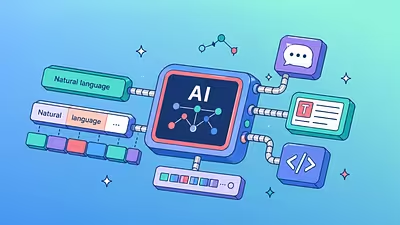
AI allows chatbots to process natural (human) language, making their communication with users more human-like and natural. Here are a few aspects of how this is possible:
-
Natural Language Processing (NLP): The presence of NLP technologies allows for the interpretation of unstructured data from users. This enables bots to understand not only direct requests but also hidden intentions.
-
Self-learning: AI is capable of continuously learning new patterns of user behavior based on collected data. This enhances the accuracy and speed of service.
-
Adaptive Logic: Chatbots can adapt their responses according to user behavior. This increases the level of personalization.
Natural Language Processing
Thanks to NLP, chatbots can interactively work with users, translating natural queries into understandable responses. For example:
- User: “I want to book a direct flight to Rome next week.”
- Chatbot: “How many tickets do you need?”
Code Example: NLP in Python
Let's consider a simple example of how to use NLTK (Natural Language Toolkit) for natural language processing:
import nltk
nltk.download('punkt')

text = "I want to book a ticket to Kyiv."
tokens = nltk.word_tokenize(text)

print(tokens)
This code will perform tokenization of the input text in Ukrainian, breaking the sentence into words or phrases.
Application of Self-learning
AI algorithms, such as deep learning, allow for the collection of data from conversations and, based on that, improve the accuracy of predicting the most common requests. This is especially useful for large businesses that work with global customer bases and seek mass automation.
Future Prospects
Involving AI in the development of chatbots opens the door to future innovations. Automation in customer support is just the tip of the iceberg. Currently, voice chatbots are actively being developed, capable of processing phrases on the fly. This will become an important tool in managing smart devices. Internal self-learning systems will allow for identifying customers by voice commands, providing significant improvements in service.