

This content has been automatically translated from Ukrainian.
Leviathan is a name that can be found in the Bible, philosophy, fiction, and video games. It usually evokes images of something gigantic and powerful: a sea monster, an unstoppable force, or a state system before which an individual seems helpless. These meanings are interconnected, although they arose in different contexts.
What does the word "Leviathan" mean
Leviathan is primarily a biblical image of a mighty creature associated with the water element. It is depicted as a sea serpent, dragon, or fearsome beast that humans cannot subdue.
The name originates from the ancient Hebrew language. Over time, it became a general term for something extraordinarily large and strong. Therefore, in a figurative sense, a leviathan can refer to a huge organization, a state apparatus, or another force whose scale exceeds the capabilities of an individual.
At the same time, Leviathan does not have a single unchanging appearance or character. Even in biblical texts, its image plays various roles.
Leviathan in the Bible
One of the most famous descriptions is found in the Book of Job. God asks Job if he can catch Leviathan, tame it, or make it his servant. These questions emphasize the limits of human power: a person cannot master everything in the world.
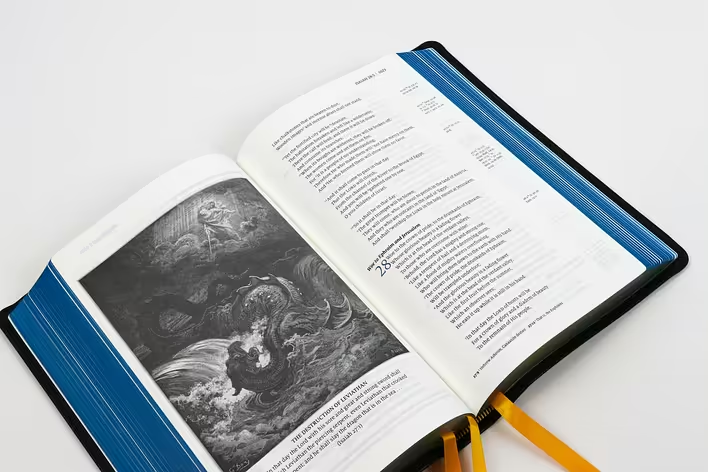
In the Book of the Prophet Isaiah, Leviathan appears as a serpent that the Lord will punish. In the Psalms, there is a mention of the broken heads of Leviathan, and in another psalm, it is described as a creature playing in the sea. Thus, reducing all these references to a single narrative about a "wicked monster" would be an oversimplification.
In some passages, Leviathan is associated with hostile forces and chaos, while in others, it reminds us that even the mightiest creature belongs to the world created by God. The meaning depends on the specific text.
Where the image of the sea monster comes from
Leviathan has parallels in ancient Near Eastern myths. In particular, in the Ugaritic tradition, Lotan is known — a serpent-like monster associated with the forces of sea chaos. Such parallels help to understand the cultural environment in which biblical images were formed.
The sea in these traditions could embody a dangerous and uncontrollable element. The victory of divine power over the sea monster accordingly expressed the establishment of order.
However, the biblical Leviathan is not simply a character from an alien myth transferred unchanged. In biblical texts, this image is reinterpreted and subordinated to their religious content.
Is Leviathan a crocodile or a dragon?
In interpretations of the Book of Job, Leviathan is often associated with a crocodile: the description of a mighty aquatic creature provides grounds for such a reading. However, it is not appropriate to apply this explanation to all references. The image of a serpent or multi-headed monster goes beyond the ordinary description of an animal.
Therefore, it is more appropriate to understand Leviathan as a poetic and religious image, in which the traits of real creatures and mythological concepts can be combined.
In modern fantasy, authors freely change its appearance. It can resemble a dragon, a giant serpent, or an unusual ocean inhabitant. These are interpretations of a specific work, not an exact reproduction of a single biblical description.
Why Thomas Hobbes called the state Leviathan
In 1651, the English philosopher Thomas Hobbes published the work "Leviathan." In it, the image of a mighty creature became a metaphor for the state — a power created by people that must ensure peace and protection.
According to Hobbes, without a common authority capable of restraining violence, people find themselves in a state of mutual danger and distrust. To escape it, they agree among themselves and empower a sovereign to maintain order.
This idea is conveyed by the famous engraving at the beginning of the publication: above the city towers a crowned giant, whose body consists of countless small human figures. He holds a sword and a bishop's staff — symbols of secular and ecclesiastical power.
Thus, for Hobbes, Leviathan embodies the united might of the political community. Its strength must restrain chaos. In modern journalism, the same metaphor often takes on a disturbing connotation: it is used to speak of excessive power, bureaucracy, or a system that oppresses the individual.
What Leviathan means in modern culture
In books, films, and games, the name Leviathan often suggests scale: before us is something ancient, enormous, and dangerous. It can belong to a monster, a ship, or another object to which the authors seek to impart a sense of exceptional power.
Leviathan should also not be automatically equated with the kraken. The kraken comes from Scandinavian maritime tradition and is usually associated with a gigantic creature with tentacles. Leviathan has a different origin and a much broader symbolic life.
Therefore, the meaning of this name is best determined by context. In a biblical passage, it may speak of the limits of human power, in philosophy — of state authority, and in a fictional story — warn of an encounter with something immeasurably greater than a human.