Who is Homer and where did the phrase "Homeric laughter" come from?
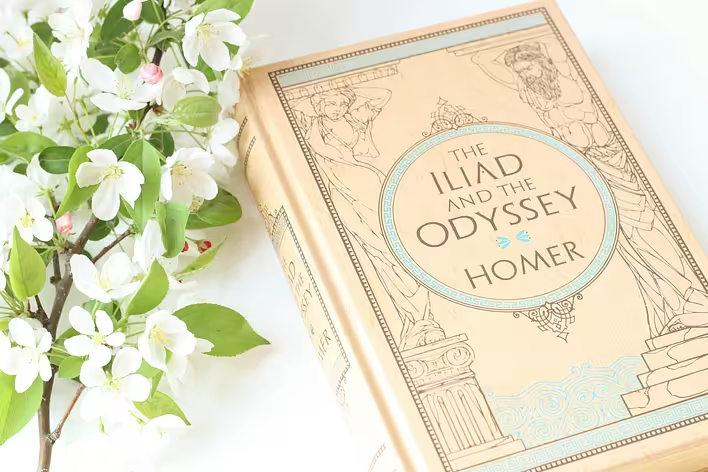
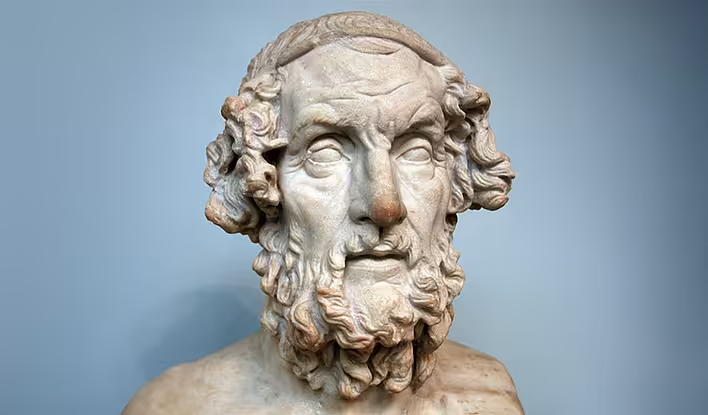
Homer is a legendary ancient Greek poet, considered the author of two of the most famous epic poems of antiquity: the Iliad and the Odyssey. There are no precise details about his life: historians even debate whether he was a real person or rather a composi...
Homer is a legendary ancient Greek poet, considered the author of two of the most famous epic poems of antiquity: the Iliad and the Odyssey. There are no precise details about his life: historians even debate whether he was a real person or rather a composite figure of the singers known as aeds.
Homer likely lived around the 8th century BC and belonged to the oral tradition — his works were passed down orally from generation to generation for a long time.
Despite this uncertainty, Homer's influence on world culture is undeniable: it is from his poems that European literature begins in its classical sense.
Why Homer is related to humor
At first glance, Homer's works are heroic stories about war, journeys, and fate. But they also have another, less obvious dimension — humor.
The poems often feature scenes where the gods behave like ordinary people: they quarrel, joke, and deceive one another. Particularly famous are the episodes where the Olympians laugh — loudly, without restraint, almost caricaturally.
It is these descriptions of the gods' laughter that became the basis for the emergence of a special expression that has survived to this day.
Гомер
What does “Homeric laughter” and “Homerically” mean
The phrase “Homeric laughter” means unrestrained, loud, sincere laughter — the kind that cannot be hidden or controlled.
Its origin is linked to descriptions in the Iliad, where the gods burst into laughter in response to funny or absurd situations. This laughter is so powerful and all-encompassing that it seems to engulf everyone around.
From this same source comes the adverb “Homerically”. It describes an action performed with excessive force, emotion, or grandeur — most often in the context of laughter, but not exclusively. For example, one can say “to laugh Homerically”, meaning to laugh very loudly and uncontrollably, or even “to exaggerate Homerically” — emphasizing the grotesqueness of the situation.
Today, these expressions are used in the following contexts:
when someone laughs very loudly and for a long time;
when a situation provokes an uncontrollable reaction;
sometimes — with a hint of irony, to emphasize exaggerated emotionality.
For example: “He laughed with Homeric laughter” — meaning he didn’t just smile, but literally burst into laughter.
Теж Гомер, але не той
The Homeric question
In academia, there is even a separate term — “the Homeric question”, which pertains to who exactly created the Iliad and the Odyssey and how these texts acquired their modern form.
Researchers have long noted the peculiarities of these poems: repetitions, fixed epithets, similar plot blocks. This has led to the idea that the works may have been formed gradually — as part of an oral tradition where different singers (aeds) performed and slightly altered the stories, passing them down from generation to generation. In this understanding, Homer's poems are not a one-time act of creation but the result of a prolonged creative process.
In the 18th–19th centuries, two main positions took shape. The first asserts that Homer was a real historical figure — a brilliant poet who collected and organized these stories into cohesive works. The second suggests that “Homer” is a conventional name under which the creativity of many generations was united.
Modern research usually occupies an intermediate position: it is most likely that there existed an outstanding poet or several poets who worked within an already established tradition. They did not invent these stories from scratch, but gave them the form we know today.
And it is here that the “Homeric question” goes beyond simple biography. It touches on a broader idea — how culture is born in general. In the ancient world, texts were not created in isolation: they were transmitted, changed, and supplemented, as if in a continuous chain. Each generation received stories while simultaneously reinterpreting them a bit.
This principle is well illustrated by the influence of Homer on subsequent eras. The Roman poet Virgil created the Aeneid, drawing on Homeric plots. Centuries later, Dante Alighieri could not have written the Divine Comedy without the influence of Virgil. Further on — William Shakespeare, and even later — James Joyce with the novel Ulysses, which reinterprets the Odyssey in the modern world.
Thus, Homer is not only a possible author but also a starting point for a vast tradition that continues for millennia. And even if we never know exactly who he was, it does not diminish the significance of his poems. On the contrary, it emphasizes the main point: great texts live not because of a single name, but because they are read, reinterpreted, and passed on again and again.
Leviathan is a name that can be found in the Bible, philosophy, fiction, and video games. It usually evokes images of something gigantic and powerful: a sea monster, an unstoppa...