Expansion is the process of extending the sphere of influence, increasing territory, power, economic presence, or cultural dominance of one state, organization, or idea beyond its initial borders.
- Political or military expansion: The seizure of new territories, colonization, annexation.
For example: the expansion of the Russian Empire in the 19th century, the aggression of the Russian Federation against Ukraine — this is military-political expansion.
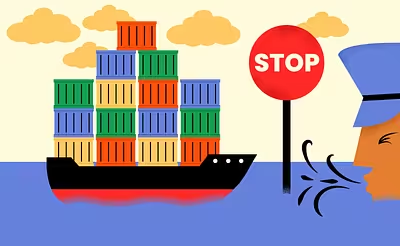
- Economic expansion: The expansion of business into new markets, countries, or regions.
For example: the expansion of Chinese goods into the European market.
- Cultural expansion: The spread of language, customs, and values of one culture among other peoples.
For example: the influence of American culture through cinema, music, the internet.
- In physics/science: The expansion of an object, substance, or the Universe (for example, the expansion of the Universe after the Big Bang).
Synonyms: Extension, spread, advance, conquest (depending on the context).
When we say that the term expansion has changed history, we mean how countries seized new territories. For example, at one time the expansion of the Roman Empire led it to become one of the largest empires in the world. The influence of Roman culture, law, and technology spread over a significant part of Europe. This changed the course of development for many countries for centuries to come.
Today, expansion also affects our lives, but in a slightly different form. Instead of seizing territories, large corporations are expanding their influence into new markets. For example, well-known brands open stores in various countries or buy local companies. Thus, the term expansion has acquired a new meaning, but its essence — expansion and growth — remains unchanged.