

This content has been automatically translated from Ukrainian.
What is a label?
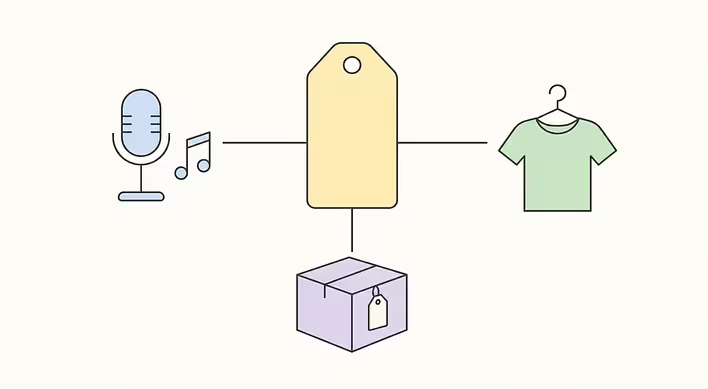
Label (from English label) is a word that has several meanings. Most often, it refers to a music company that is engaged in the release and promotion of music. However, in other fields, a label can refer to a clothing brand, a trademark, or even a regular tag on a product.
This is why confusion sometimes arises. For example, the phrases “he signed a contract with a label” and “this is a new Ukrainian clothing label” sound similar but refer to completely different areas.
To better understand the meaning of this word, it is worth first exploring its origin.
Origin of the word

The word label comes from the English label, which means “tag”, “sticker”, “label”, or “mark”.
Initially, this word referred to a regular sticker or paper label that contained information about a product or manufacturer. Over time, the meaning gradually expanded.
For example, in the music industry, label began to refer to a company whose name was printed on the label of a vinyl record. Over time, the word ceased to mean the sticker itself and came to denote the publisher of music.
In a similar way, it began to be used in other fields as well. Today, a label can refer to both a company or brand and a regular tag—everything depends on the context.
Music label
This is a company that is engaged in the release, promotion, and distribution of music. It helps artists record songs, release albums, place them on streaming services, organize advertising campaigns, and promote their creativity to listeners.
That is why you can hear phrases like:
- “The band signed a contract with a major label.”
- “The singer switched to an independent label.”
- “This album was released by a British label.”
Previously, music labels were almost the only way to release an album and reach a wide audience. Today, thanks to Spotify, Apple Music, YouTube Music, and other platforms, musicians can publish their works independently. Despite this, labels still play an important role, as they take on marketing, legal issues, copyright work, release organization, and many other tasks.
How does a music label work?
Many people imagine a music label as a company that simply “releases songs.” In reality, its role is much broader.
When an artist signs a contract with a label, they gain not only the opportunity to officially release music but also a team of professionals who help build their career.
Depending on the size of the company, a label can engage in:
- recording and financing music;
- organizing music video shoots;
- promoting songs on streaming services;
- advertising and PR;
- working with the media;
- distributing music on Spotify, Apple Music, YouTube Music, and other platforms;
- protecting copyright;
- organizing concerts and promotional campaigns.
In other words, a label helps ensure that as many people as possible learn about the artist's work.
Of course, not every label provides the full range of these services. Some companies only handle digital music distribution, while large international labels can accompany an artist at almost every stage of their career.
How does a music label make money?
A label is a business, so its main goal is not only to release music but also to generate profit.
Typically, the company invests money in recording songs, advertising, music videos, or promotion, and then receives a portion of the income from the artist's work.
Sources of income can include:
- streaming on services;
- music sales;
- use of compositions in films, advertisements, or video games;
- sales of physical media;
- merchandise;
- music licensing.
The specific terms of cooperation always depend on the contract. Some artists transfer rights to a label for only a single album, while others sign long-term contracts that cover a significant portion of their work.
Is it necessary for a musician to work with a label?
Today—no.
Twenty to thirty years ago, releasing music without the support of a label was extremely difficult. Such companies controlled album recording, CD production, collaboration with radio stations, and music stores.
The situation changed with the advent of streaming platforms.
Today, a musician can independently upload their compositions to Spotify, Apple Music, YouTube Music, and other services through special distribution companies. As a result, many independent artists successfully build their careers without a contract with a major label.
At the same time, collaboration with a well-known company still has its advantages. Major labels have experience, financial resources, professional teams, and contacts that help promote new artists more quickly.
That is why today, two models coexist: some musicians choose complete independence, while others collaborate with a label.
How does a label differ from a producer, manager, and distributor?
These concepts are often confused, although they denote different roles in the music industry.
For example, an artist may work with a manager and a music producer but not have a contract with a label. Or vice versa—collaborate with a label that organizes recording, distribution, and marketing.
Label in the fashion world

In the fashion industry, the word label most often refers to a brand or company that creates and releases clothing, footwear, or accessories.
For example, when people say:
- “This designer founded their own label.”
- “A new Ukrainian label presented a collection at Fashion Week.”
they mean not the tag on the clothing but the brand itself.
In this sense, the word label is very close to the words “brand” and . However, there is a slight difference between them. If brand primarily refers to the recognizable image and reputation of a company, then label more often means the trademark itself or the creative team behind the release of collections.
That is why in fashion magazines and the industry, you can often encounter the phrase fashion label.
Label as a tag or sticker

This is the oldest and literal meaning of the word.
The English label translates to “tag”, “sticker”, “label”, or “mark”.
This is how the word is used in production, logistics, trade, and many other fields.
For example, a label can refer to:
- a paper label on a bottle;
- a tag on clothing;
- a sticker with a barcode;
- an informational sticker on packaging.
In the Ukrainian language, in this meaning, the words etiketka, birka, or yarlyk are used more often, so the word label appears here much less frequently.
Other meanings of the word “label”
Depending on the context, the word label can also be found in other fields.
For example, in programming and interface design, label is a text caption next to a button, input field, or other element.
In marketing, the term private label refers to a store or retail chain's own brand. For example, a supermarket may sell products under its own brand, even though they are produced by another company.
Such meanings are less common in everyday language; however, they also derive from the English word label.
In what meanings is the word “label” most often used?
Frequently Asked Questions
Is a label the same as a brand?
Not quite.
Brand is the reputation, recognition, and image of a company or product.
Label is a company, trademark, or organization under which products or creative works are released.
In everyday language, these words are often used as synonyms, especially when it comes to fashion.
What does a music label do?
A music label helps artists record, release, and promote music. Depending on the company, it may also engage in advertising, distribution, copyright, concert organization, and other areas of career development.
Can a musician work without a label?
Yes. Thanks to modern streaming services, many artists independently release their music and successfully develop their careers without a contract with a label.
What is the largest label in the world?
The largest music labels or, more precisely, music companies are considered to be Universal Music Group, Sony Music Entertainment, and Warner Music Group. These companies work with a large number of world-famous artists and hold a significant share of the global music market.