This content has been automatically translated from Ukrainian.
Today, the word stream can be heard almost everywhere. Some are watching a new game walkthrough on Twitch, others are following a smartphone presentation on YouTube, while some are holding a work meeting or a lecture live. Online broadcasts have become a common part of the modern internet, and along with them, the word stream has become established in the Ukrainian language.
But what does it mean, how should it be written correctly, and how does streaming differ from regular video?
How to write it correctly: stream or стрім?
The word comes from the English stream, which literally means "flow." In information technology, it has taken on the meaning of continuous data transmission, and later — live online broadcasting.
In the Ukrainian language, the form стрим is most often recommended. This spelling corresponds to the established practice of transmitting many English borrowings, where the sound [i:] is represented by the letter и. Following a similar principle, words like marketing, branding, leasing, and trading have entered the Ukrainian language.
At the same time, the variant стрім is also very common on the internet. It can be found on social networks, forums, video blogs, and even in some media. This form arose due to a literal approximation to the English pronunciation. However, in most Ukrainian publications that adhere to modern language recommendations, the spelling стрим is preferred.
What is streaming?
Streaming is a live broadcast of video or audio over the internet in real-time. During it, viewers can simultaneously watch what is happening, communicate in the chat, ask questions, and receive answers almost instantly.
Unlike regular video, which is first recorded, edited, and only then published, streaming happens live. It is the ability to interact with the audience that makes it special.
You can stream practically anything: computer games, musical performances, cooking recipes, lectures, master classes, sports training, creative processes, or even a simple walk around the city.
What does "to stream" mean?
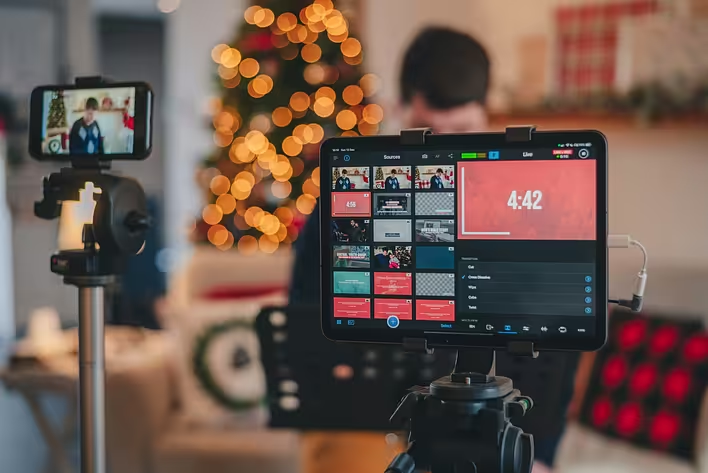
From the word стрим, the verb стримити was formed, meaning to conduct a live online broadcast.
For example:
- “He is streaming a new game on Twitch.”
- “The blogger streamed a concert live from her smartphone.”
- “The company streamed the presentation of a new product.”
Although the verb is colloquial, it has long become familiar among internet users.
What types of streams are there?
Initially, gaming streams gained immense popularity, but today this format has long gone beyond gaming.
Millions of people watch broadcasts of concerts, sports events, press conferences, lectures, travels, cooking shows, art workshops, programming, car repairs, and even plant growing every day.
A separate popularity has been gained by the IRL (In Real Life) format — broadcasts of everyday life, during which the author simply walks around the city, travels, visits interesting places, or communicates with their viewers.
Where are streams conducted?
Today, there are many platforms for online broadcasting.
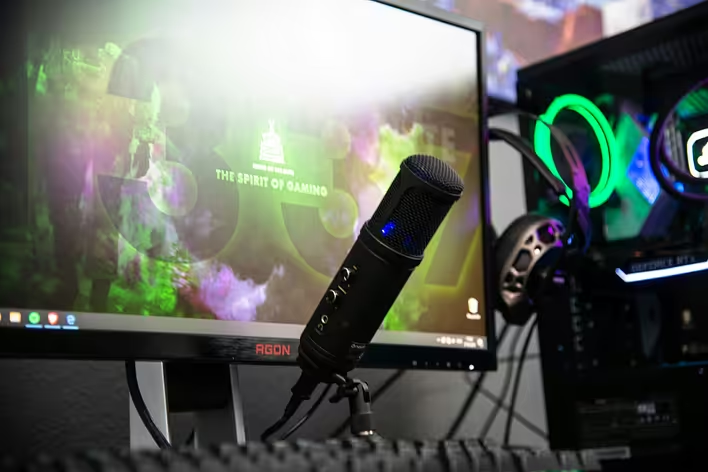
The most famous among gamers remains Twitch, which has practically become a symbol of streaming. Here, games, esports, communication with the audience, music, and creativity are streamed.
No less popular is YouTube Live, where presentations of new products, conferences, concerts, interviews, and educational events are held.
Streams are also supported by TikTok, Instagram, Facebook, Discord, and many other platforms.
Who is a streamer?
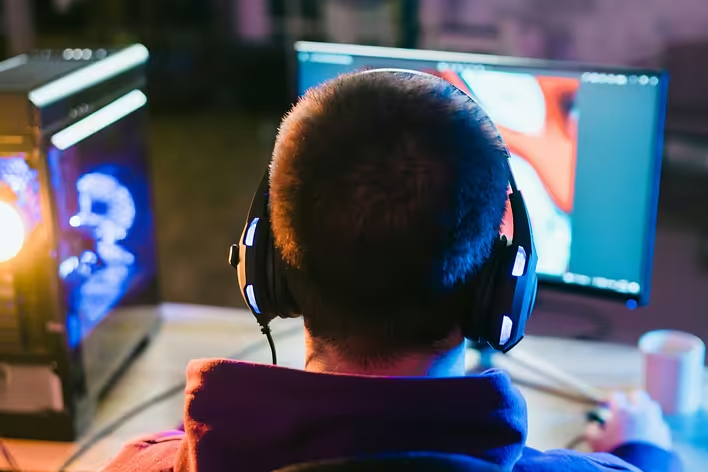
Streamer is a person who regularly conducts streams.
For some, it is a regular hobby, while for others, it is a full-fledged profession. Popular streamers can earn income from advertising, affiliate programs, paid subscriptions, sponsorship contracts, and donations — voluntary monetary contributions from viewers.
Thanks to audience support, many creators can dedicate all their working time to streaming.
The history of streaming
Although today streams are primarily associated with Twitch, YouTube, or TikTok, the technology of online broadcasting is much older. The first attempts to transmit video over the internet appeared back in the early 1990s when network speeds were so low that even a few seconds of video could take minutes to load.
The emergence of streaming technology was a true breakthrough. Instead of waiting for the entire file to load, the user received a small fragment of data, and playback began almost immediately while the rest of the information continued to be transmitted in the background. This principle is the foundation of modern streaming.
One of the first known internet broadcasts was the Trojan Room Coffee Pot webcam, set up in 1991 at the University of Cambridge. It showed... an ordinary coffee pot. Scientists created it so they wouldn't have to walk to the break room unnecessarily when the coffee was already gone. Over time, this camera became a true internet legend and is considered one of the first examples of continuous online broadcasting.
By the late 1990s and early 2000s, the development of broadband internet made streaming significantly more accessible. Services emerged that allowed broadcasting sports events, concerts, and news in real-time. However, the real explosion in popularity occurred in the late 2000s.
In 2007, the service Justin.tv launched, allowing anyone to conduct their own live broadcasts for free. Initially, its founder, Justin Kan, streamed literally his entire life almost non-stop, and soon thousands of people began using the platform. It was on Justin.tv that the culture of modern streaming was formed — with chats, communication with viewers, and live broadcasts on a wide variety of topics.
It quickly became clear that video game broadcasts attracted the largest audience. Therefore, in 2011, a separate service Twitch was created, specializing in gaming streams. Its popularity grew so rapidly that by 2014, the platform was acquired by Amazon for nearly $970 million. Since then, Twitch has become the world leader among live broadcasting services.
Shortly thereafter, other major platforms actively joined this format. YouTube launched YouTube Live, Facebook introduced Facebook Live, and Instagram, TikTok, and Discord also received their own tools for conducting broadcasts. Today, you can stream literally from your smartphone, anywhere there is internet access.
Now, streaming has long ceased to be entertainment only for gamers. Live broadcasts are used by journalists, universities, musicians, businesses, charitable organizations, government agencies, and even space agencies. Through streams, sports championships, conferences, concerts, lectures, presentations of new products, and even the launch of space rockets are broadcasted.
In just over three decades, the technology has come a long way from a camera aimed at a coffee pot in a university lab to one of the most popular ways for millions of people to communicate around the world.
What are streaming services?
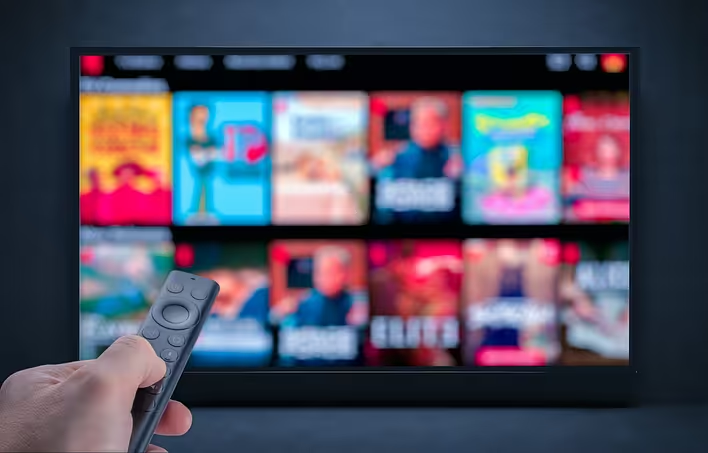
When talking about streaming, it refers not only to live broadcasts. This term also describes the technology that allows you to watch or listen to content over the internet without downloading the file in advance.
This is exactly how streaming services work. When you start a movie on Netflix or listen to music on Spotify, the device does not download the entire file at once. Data is transmitted in small parts in real-time, so playback starts within a few seconds, while the rest of the information continues to load unnoticed by the user.
In fact, this is the same principle as during live broadcasts. The only difference is that streaming can be either live or based on pre-recorded content.
For example, when a blogger conducts a broadcast on Twitch or YouTube Live, viewers watch the events in real-time. But when you start a series on Netflix, the movie has long been recorded, but it is transmitted using the same streaming technology.
That is why Netflix, Disney+, Max, Amazon Prime Video, and other similar platforms are called streaming services. They do not send users the complete file for download but transmit it gradually during viewing.
The same principle is used by music services, including Spotify, Apple Music, YouTube Music, and Deezer. Songs also do not need to be fully downloaded to the device — they are played as data is received from the server.
Today, streaming information has become the standard for most digital services. We watch movies, listen to music, follow sports broadcasts, learn on online courses, and even play some video games through cloud services — all thanks to streaming technology.
Frequently Asked Questions
How does streaming differ from regular video?
Streaming occurs in real-time, while regular video is recorded and published later. During a stream, the author can interact with viewers live.
Can you watch a stream after it has ended?
Yes. Most platforms automatically save the recording of the broadcast unless the author has turned off this feature.
Is streaming and broadcasting the same thing?
Almost. Broadcasting is the Ukrainian equivalent of the English word stream. However, in modern speech, the word стрим most often refers specifically to live internet broadcasts with the possibility of interacting with the audience.
Streaming is a modern way to conduct live online broadcasts and communicate with the audience in real-time. Today, streams include not only computer games but also concerts, lectures, sports events, travels, creative processes, and even everyday life.
It is the ability for instant feedback that has made streams one of the most important formats of digital communication. And although in colloquial speech you might still encounter the spelling "стрім," in modern Ukrainian practice, the form "стрим" is increasingly used.