
When a new star appears in the sky, humanity looks up with dreams and questions. And when a rocket launches, we hold our breath — because in every launch into space is embodied the hope of learning more about ourselves. This is the mission that NASA has been living for over half a century — an organization that has become synonymous with progress, curiosity, and the embodiment of the space dream.
NASA Origins: From Earth Sky to Starry Infinity
NASA, or National Aeronautics and Space Administration, was established in 1958, in an era when the sky ceased to be a boundary and became a beginning. The Cold War between the USSR and the USA sparked the space race, and Washington needed a structure capable of responding adequately to the challenges of the time.
Based on the previous structure — NACA (National Advisory Committee for Aeronautics), which had been engaged in aviation research since 1915, a new era emerged — the era of launch vehicles, orbital stations, and interplanetary ambitions.
Space Milestones That Changed the World
When on July 20, 1969, Neil Armstrong stepped onto the surface of the Moon, it was not just a step for man. It was a leap into a new era of science, technology, and philosophy of existence. Since then, NASA has not ceased to pave the way into the unknown.
Among its most iconic projects:
- Hubble Space Telescope — the eyes of humanity that have seen distant galaxies, the birth of stars, and even traces of dark matter.
- Perseverance Rover — an autonomous explorer currently studying the red planet in search of signs of life.
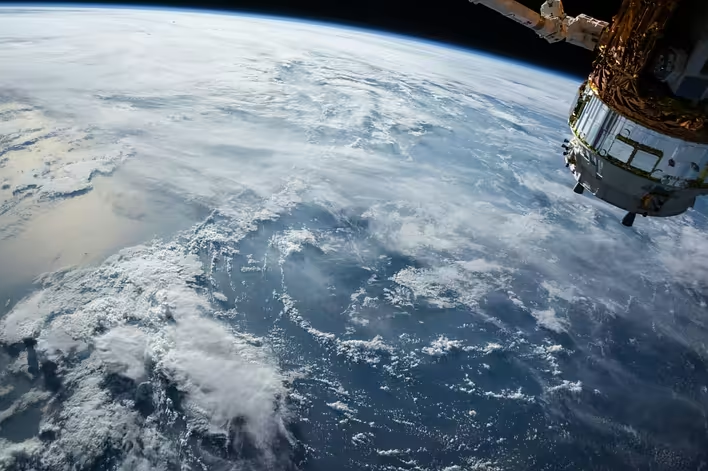
- International Space Station (ISS) — a laboratory in orbit around Earth, where for over two decades scientists from around the world have been researching the effects of space on humans, materials, and life in general.
Each of these missions is not only a scientific breakthrough but also proof that collaboration, intellect, and inspiration can change reality.
NASA — Closer Than It Seems
“So what? They fly into space. What do I care?” — you might say. And you would be partially right — if you don’t know that today you are using technologies developed or improved thanks to space programs. For example:
- Water purification systems used in households arose in response to the challenges of prolonged space missions.
- Temperature-resistant materials for clothing, transportation, and construction are the result of testing in the extreme conditions of space.
- Navigation systems, sensors, and even mobile cameras — in many cases have roots in NASA developments.
Moreover, the agency's satellites collect data daily about climate, glaciers, forest fires — helping to predict disasters and save lives.
How to Get to NASA?
NASA is not just astronauts. It is engineers, chemists, programmers, doctors, architects, biologists. If you have curiosity, education in STEM fields, and a desire to contribute to the future — the doors are open.
- Universities in the USA and other countries offer internships as part of joint programs.
- The official NASA website constantly updates its list of job openings.
- Experienced professionals can join international projects under cooperation programs.
It is important not only to dream but also to act. Because each of us is a potential researcher, designer, discoverer of new horizons.
Space Is Close: Interesting Facts
- To become a NASA astronaut, one must undergo several years of rigorous training, including training in deserts, oceans, and isolation chambers.
- Some missions are planned decades in advance, such as Artemis — the return of humans to the Moon and preparation for a flight to Mars.
- NASA actively collaborates with countries such as Canada, Japan, the EU, the UAE, Ukraine, and others, forming a global space community.
When we look at the starry sky, we seek not just answers — we seek meaning. And NASA is one of those organizations that helps humanity find it in the vast Universe. And perhaps, rediscover itself.