

This content has been automatically translated from Ukrainian.
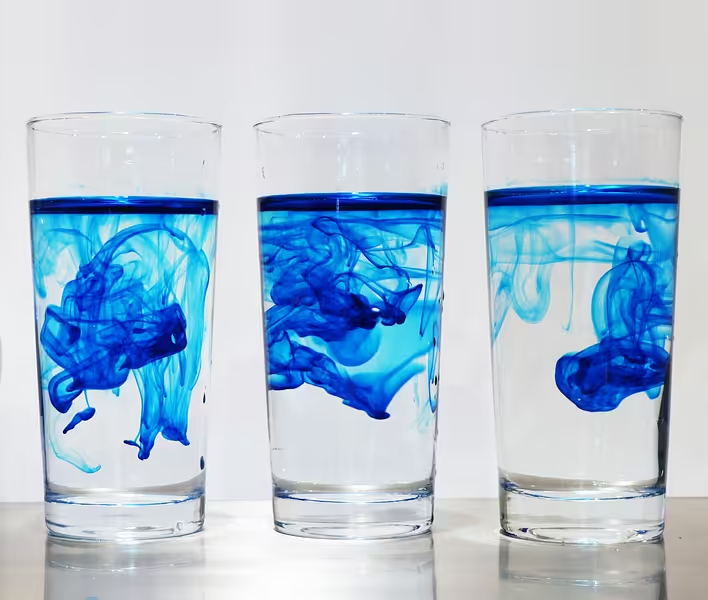
The smell of freshly brewed coffee gradually spreads through the kitchen, a drop of ink colors the water, and sugar eventually makes the entire tea sweet, even if it is not stirred. Behind these familiar phenomena lies one physical process — diffusion.
Diffusion occurs practically everywhere: in the atmosphere, bodies of water, living organisms, and even solid metals. It is thanks to diffusion that oxygen moves from the lungs into the blood, and cells can exchange certain substances with the surrounding environment.
What is diffusion in simple terms
Diffusion is the process of spontaneous movement and mutual penetration of particles of substances due to their chaotic thermal motion. If the concentration of a certain substance is higher in one area than in another, diffusion usually leads to its gradual equalization.
For example, if you drop a little food coloring into a glass of still water, initially the color will be concentrated only near the drop. Over time, the colored area will expand until the dye is distributed more evenly.
Importantly, the particles do not know where they need to move. Each one moves chaotically, constantly interacting with other particles. However, a regular result emerges overall: the substance spreads from an area of higher concentration to an area of lower concentration.
This cumulative movement is called a diffusion flow.
How diffusion occurs
Molecules of gases and liquids are in continuous thermal motion. They change direction, collide with other particles, and gradually distribute themselves in the available space.
At the beginning of the process, there may be significantly more molecules of a certain substance in one part of the space than in another. Since there are more particles there, under the same conditions, more of them move out of this area than return back. As a result, the concentration difference decreases.
When the concentrations equalize, diffusion does not stop completely. Molecules continue to move chaotically, but under the same conditions, approximately the same number of particles moves in each direction on average. This state is called dynamic equilibrium.
Examples of diffusion in everyday life
The simplest way to understand diffusion is through examples we observe every day.
- The smell of perfume in a room. Molecules of aromatic substances evaporate and spread through the air. In a real room, air currents also help with this.
- A tea bag in water. Soluble substances from the tea leaves move into the water and gradually spread through it.
- Sugar in tea. After dissolving, sugar molecules can distribute themselves in the liquid due to diffusion. Stirring significantly accelerates this process.
- Pickling cucumbers. Dissolved salts gradually penetrate into the plant tissues. Here, diffusion combines with other processes of water and substance transfer.
- Dyeing fabric. Dye molecules penetrate the fibers of the material, and the speed of the process depends on the temperature, the composition of the dye, and the properties of the fabric.
In many everyday situations, diffusion acts together with other phenomena. For example, the smell of food in the kitchen spreads not only through the chaotic movement of molecules but also due to air circulation.
Diffusion in gases, liquids, and solids
Diffusion is possible in all three main states of matter, but the speed of the process differs significantly.
In solids, atoms do not move as freely as gas molecules. However, under certain conditions, they can transition between positions in the crystalline structure.
This phenomenon is of great importance in metallurgy. For example, during the cementation of steel, carbon atoms diffuse into its surface layers at high temperatures. As a result, after appropriate heat treatment, the surface of the metal can be made harder and more wear-resistant.
What affects the speed of diffusion
The speed of diffusion is influenced by temperature, the properties of the particles and the medium, the concentration difference, and the distance that needs to be covered.
Temperature. With an increase in temperature, diffusion accelerates in most normal conditions. This is why dye usually spreads faster in hot water than in cold, even without considering stirring.
Size and nature of the particles. Small molecules often diffuse faster than large ones in the same medium, although the speed also depends on their shape and interaction with surrounding molecules.
Concentration difference. The greater the concentration difference between two areas, the more intense the diffusion flow will be under other equal conditions.
Properties of the medium. The viscosity of the liquid, the density of the material's structure, and the presence of obstacles affect how easily particles can move.
Distance. Diffusion is particularly effective over short distances. The characteristic time of diffusion spread increases approximately in proportion to the square of the distance. This means that doubling the distance can increase the required time by about four times.
This last feature explains why diffusion effectively facilitates the exchange of substances within a single cell, but for transporting oxygen over significant distances in the human body, a circulatory system is needed.
What role does diffusion play in the human body
One of the most important examples of diffusion is gas exchange in the lungs.
Inside the lungs are millions of tiny air sacs — alveoli. Their thin walls separate the inhaled air from the blood in the capillaries.
Oxygen moves from the alveolar air into the blood due to the difference in partial pressures. At the same time, carbon dioxide moves in the opposite direction — from the blood to the alveoli, from where it is expelled during exhalation.
This gas exchange occurs without the need for cells to expend energy directly on transporting oxygen or carbon dioxide molecules across the respiratory membrane.
Diffusion also participates in the exchange of substances between blood and tissues. At the level of individual cells, it helps move certain molecules across cell membranes and within the cytoplasm.
How diffusion differs from osmosis
These two concepts are often confused since both describe passive transport of substances.
Osmosis is the transport of water through a selectively permeable membrane, caused by the difference in chemical potential of water on both sides of the membrane. In simple cases, water moves toward the solution with a higher concentration of solute that cannot pass through the membrane.
For example, if a plant cell is placed in a sufficiently concentrated salt solution, water will exit it through the membrane. The cell will lose water, and its internal contents may pull away from the cell wall. This phenomenon is called plasmolysis.
Thus, diffusion is a broader concept, while osmosis can be seen as a special case of passive transport of water across a membrane.
Is energy needed for diffusion
Diffusion is classified as a passive process. It does not require a separate expenditure of cellular energy in the form of ATP, as is the case with active transport of substances across a membrane.
However, this does not mean that particles move without energy at all. Their chaotic movement is associated with the thermal energy of the substance.
Diffusion occurs spontaneously because, under appropriate conditions, the system transitions from a less probable uneven distribution of particles to a more probable uniform distribution.
From a thermodynamic perspective, this process is associated with an increase in the entropy of an isolated system.
Where else is the concept of diffusion used
The word "diffusion" comes from the Latin diffusio — "spreading," "dispersing." Therefore, over time, it has extended beyond physics and chemistry.
In sociology, there is talk of the diffusion of innovations — the spread of new ideas, technologies, and behaviors among people. For example, how a small group initially starts using a new technology, and later a significant part of society adopts it.
In cultural studies, the term "cultural diffusion" refers to the spread of cultural elements between communities: traditions, dishes, musical genres, words, or technologies.
And in photography and cinematography, the diffusion of light refers to its scattering, which helps achieve softer lighting and less harsh shadows.
In all these cases, the common idea of spreading is preserved, although the specific mechanisms differ significantly from molecular diffusion.