

This content has been automatically translated from Ukrainian.
When people talk about Gemini today, they may mean several different things at once. This includes Google's family of artificial intelligence models, a separate AI assistant that can be interacted with much like ChatGPT, and the technology that Google is gradually embedding into its other products — from Search and Gmail to Android, Google Maps, and YouTube.
Therefore, calling Gemini simply a "Google chatbot" is no longer entirely accurate. In 2026, it is more of a whole AI ecosystem of the company.
What Gemini is in simple terms
Gemini is a family of multimodal artificial intelligence models developed by Google DeepMind.
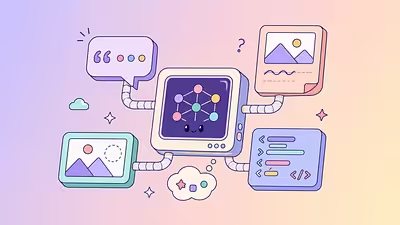
Multimodality means that such models can work not only with text but also with images, audio, video, programming code, and other types of information.
The first version of Gemini was introduced by Google in December 2023. Unlike many early language models, it was designed from the very beginning as a multimodal system capable of working with information in various formats.
In practice, this means that Gemini can, for example, be asked to explain text, analyze a photograph, break down a table, find an error in code, process a video, or correlate information from multiple sources.
However, the Gemini model and the Gemini application are not quite the same thing. The model is the technological foundation, while the Gemini application is the ready-made Google service through which an ordinary user can interact with this technology.
Before Gemini, there was Bard
Google's own generative AI-chatbot was initially called Bard. It was launched in 2023 against the backdrop of the rapid development of generative artificial intelligence and the popularity of ChatGPT.
In December of the same year, Google began using Gemini Pro within Bard, and on February 8, 2024, completely abandoned the old name: Bard became Gemini. At that time, the company also introduced the Gemini mobile application and a paid plan with access to more powerful models.
Since then, the brand's meaning has significantly expanded. Now Gemini is not just a service for conversing with artificial intelligence, but a whole family of models and technologies that Google uses in its own products, corporate solutions, and developer tools.
What Gemini models exist in 2026
Gemini is evolving very quickly, so names like Gemini 1.0 or Gemini 2.0, which often appear in older articles, no longer reflect the current state of the platform.
As of August 2026, among the main models listed on the Google DeepMind website are Gemini 3.7 Flash, Gemini 3.5 Flash-Lite, Gemini 3.1 Pro, and Gemini 3.1 Deep Think. At the same time, Google is developing other versions of Gemini for working with audio, images, robotics, and specialized tasks.
One of the newest models is Gemini 3.7 Flash, introduced on August 13, 2026. Google describes it as a fast universal model for complex agent tasks, programming, reasoning, multimodal work, and everyday tasks.
A separate direction is Gemini Omni, presented at Google I/O 2026. It expands Gemini's multimodal capabilities and is focused on working with several types of content at once.
Thus, Gemini today is not one large model that Google uses everywhere. The company has a whole family of models and selects them depending on the product, required speed, complexity of the task, and volume of data.
The Gemini application
The most obvious place to encounter Gemini is the Gemini application itself and its web version.
Here you can ask questions, work with files, images, and videos, create content, program, conduct in-depth research, or interact with Gemini by voice.
There is also Gemini Live — a natural voice conversation mode. On compatible devices, Gemini can work with images from the camera or screen content, allowing the user to show the assistant an object or page and immediately ask questions about what they see.
In 2026, Google is increasingly transforming Gemini from an assistant that merely responds to queries into an agent capable of performing multi-step tasks. One example is Gemini Spark, a personal agent that can work on an assigned task for an extended period and interact with other services. According to Alphabet, in the second quarter of 2026, Gemini Spark was already available not only in the USA but also in international markets.
The scale of the service itself has also significantly increased: according to Alphabet for the second quarter of 2026, the Gemini application had about 950 million active users per month.
Gemini in Google Search
One of the most important places for using Gemini is the regular Google Search.
Gemini models form the basis of AI Overviews — AI-generated responses that Google displays above traditional results for certain search queries.
Gemini is even more integrated into AI Mode — a search mode where users can ask complex questions in natural language, clarify them with follow-up replies, and use text, photos, files, videos, or open Chrome tabs as input.
At Google I/O 2026, the company announced Gemini 3.5 Flash as the new standard model for AI Mode in countries where this mode is available.
In fact, the boundary between a traditional search engine and an AI assistant in Google is gradually becoming less noticeable.
Gemini in Gmail
In Gmail, Gemini already performs significantly more work than just completing sentences.
It can summarize long email threads, help write and edit emails, suggest replies, and find information among messages.
Google is also developing AI Inbox and other features that use artificial intelligence to work with email. In 2026, the company added new voice capabilities for Gmail and continued to expand Gemini's features in Google Workspace.
As a result, Gmail is gradually transitioning from a traditional keyword search to a format where the user can describe the information they need in natural language, and the system will find it among emails on its own.
Gemini in Google Docs, Sheets, Slides, and Drive
Gemini has become one of the central components of Google Workspace.
In Google Docs, it helps create and edit texts, summarize documents, and work with their content.
In Google Sheets, Gemini can create and edit tables, organize data, generate formulas, and perform more complex operations based on textual descriptions. In 2026, Google introduced new capabilities that allow Gemini to modify entire tables according to user requests.
In Google Slides, artificial intelligence helps work with the structure of presentations and create visual content.
And in Google Drive, the Ask Gemini feature allows users to ask questions about their own files, find necessary documents, compare information from multiple sources, and receive summarized answers. In some of the new capabilities, Gemini can also consider information from Gmail, Calendar, and the web.
At the same time, the availability of these features depends on the plan, language, and country: some of the 2026 innovations were initially launched in beta for Google AI Pro and Ultra subscribers.
Gemini in Android
Google is gradually making Gemini the main AI assistant of its mobile ecosystem.
It can already work with information on the screen, interact with applications, assist with everyday tasks, and support natural dialogues instead of rigidly defined voice commands.
In 2026, the company introduced the concept of Gemini Intelligence, which integrates AI even deeper into Android. Among the announced capabilities are the automation of multi-step tasks, filling out complex forms, working with web content, and using information from connected applications.
Google plans to extend Gemini Intelligence not only to smartphones but also to other devices in the Android ecosystem — including watches, cars, glasses, and laptops.
Gemini in Google Chrome
Gemini also works directly in Chrome.
The assistant can summarize long pages, answer questions about their content, compare information, and interact with some other Google services.
In 2026, Google began actively rolling out Gemini in Chrome for Android. There is also an auto browse mode, in which the agent can independently perform a sequence of actions on websites — for example, assisting with bookings, regular orders, or organizing travel.
For certain sensitive actions, auto browse must request user confirmation. As of August 2026, some agent capabilities in Chrome for Android still depend on the country and plan: for example, in the USA, auto browse is available to Google AI Pro and Ultra subscribers.
Gemini in Google Maps
In Google Maps, Gemini is used for a new, more conversational way of searching for places and information about them.
In March 2026, the company introduced Ask Maps. Instead of a short query like "coffee shop," users can describe a more complex situation — for example, asking to find a place with specific characteristics — and Gemini will analyze the information in Google Maps and formulate a response.
Thus, Google Maps is gradually moving away from a model where users need to manually select exact keywords and filters. Part of such searching can be delegated to Gemini, allowing users to simply explain to the assistant what they need.
At the same time, Ask Maps should not yet be perceived as a universal feature available to every user worldwide: its rollout began in specific countries, including the USA and India.
Gemini in Google Photos
In Google Photos, Gemini models form the basis of the Ask Photos feature.
Instead of searching for photos only by date, location, or keyword, users can ask questions in natural language. For example, they can request to find photos from a specific trip or recall what they ate during it.
Gemini analyzes the context of photos and videos and tries to find relevant materials in the library.
Google Photos is also introducing other features based on Gemini: for example, the ability to request photo edits using a regular text or voice command.
The availability of Ask Photos and other AI features also depends on the region and device. At the beginning of 2026, some capabilities were still available only to specific categories of users, particularly in the USA.
Gemini in YouTube
In YouTube, there is a feature called Ask YouTube, which uses Gemini models.
This allows users to ask questions about specific videos, quickly get key points, or find the needed moment without watching the entire clip. Google is also transferring this conversational interaction format to broader YouTube search.
According to Alphabet, in June 2026 alone, the Ask YouTube feature was used by over 140 million people on viewing pages.
Gemini in cars, TVs, and smart homes
Gemini is gradually replacing or complementing Google Assistant not only on smartphones.
In Google TV, it allows searching for movies and series using complex descriptions, asking clarifying questions, and obtaining information on other topics directly through the television. In 2026, Google began adding enhanced visual responses, thematic overviews, and sports summaries to it.
In the Google Home system, Gemini for Home provides more natural voice dialogues and helps manage smart home devices. In June 2026, Google released the Google Home Speaker — the first speaker specifically designed for the Gemini for Home voice assistant.
Gemini is also coming to cars. In vehicles with Google built-in, it is gradually replacing Google Assistant and can work with navigation, music, messages, car functions, and even information from the manual of a specific car model. The rollout began in 2026 with English-speaking users in the USA and is expected to gradually cover more countries and languages.
Is Gemini an analog of ChatGPT?
In the simplest sense, they can indeed be compared. Both Gemini and ChatGPT allow for interaction with generative AI, working with texts, images, and files, programming, searching for information, and performing more complex tasks.
However, the term Gemini has a broader meaning than just a chat name. Google uses models from this family as the foundation for a large number of its own AI features.
Therefore, a person can use Gemini technologies without even opening the Gemini application: when asking a complex question in Google Search, requesting Gmail to assist with correspondence, searching for a place through Ask Maps, asking questions about their photos, or interacting with a TV, car, or smart speaker.
This best describes Gemini's place in Google's ecosystem in 2026: from a separate AI service, it is gradually transforming into a technology that the company is embedding into an increasing number of its products and devices.
At the same time, specific Gemini features vary depending on the country, language, device, and plan. Some innovations initially appear in the USA or for Google AI Pro and Ultra subscribers and are only later expanded to other regions.