
This content has been automatically translated from Ukrainian.
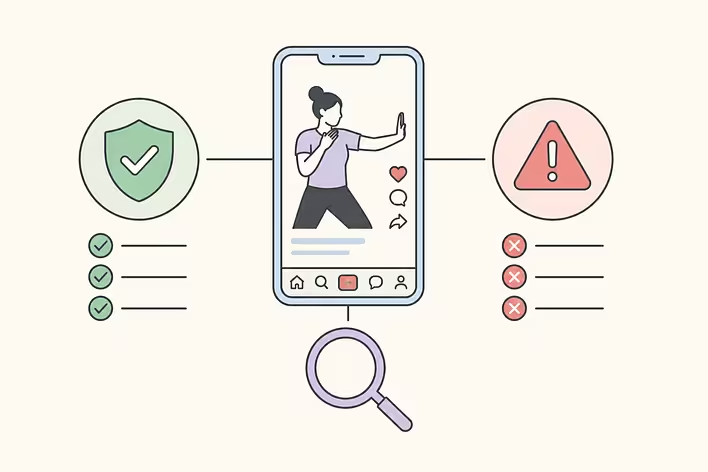
Self-defense tips are a separate genre on the internet. Millions of views, thousands of saves, comments like "thank you, it saved me." The problem is that the algorithm ranks not by correctness but by spectacle. And these are two different criteria.
Keys between fingers: the most enduring myth of the internet
The classic of the genre. Squeeze the keys between the fingers of your fist, like Wolverine's claws. It looks convincing, shared by millions.
It doesn't work. Upon impact, the keys twist and tear the skin of your own palm. A fist with a foreign object inside is formed incorrectly—you risk breaking your fingers before you cause any harm. Self-defense instructors have repeated this for years, but the image is too striking to die.
What instead: if you must use keys—hold one key in your fist with the tip down, like a awl. Although it's better not to use keys at all.
Groin strike: overrated
In every second video. In reality, men reflexively cover this area, and hitting it while moving is harder than it seems. A miss puts you in a worse position than before the attempt.
What instead: throat, eyes, side of the knee. Less obvious and less protected.
Scream "fire," not "help": works
A rare case where viral advice is correct. The reason is the bystander effect: when the scream is addressed to everyone, it is addressed to no one. "Fire" concerns everyone who hears it personally. Doors open.
"Hold the can like a phone": good idea, poor execution
A trend where a girl walks down the street holding a spray can in her palm disguised as a smartphone. The logic is correct: a device that lies in a bag does not exist. Getting it out from under two layers of clothing in three seconds during an attack is fantasy.
But the main point is missing from the videos—the type of spray. An aerosol model in an elevator or hallway will cover you along with the attacker: a cloud will fill the cabin in a second, and both will become incapacitated. In a confined space, a stream is needed, not an aerosol.
For this scenario, for example, pepper sprays Ballistol— a narrow stream hits precisely in the face and does not disperse in volume, while a compact can be easily carried in a pocket every day. In the "hold like a phone" video, this difference is absent. In the elevator, it makes all the difference.
Tactical pen: 90% marketing
A trend that came from gadget reviews. A metal pen with a "strike tip." It looks good in hand, looks great on camera.
To use it, you need the distance of an outstretched arm, the readiness to hit a person with metal, and some skill. Three conditions that most people lack. They buy it for aesthetics, carry it as a talisman.
Location sharing: underrated
The most boring advice in the feed and the most useful. Constantly sharing your location with two or three people, automatic notifications when returning home. Zero views, zero dramatics, real benefit.
Why the algorithm loves bad advice
Here the mechanics are simple. Good advice is usually boring: "carry the device in an outer pocket," "don't get in the elevator with a stranger," "turn on sharing." This doesn't gather views.
Bad advice is cinematic. Key-claws, spinning strikes, spectacular moves. It looks like a scene from a movie—that's why it spreads.
A simple filtering rule: if the advice looks like a frame from an action movie, it most likely came from an action movie.