
This content has been automatically translated from Ukrainian.
When did people first start holding conferences?
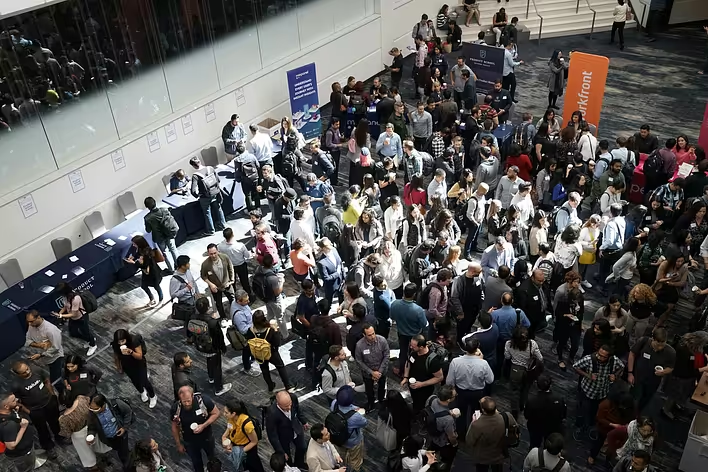
Today, the word “conference” is firmly associated with large conference halls, presentations, participant badges, coffee breaks, and expert speeches. Every year, tens of thousands of scientific, business, medical, technological, and cultural conferences take place around the world, where new ideas are born, partnerships are formed, and future directions for entire industries are defined.
However, the very idea of a conference emerged long before the advent of universities, modern science, or even printing. People began gathering together to discuss important issues thousands of years ago. States, technologies, modes of travel, and means of communication changed, but the desire to share knowledge, debate, teach others, and learn remained constant.
The history of conferences is not just the history of science. It is closely intertwined with the development of democracy, education, culture, and human communication in general. Each era has left its mark on how people organized meetings to exchange ideas: from the open squares of ancient cities to virtual conference halls, where today participants from different continents can communicate simultaneously.
That is why a modern conference can be viewed not just as a separate type of business event, but as a result of centuries of evolution of human curiosity and the desire to collectively seek answers to complex questions.
The Ancient Greek Agora — the first platform for knowledge exchange
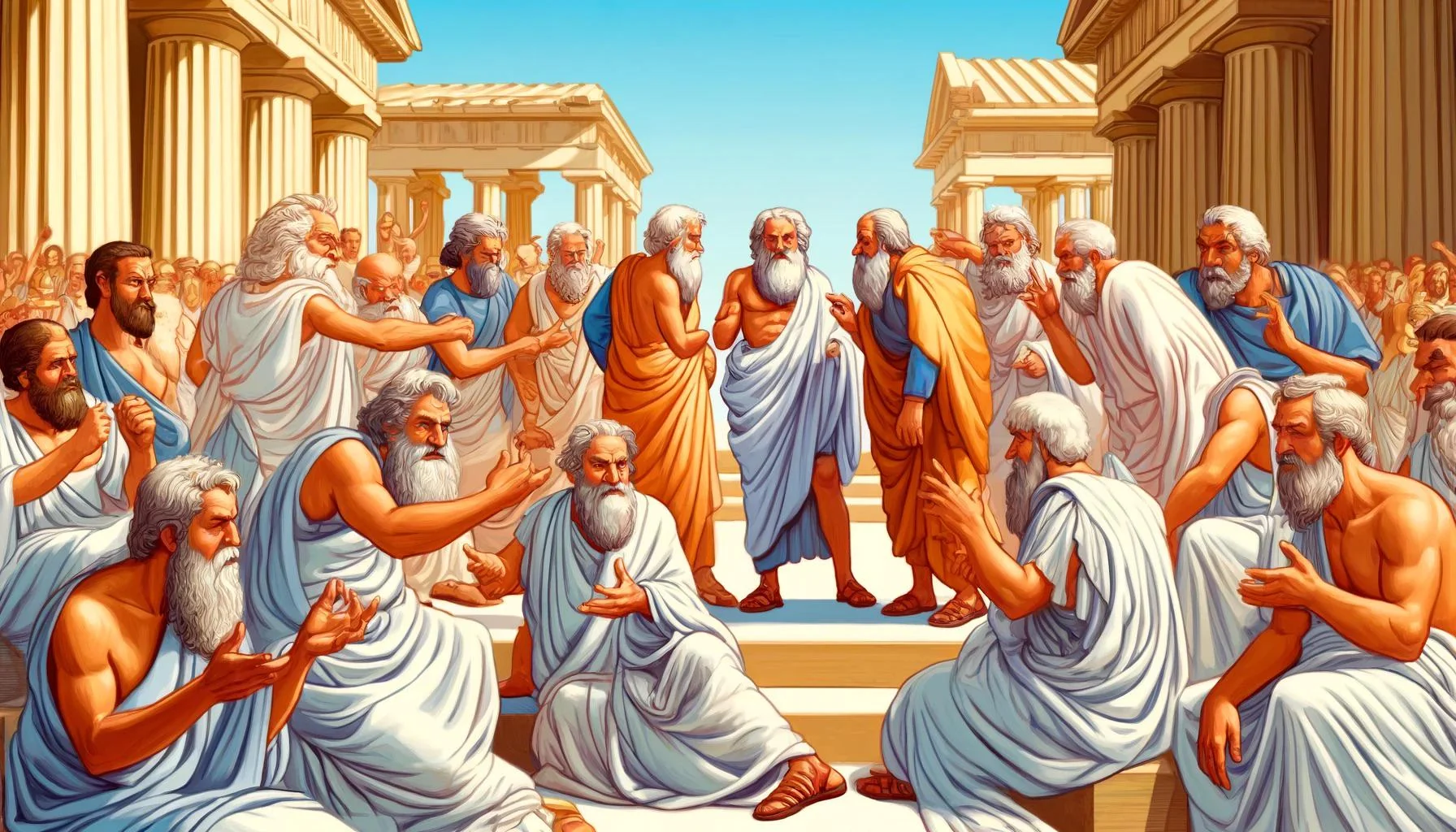
If we try to find the oldest ancestor of the modern conference, most historians would name the Agora — the central square of an ancient Greek city. It was here, over two and a half thousand years ago, that the life of the polis thrived.
The word “agora” (ἀγορά) translates from ancient Greek as “place of assembly” or “gathering.” It was not just a square, but the main public space of the city, where hundreds of people met every day.
Merchants worked here, actors performed, sports competitions took place, political issues were resolved, state decisions were announced, agreements were made, and public events were celebrated. But alongside this, the agora served another extremely important function — it was a place for the birth of new knowledge.
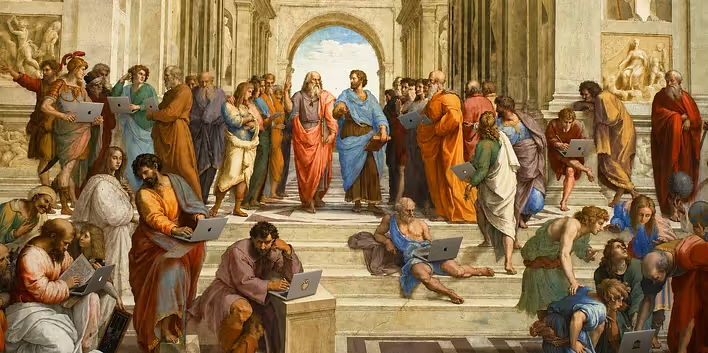
It was here that philosophers, mathematicians, doctors, and thinkers gathered to discuss the structure of the world, the nature of humanity, the laws of the state, and moral questions. Unlike modern lectures, such meetings rarely resembled a monologue by a single teacher. Instead, they were open discussions, during which truth was born in arguments, questions, and collective reflections.
One of the most famous participants in such conversations was Socrates. He left almost no written works, but made live conversation his main teaching tool. Instead of ready-made answers, the philosopher posed questions to his interlocutors, forcing them to seek truth independently. This approach, known today as the Socratic method, is still used in education, law, and even modern management.
Plato and Aristotle also actively utilized the agora. Although they later founded their own philosophical schools — the Academy and the Lyceum — it was the open public discussions that became one of the foundations of ancient science. Here, one could also meet Hippocrates, traditionally called the “father of medicine,” or followers of the Pythagorean school, who discussed mathematical and philosophical issues.
Unlike modern conferences, the agora had no program, registration, or invited speakers. However, it already contained the most important element — people who came not just to listen, but to ask questions, debate, argue, and collectively seek new knowledge.
That is why many researchers call the agora the first great platform for intellectual exchange. Of course, there are huge differences between it and modern conferences, but the main principle remains unchanged: the best ideas are born when people gather together and start a conversation.
From monasteries to universities: how the Middle Ages preserved the tradition of discussions
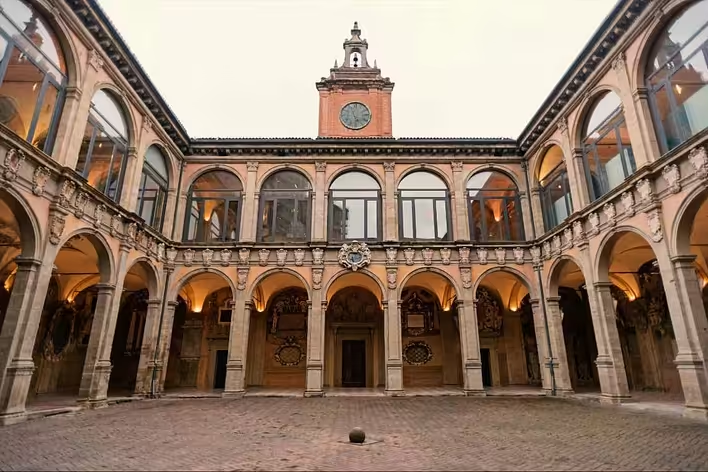
After the decline of the ancient world, it might have seemed that the tradition of open intellectual discussions disappeared along with the ancient Greek city-states. In reality, it merely changed form. If previously the center of knowledge exchange was city squares, in the Middle Ages this role was gradually taken over by monasteries, cathedral schools, and later — the first universities.
Monasteries became places where ancient manuscripts were preserved and copied for centuries. Monks not only copied the works of ancient Greek and Roman authors, but also discussed them, trying to combine ancient philosophy with Christian theology. Although such discussions took place in a closed environment, they helped preserve a vast body of knowledge that later became the foundation of European science.
A true breakthrough occurred in the late 11th — early 12th centuries when the first universities began to emerge in Europe. The oldest of them is considered to be the University of Bologna, founded around 1088. Soon, the University of Paris, the University of Oxford, and other educational institutions arose, which gradually became the main centers of intellectual life on the continent.
Unlike modern universities, medieval educational institutions were significantly smaller, but even then they had an international character. Students and teachers from various countries of Europe traveled to Bologna, Paris, or Oxford. They were united by Latin — the universal language of science at that time. This allowed people who spoke different native languages to easily learn, debate, and exchange ideas.
One of the most interesting features of medieval education was public disputes. These were a kind of intellectual duels, during which a teacher or student would put forward a certain thesis, and other participants would try to confirm or refute it using logical arguments and references to authoritative sources. The winner was not the one who spoke the loudest, but the one whose evidence proved to be more convincing.
For a modern person, such disputes may resemble a scientific conference or panel discussion. Indeed, there are many similarities between them. Even then, participants prepared their arguments in advance, spoke before an audience, answered questions, and participated in professional debates. The main goal was not just to express one’s opinion, but to test it against the arguments of others.
It was the university environment that gradually formed the academic traditions we consider customary today: open lectures, scientific disputes, research defenses, and regular meetings of scholars. Although it would take several more centuries before modern conference centers emerged, the foundation had already been laid. Knowledge increasingly began to be born not in solitude, but in dialogue, where each participant could ask questions, offer their own vision, or challenge accepted opinions.
This culture of reasoned discussion became one of the most important steps toward the emergence of the first scientific societies, which in the 17th century would turn knowledge exchange into a regular and well-organized process.
When the best ideas were born over a cup of coffee
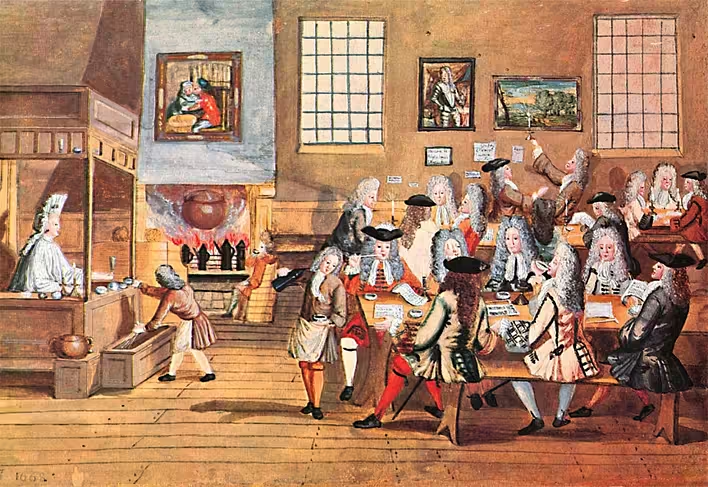
If we were to travel to London or Paris in the 17th century, we would hardly find the most interesting discussions in university classrooms. Most likely, they would take place in a bustling café or a cozy literary salon.
It was during this time that a new culture of communication began to form in Europe. Educated people increasingly met not only for learning but also to discuss politics, science, literature, philosophy, and art. Official university walls were no longer necessary — all that was needed was a place where curious interlocutors gathered.
This tradition spread particularly quickly in France and Great Britain. In Paris, literary salons, often organized by members of the aristocracy, became very popular. Hosts would invite writers, artists, scholars, diplomats, and philosophers to discuss new books, theatrical productions, scientific discoveries, or political events.
Such meetings often defined the cultural life of entire countries. It was during salon discussions that new literary movements were born, artistic tastes were formed, and ideas that later influenced European culture were disseminated.
English coffeehouses also played a significant role. While French salons had a somewhat elitist character, London coffeehouses were much more democratic. For a small fee, visitors received a cup of coffee and the opportunity to join lively discussions. That is why such establishments even began to be called “penny universities” (Penny Universities): for the price of one cup of coffee, a person could hear the latest news, converse with scholars, writers, or entrepreneurs, and learn about the newest ideas of their time.
People from various professions came here. Merchants discussed maritime trade, doctors talked about new treatment methods, writers read excerpts from their works, and philosophers debated the nature of humanity, the state, and society. The boundaries between different fields of knowledge were much less pronounced than today, so one conversation could easily shift from astronomy to economics and then to poetry.
Unlike medieval universities, such meetings were more open. One did not need a scientific title or noble origin to participate in discussions. This openness made coffeehouses and salons one of the main engines of the European Enlightenment.
From friendly meetings to the first scientific societies
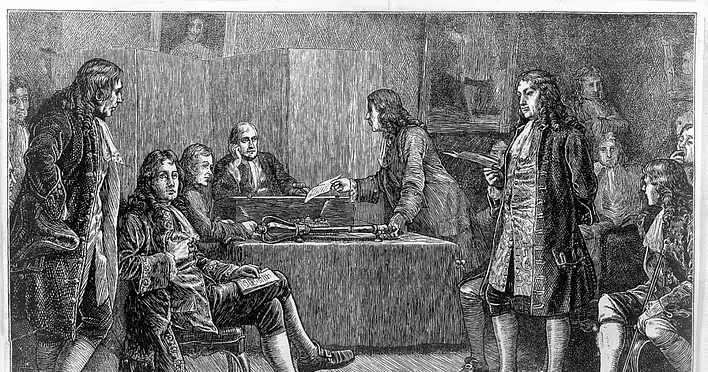
Over time, it became clear that random meetings were no longer sufficient. Science was developing at an ever-increasing pace, knowledge was accumulating, and researchers needed constant platforms to discuss their discoveries.
This led to the emergence of the first scientific societies — organizations whose members regularly gathered to present the results of their research, debate new theories, and publish their works.
One of the most famous was the Royal Society of London, founded in 1660. Today, it is primarily known as one of the most authoritative scientific organizations in the world, but in its early years, its members were interested in a wide range of issues — from physics and astronomy to history, archaeology, and antiquities.
The meetings of the society already resembled modern conferences. Participants prepared reports, demonstrated the results of experiments, discussed colleagues' works, and asked each other questions. The most important presentations were recorded in the minutes and later published. In fact, it was during this time that the tradition of official scientific presentations began to take shape.
Shortly thereafter, other specialized organizations emerged. In the 18th century, the Society of Antiquaries of London was established, bringing together historians and archaeologists, and a little later — the Literary and Philosophical Society of Manchester, which discussed not only humanities disciplines but also natural sciences, medicine, and technical inventions.
These societies became the first permanent professional communities that gathered for the purpose of knowledge exchange. While the ancient agora was an open public space, and salons and coffeehouses were places for informal communication, scientific societies established a completely different tradition. They introduced regular meetings, a defined order of presentations, minutes-taking, publication of materials, and professional peer review. These principles today form the basis of almost every scientific conference.
The 19th century: when conferences became international
At the beginning of the 19th century, the world began to change at an unprecedented pace. The Industrial Revolution, urban development, the emergence of new universities, and the rapid progress of science made knowledge one of the main values of the era. But there was a problem: even the most outstanding discovery had little chance of impacting the world if it was known only in one city or country.
That is why scientists increasingly sought to meet in person.
This was facilitated by technological advancements. Just a hundred years earlier, travel between European capitals could take weeks, but with the advent of railways, steamships, and telegraphs, the world seemed to become smaller. Scientists, doctors, engineers, and researchers gained the opportunity to regularly gather, discuss their discoveries, and return home with new ideas.
During this period, international scientific congresses and conferences began to develop actively. They gradually ceased to be exceptional events and became an important part of academic life. For many scientists, participation in such meetings became as important as publishing their own works.
At the same time, the format of the events changed. While previously discussions mostly occurred within a single society, now conferences gathered hundreds of participants from different countries. Plenary sessions, thematic sections, printed programs, and collections of scientific materials emerged. It was during this time that many traditions were formed that have persisted to this day.
Paris 1900 — the birth of the modern international conference
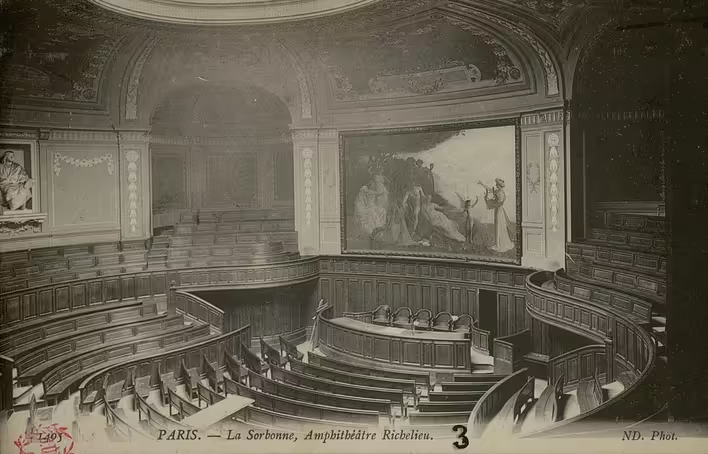
One of the most significant events in the history of conferences is considered to be the First International Congress of Historical Sciences, which took place in Paris in 1900.
Although individual international meetings of historians had been held before, it was the Paris congress that most researchers call the beginning of the modern model of a large scientific conference.
Historians from many countries of the world came to the French capital. They presented the results of their research, debated methods of working with historical sources, and tried to understand what historical science should be in the new century.
However, the significance of this event was much broader than just the exchange of scientific reports.
For the first time, a large international conference became a place where common standards of scientific work were born. It was during such meetings that scholars agreed on terminology, became acquainted with new research methods, and found partners for future international projects.
In fact, the conference ceased to be merely a platform for presenting results. It transformed into a tool for the development of an entire scientific community.
Not just historians: conferences encompass the entire world of science
At the beginning of the 20th century, a similar path was taken by almost all fields of knowledge.
Doctors began to hold international medical congresses, where they discussed new treatment methods and results of clinical research. Engineers met to exchange technical solutions. Mathematicians, physicists, and chemists regularly gathered to present new theories and test them in professional discussions.
The humanities did not lag behind either. Literary scholars, linguists, archaeologists, philosophers, and art historians also began to organize large international conferences, where they introduced colleagues to new research and debated the development of their disciplines.
It was during this time that the familiar image of a conference was formed: hundreds of participants, a rich program, several parallel sections, expert presentations, lively discussions in the corridors, and new acquaintances that often became the beginning of long-term collaborations.
The conference ceased to be merely a meeting of like-minded individuals. It became an important part of international scientific life, without which it was already difficult to imagine the development of any discipline.
When conferences went beyond science
If a person who attended one of the first international scientific conferences at the beginning of the 20th century were to attend a modern event, they would undoubtedly recognize the familiar format. Presentations, questions from the audience, discussions among experts — all of this has hardly changed. However, the scale of such events today is entirely different.
In the second half of the 20th century, conferences ceased to be an exclusively academic tradition. The idea of regular meetings for knowledge exchange proved so successful that it began to be used in almost all professional fields.
This format spread particularly quickly in the business world. Large companies realized that a conference was not just an opportunity to train employees or present a new product. It was also an effective way to gather partners, clients, journalists, and potential investors in one place. This is how large business conferences emerged, which today are attended by tens of thousands of people each year.
The medical field also actively adopted this format. For doctors, conferences became one of the most important ways to quickly learn about the results of clinical research, new treatment methods, and modern medical equipment. In many countries, participation in professional conferences is even a component of continuous professional development for medical professionals.
A true explosion of popularity occurred with the development of information technology. As early as the 1980s, large conferences for programmers, engineers, and software developers began to be held. It was at such events that companies showcased new computers, processors, operating systems, and software products, and participants had the opportunity to see technologies that would later change the world.
Over time, conferences became an integral part of other fields as well. Architects discussed new approaches to city design, ecologists addressed climate change issues, educators explored modern teaching methods, and representatives of creative professions held conferences dedicated to design, cinema, music, or literature.
In fact, the conference transformed into one of the most important types of professional events. Today, this format is used everywhere knowledge needs to be quickly disseminated, specialists need to be united, or new collaborations need to be initiated.
The internet changed the rules of the game

Despite the rapid development of air travel and globalization, by the beginning of the 21st century, most conferences still required in-person attendance. If a researcher or entrepreneur wanted to speak before an international audience, they had to travel to another country, arrange documents, and pay for travel and accommodation.
The internet gradually began to change this model. Initially, it simplified the organization of conferences: participant registration moved online, programs began to be published on websites, and presentations and materials became available for download immediately after the event.
However, the main revolution occurred much later.
From conference halls to Zoom
In the spring of 2020, the COVID-19 pandemic virtually halted international travel and mass events. This posed a serious challenge for conference organizers. It seemed that thousands of annual meetings would have to be canceled.
Instead, something unexpected happened.
Within just a few months, the world transitioned en masse to online conferences. Video conferencing platforms, which had previously been used mainly for business meetings, transformed into full-fledged conference halls. One of the main symbols of this transition was the service Zoom, whose name for many people effectively became synonymous with online conferencing.
Of course, initially, the new format presented many challenges. Organizers had to learn to moderate large online audiences, ensure stable streaming, and maintain interaction among participants. However, at the same time, opportunities opened up that simply did not exist before.
A person from a small Ukrainian town could now listen to lectures by professors from the USA, Japan, or Australia without expensive flights. Students could join international conferences that had previously been out of reach due to high participation costs. Speakers began to present to audiences from dozens of countries simultaneously.
After the pandemic ended, most conferences returned to the traditional format. However, organizers were no longer willing to completely abandon online participation.
This gave birth to the hybrid format — a model in which some participants are in the conference hall while others join via the internet. Today, this approach is increasingly used by large international conferences, as it allows for a combination of the benefits of personal communication with the accessibility of modern digital technologies.
What will future conferences look like?
The history of conferences shows an interesting pattern: every major technological breakthrough did not eliminate personal communication but only changed its form.
Once, people gathered in the squares of ancient Greek cities. Then they debated in university classrooms, literary salons, and coffeehouses. In the 19th century, they began to travel across Europe to speak at international congresses, and at the beginning of the 21st century, they learned to do so without leaving home.
It seems that this process will continue.
Already today, artificial intelligence is capable of almost instantaneously translating speeches into dozens of languages, automatically creating brief summaries of presentations, and helping participants find people with similar professional interests. Organizers are increasingly using systems that create individual conference programs according to each visitor's preferences.
Technologies for virtual and augmented reality are also gradually developing. Although they have not yet become a standard element of conferences, experiments are already being conducted where participants interact in digital spaces using avatars, can collaboratively explore three-dimensional models, or work on projects as if they were in the same room.
It is quite possible that in a few decades, an international conference will not require a flight to another continent. It will be enough to wear mixed reality glasses or use another emerging technology. At the same time, it is hard to imagine that even the most advanced digital tools could completely replace the value of live human interaction.
After all, conferences are valued not only for the presentations. Very often, the most interesting conversations happen after the talks — in the corridors, during lunch breaks, or in chance meetings by the coffee stand. It is there that new ideas are born, professional acquaintances arise, and projects begin that may later change an entire industry.
Technologies can make conferences more accessible, convenient, and larger in scale, but they are unlikely to fully replicate the value of personal human interaction.
From the agora to Zoom — and beyond
If we look at the history of conferences from a distance of over two thousand years, one remarkable thing becomes apparent. Despite all the wars, changes in states, scientific revolutions, and technological progress, humanity has never abandoned the need to gather together.
The places of meetings have changed. The ancient Greek agora was replaced by university classrooms. They were followed by literary salons and scientific societies. Then came huge conference centers, international congresses, and later digital platforms that allowed people separated by thousands of kilometers to communicate.
But the main goal of such meetings has remained unchanged — the exchange of knowledge.
Each era created its own format for conferences, using the most advanced technologies of the time. In ancient times, these were open squares; in the 18th century — printed books and postal letters; in the 19th — railways and steamships; in the 20th — airplanes and television; and in the 21st — high-speed internet, video communication, and artificial intelligence.
That is why the history of conferences is much more than the history of a specific type of event. It is the history of how humanity learned not just to accumulate knowledge but also to pass it on to others. After all, great discoveries rarely emerge in complete solitude. Most often, they appear where people are ready to listen, argue, ask questions, and collectively seek answers.
Perhaps in a hundred years, conferences will look completely different. But if we reflect on the journey from the ancient Greek agora to modern hybrid events, one can assume this: as long as people strive to understand the world and share their ideas, conferences will remain an integral part of human civilization.