This content has been automatically translated from Ukrainian.
Nickname, or simply nick, is an additional name under which a person is known by others. It can replace a real name, complement it, or be used only in a specific environment: among friends, in a game, social network, chat, or professional community.
What does the word "nickname" mean
The English word nickname refers to an unofficial, familiar, humorous, or additional name by which a person or sometimes an object is called instead of or alongside the official name.
In terms of content, a nickname can be:
- a shortened or affectionate form of a name;
- a nickname given by others;
- a self-chosen pseudonym;
- a character's name in an online game;
- a username in a chat, forum, or other platform.
That is why the Ukrainian equivalents of the word can be nickname, pseudonym, online name, or simply nick. However, these words are not always completely interchangeable.
A nickname is often given to a person by others and can be based on a noticeable trait or an incident from life. A pseudonym is usually chosen by a person themselves, especially for creative or public activities. A nickname can belong to both types: it can be received from the environment or specially invented for oneself.
Where does the word nickname come from
The origin of the word nickname is interesting because it is not related to the personal name Nick. Its modern form arose from a change in the boundary between words.
In Middle English, there was the phrase an eke-name. The word eke meant an addition or increase, so eke-name literally meant "an additional name." Over time, the combination an ekename began to be mistakenly divided as a nekename: the sound n shifted from the article to the next word. Later, the form changed to the modern nickname.
Thus, by its original meaning, a nickname is literally another, added name. This etymology well conveys its function: a nick does not necessarily hide the real name but simply gives a person another way to introduce themselves.
The word nickname came into the Ukrainian language from English along with computer and internet vocabulary. In spoken language, the shorter form nick is used much more frequently: "come up with a nick," "change the nick," "register under another nick."
Why do people use nicknames
A nickname can arise accidentally, be established in childhood, or be a deliberate part of an image. In the digital environment, it helps separate personal life from public life, be memorable to the audience, or show one's interests.
For example, the name PixelWitch may indicate an interest in digital art and fantasy, while "Mr. Fluffy Pants" creates a humorous and friendly image. A neutral nick like north_line tells almost nothing about the owner, which can also be a conscious choice.
Nicknames are used to:
- not use the full or real name;
- create a recognizable image;
- show belonging to a community;
- convey a character trait or interest;
- distinguish people with the same names;
- communicate less formally.
At the same time, a nickname does not guarantee complete anonymity. Even when the real name is hidden, a person can sometimes be recognized by their photos, posts, connections with other profiles, and the reuse of the same nick across different sites.
What types of nicknames are there
There is no universal classification of nicknames, as they arise in very different environments—from a school classroom to an online game. However, by origin and purpose, they can be conditionally divided into several types.
Nicknames derived from real names
The simplest option is a shortening, affectionate form, or altered name. For example, Oleksandr may use the nick Alex, Oleksandra—Sasha, and Margarita—Rita.
In social networks, numbers, initials, birth year, or a short word are often added to the name: anna_k, max.art, oleh_91. Such nicks are easy to associate with a person, making them convenient for personal profiles, but they provide almost no anonymity.
Imaginary and fictional nicknames
Such names are not directly related to the real name and create a certain image. They can be MoonFox, SilentOak, "Coffee Ghost," or "Ms. Comet."
An imaginative nick often combines two unexpected words, hinting at the character, mood, or aesthetics of the owner. Such names are well remembered in games, blogs, and creative communities.
Nicknames based on hobbies or profession
A nick can immediately indicate what a person is interested in or does: CodeNomad, BookHunter, PlantMama, "Mr. Photographer," or "Traveling Chef."
For a thematic blog or professional profile, this is convenient, as a new reader understands the theme even before getting acquainted with the content. At the same time, a too narrow nick can become inconvenient if the person later changes their field of activity.
Humorous nicknames
This group includes names built on wordplay, self-irony, or absurd combinations: "Director of Dumplings," "Cat Without a Plan," ErrorHuman, or "Count Deadline."
They work well in informal communities but may seem inappropriate in professional correspondence. Therefore, one person often has a separate nick for work, games, and personal communication.
Nicknames given by other people
Not all nicks are invented by the person themselves. A nickname can arise due to a feature of appearance, character, pronunciation, profession, or a specific story.
Such names often take root in a company of friends, a sports team, or a work collective. They can be friendly, neutral, or offensive, so the person's attitude towards such a reference is important. If a nickname is unpleasant to the owner, it should not be justified by tradition or humor.
Where are nicknames used
Nicknames appear in almost all environments where people need to call each other in some way outside of official documents.
In social networks and messengers
In social networks, a nickname is usually displayed next to posts, comments, and messages. It can coincide with a real name, be a pseudonym, or serve as the name of a page.
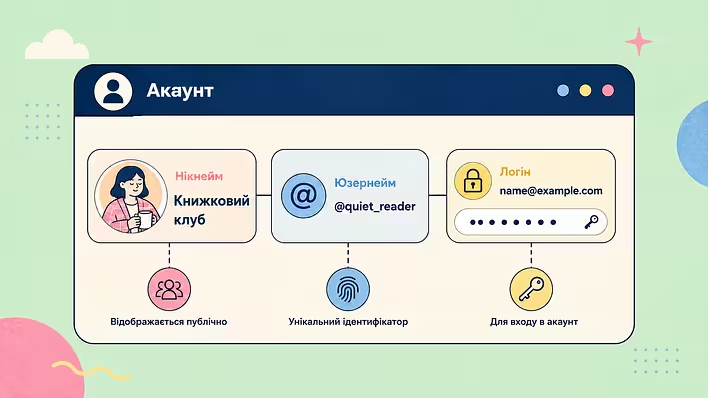
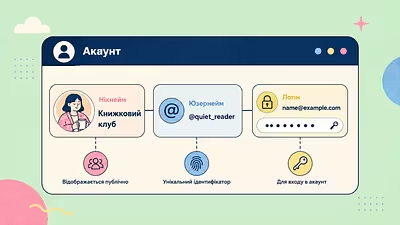
At the same time, the platform may separately have a username—a unique designation like @book_fox. Then the nickname answers the question "how is the profile named," while the username answers "how to find this specific account."
In online games
In a game, a nick often becomes the name of a character or designation of a player. It is seen by allies, opponents, and participants in the ranking.
A gaming nick can reflect the style of play, team affiliation, or simply create the desired image. Sometimes a clan tag is added to it: for example, [OWL]NightFox.
In some games, the character's name and account name are separated. One account can contain several heroes with different names.
On forums and in comments
Forums have become one of the environments where the word "nick" has actively spread in the Ukrainian internet. Users could know a person for years only by their online name, even if regular participants were already communicating outside the site.
A nick in such a community gradually gains a reputation. Under it, messages, ratings, history of disputes, and useful answers accumulate. Therefore, changing a nick is sometimes perceived almost as changing a public name.
In creativity and media
Authors, musicians, artists, streamers, and bloggers can use a nick as a creative name. In this case, it approaches the meaning of a pseudonym or brand name.
A well-chosen nick helps form a recognizable image. However, as the audience grows, it ceases to be just a random profile name: it can be used to register a trademark, sell products, or enter into advertising contracts.
In everyday life
Nicknames exist outside the digital environment as well. A second person with the same name may be called by their surname, a character trait, or a shortened form. Athletes, historical figures, and rulers also often received nicknames that later became more well-known than their full names.
Thus, the internet did not create the phenomenon of nicknames; it merely made it a mass part of digital identity.
Nickname, pseudonym, and nickname: what is the difference
These concepts overlap but have different shades of meaning.
Nickname is the broadest and most neutral word in the modern digital context. It is the name under which a person is presented in a particular community or service.
Pseudonym is usually consciously chosen for public, professional, or creative activities. A writer may publish books under a pseudonym, and a musician may perform under a stage name. A pseudonym is often a more stable and thoughtful part of an image than an ordinary nick in a chat.
Nickname mainly arises in communication and is often given by other people. It can be related to character, appearance, habit, or a specific event.
For example, "Gray" in a group of friends may be a nickname, SilverFox in a game—a nickname, and "Oles Sribny" on a book cover—a pseudonym. At the same time, the same name can transition from one category to another. A gaming nick sometimes becomes a creative pseudonym, and an old nickname becomes the name of a public profile.
How is a nickname different from a username
A nickname shows how a user wants to be called, while a username helps the system and other people find a specific account.
For example:
- nickname—"Book Club";
- username—@quiet_reader.
A nickname can contain spaces, emojis, and may not be unique. A username usually has technical limitations and cannot be repeated within one service.
However, on some platforms, these functions are combined. Then one name serves both as a public nick and a unique username. This difference should be explained in more detail with an internal link to the article about nicknames, logins, usernames, and accounts.
Frequently asked questions
Does a nickname have to be fictional?
No. A nickname can be a real name, its abbreviation, surname, initials, or any other form under which a person is known in a particular environment.
Can several people have the same nick?
Yes, if the service does not require uniqueness. Identical display names are often allowed, and a separate username or internal number is used to distinguish accounts.
Can a nickname be changed?
Usually yes, but the rules depend on the platform. Some services allow changing the nick at any time, while others impose time restrictions or charge a fee for a repeated change.
Is a stage name a nickname?
In a broad sense—yes, as it is an additional name of a person. However, for professional creative activities, it is more accurate to use the words pseudonym or stage name.
Can a nickname become a brand?
Yes. If content is regularly published under it, products are sold, or services are provided, a nick can gradually turn into the name of a project or personal brand.
How is a nickname different from a profile name?
Often, not at all: a profile name can serve as a nickname. However, a profile also contains an avatar, description, links, and other information, while a nickname is just the name under which the user is presented.