This content has been automatically translated from Ukrainian.
Reader is an electronic device primarily designed for reading digital books and documents. It is also referred to as an e-book, e-reader, or the English term e-reader.
Externally, the reader does resemble a small tablet, but it operates differently. The main difference is the screen. Most modern models use electronic paper technology, the most well-known type of which is E Ink. It is precisely because of this display that the reader is convenient for prolonged reading.
How the reader's screen works
A regular smartphone or tablet display constantly emits light and refreshes the image many times per second. The electronic paper screen behaves differently: it forms images using microscopic particles inside the display and can then hold a page almost without consuming energy.
Visually, this screen resembles printed text more than an image on a monitor. It is easily readable in daylight and typically does not create the glare characteristic of glossy screens.
Many readers have built-in lighting. In this case, the light is directed onto the surface of the screen rather than directly into the eyes, as with most LCD and OLED displays. In some models, it is also possible to change the color temperature — for example, to make the lighting warmer in the evening.
Why the reader lasts so long without charging
Electronic paper consumes the most energy primarily at the moment of changing the image, for example, when the reader turns the page.
Therefore, the reader's battery can last significantly longer than that of a smartphone or tablet. Depending on the model, lighting, wireless features, and reading intensity, the charge can last from several days to several weeks.
Autonomy is one of the reasons why readers are convenient for travel: they do not need to be charged every evening.
What can be read on a reader
Readers support electronic books in various formats. The most common ones are:
- EPUB;
- PDF;
- TXT;
- HTML;
- MOBI and other formats, depending on the specific device.
Format support varies among manufacturers, so it is worth checking the specifications of a specific model before purchasing.
The most convenient format for reading on a reader is EPUB, where the text automatically adjusts to the screen size. The reader can change the font, its size, line spacing, and margins.
The situation with PDF is more complicated. A PDF page usually has a fixed layout, so large documents, magazines, textbooks, or files with tables may not display very conveniently on a small screen. For such materials, readers with larger displays are more suitable.
Reader and tablet are not the same
A reader has a much narrower purpose than a tablet.
On a tablet, you can watch videos, work with a browser, run applications, games, messengers, and social networks. The reader is primarily focused on text.
This is both a limitation and an advantage.
A tablet is more versatile, but its bright color screen, shorter battery life, and constant notifications can distract from reading. The reader, on the other hand, usually does not try to replace a computer or smartphone. Its task is to provide convenient access to books.
There are also color readers using electronic paper, but in terms of saturation and display speed, they still differ from regular tablets. Such devices can be useful for comics, diagrams, or illustrated books, but their main feature remains the same — a display based on electronic paper.
Why a reader is more convenient than a paper book
The main advantage is obvious: one small device can hold a large library.
This is especially noticeable when traveling. Instead of carrying several paper books, you can take one reader and decide what to read on the spot.
There are also less obvious advantages. In most readers, you can:
- increase or decrease the font size;
- search for words in the text;
- leave bookmarks and notes;
- highlight fragments;
- use built-in dictionaries;
- sync reading progress if the service supports it.
For people who find it uncomfortable to read small print, the ability to change the text size can be significantly more important than the device's compactness.
Can a reader completely replace paper books
Not necessarily.
The reader primarily solves a practical task: it allows you to store many books in one lightweight device and read them on a screen specifically designed for text.
A paper book has other advantages. It does not require charging, does not depend on software or file formats, and for many readers, the physical medium, the design of the publication, and the reading experience are also important.
Therefore, readers and paper books can coexist quite well. Printed editions remain on the shelf at home, while the electronic device is more convenient to take on the go or to use for books that one does not want to purchase in physical format.
What to consider when choosing a reader
First of all, the screen size matters. Compact models are easier to carry, while larger ones are better suited for PDFs, educational materials, and documents with complex layouts.
It is also worth paying attention to:
- lighting — whether it is present and if its temperature can be changed;
- pixel density — which affects the clarity of the text;
- supported formats — especially if you already have your own library of electronic books;
- memory capacity — for regular books, it usually does not need to be much, but audiobooks and large PDFs take up significantly more space;
- water resistance — useful for reading on the go, at the beach, or in the bath;
- touch control and page-turn buttons — here the choice mainly depends on personal habits.
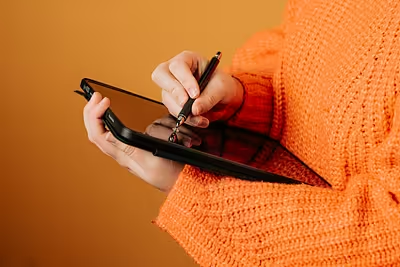
Some models support a stylus and handwritten notes. This is no longer just a compact e-book, but a device that can be used for working with documents and educational materials.
Who will truly benefit from a reader
The greatest advantages of a reader are felt by people who read regularly.
It is especially convenient if you have to read a lot on the go, do not want to carry heavy books, need a larger font, or it is important to have several editions on hand at once.
However, if a person reads one or two books a year and is completely satisfied with a smartphone or paper editions, a separate device may simply be unnecessary.
That is why the reader should not be perceived as a “tablet just for books,” but as a separate type of device. It consciously has fewer functions, but its screen, autonomy, and software capabilities are tailored to one specific task — comfortable reading.