

This content has been automatically translated from Ukrainian.
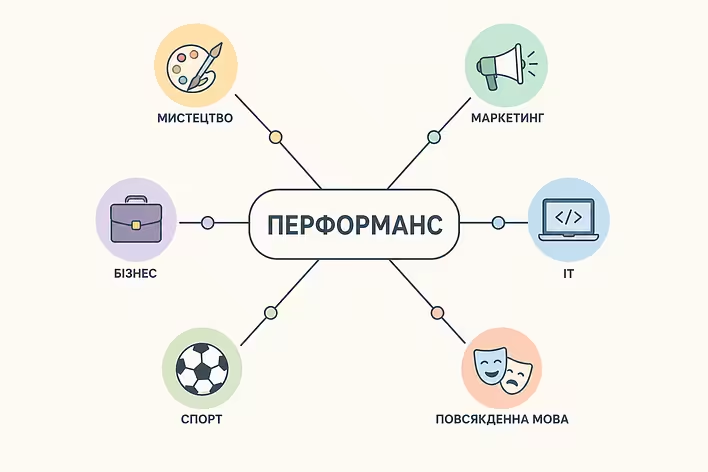
The word “performance” is most often associated with contemporary art: the artist steps in front of the audience, performs unusual actions, and transforms their own body, behavior, or interaction with space into part of the artwork. However, the meaning of the term is not limited to this. In business, performance can refer to work efficiency, in marketing — to a direction focused on measurable results, and in technology and IT, the English performance means productivity or speed.
Performance is an action, a performance, or execution, the meaning of which depends on the context. In contemporary art, performance refers to a work created through the actions of the artist or other participants. In a broader everyday understanding, it can refer to an unusual, spectacular, or deliberately theatrical act. In professional vocabulary, the word is also used to mean effectiveness, productivity, or efficiency.
Due to such polysemy, phrases like “artistic performance,” “to stage a performance,” “performance of an advertising campaign,” and “computer performance” can refer to completely different phenomena. What unites them is the initial idea of performing a certain action and the resulting outcome.
What does performance mean in simple words?
In simple terms, performance is an action performed in front of other people or evaluated by its outcome.
When it comes to art, the main work is not a painting, sculpture, or other material object, but the action itself. The artist may silently sit in front of the viewers, perform repetitive movements, interact with objects, change the space, or engage the audience. Such an action can be premeditated or partially improvised, occur live or be recorded on video. This is how performance is defined, in particular, by Tate and the Museum of Modern Art in New York.
In conversational language, this word often has a slightly different connotation. If someone behaves too demonstratively, turning an ordinary event into a spectacular spectacle, one might say:
“That was a real performance.”
In this case, it does not necessarily refer to art, but to bright, theatrical, or provocative behavior.
In business, marketing, and technology, the meaning changes even more. Here, performance usually refers to how well a person, system, device, or advertising campaign performs the assigned task. The English word encompasses public speaking, performing an action, and the ability of a mechanism or person to work effectively.
The meaning of the word in different contexts
To correctly understand the term, one must pay attention to the field in which it is used.
Thus, the word “performance” should not always be translated as “artistic action.” Depending on the situation, appropriate equivalents may include performance, execution, act, effectiveness, efficiency, productivity, or speed.
Origin of the word
The Ukrainian word “performance” comes from the English performance. In modern English, it can mean the execution of a certain action, a performance in front of an audience, a theatrical production, achieved results, effectiveness, or productivity.
The word performance is derived from the verb to perform — “to execute,” “to carry out,” “to perform.” Its earlier meaning was related to the completion or successful execution of a certain task. The noun performance has been recorded in the English language since the late 15th century in the meaning of “execution” or “completion,” and later it began to refer to an executed act, theatrical play, and public performance.
The meaning related to contemporary art formed much later. The very phrase performance art became widely established in the second half of the 20th century, although artists had been using their own actions, movements, music, and provocative public performances since the beginning of the century. In particular, such practices were characteristic of Futurism and Dadaism.
In the Ukrainian language, the normative and most common spelling is перформанс — with two letters р in the root: пер-фор-манс. The variant “перфоманс” also occasionally appears in colloquial use and some sources, but for a consistent literary text, it is better to use the form “перформанс”.
Performance as a form of contemporary art
Despite the large number of contemporary meanings, art remains the main context in which the word “performance” is used in the Ukrainian language.
Performance in art is a work based on the action of the artist, a group of participants, or the audience. It can combine movement, speech, music, video, costumes, objects, light, space, and interaction with viewers. However, none of these elements is mandatory: sometimes a performance consists solely of a person's presence in a certain place for a specified time.
In traditional art, after the completion of the work, a material object remains — a painting, sculpture, or photograph. In performance, the main work becomes the event itself. After it, there may be video recordings, photographs, props, or memories of the viewers, but they only document what happened and do not always fully replace the live experience.
Performance can be carefully planned or improvised, last for a few seconds or many hours, take place in a museum, on the street, in an abandoned building, or in digital space. The artist can perform it alone, involve other participants, or give the audience part of the control over the event.
This freedom makes performance one of the most difficult forms of contemporary art to define precisely. It can resemble theater, dance, concert, ritual, protest, or an ordinary domestic action, but it transforms into an artistic work thanks to the author's intention and the context in which it occurs.
The history of the emergence of performance
Although performance as a separate direction in art formed only in the 20th century, its roots can be found much earlier. In various cultures, there were rituals, ceremonies, carnivals, and public acts where the main significance lay not in the created object but in the action itself. This idea — that art can be a process, not just a finished result — later became the foundation of performance.
The first steps toward modern performance were taken by European avant-gardists in the early 20th century. Representatives of Futurism organized public performances during which they combined poetry, music, painting, and provocative actions. Their goal was not just to show an artistic work but to provoke a strong emotional reaction from the audience.
Shortly thereafter, similar experiments began to be conducted by representatives of Dadaism. They deliberately destroyed conventional notions of art, combining absurdity, randomness, improvisation, and unexpected interaction with the audience. It was during this period that the question increasingly arose: can the action itself be art, even if no material work remains after it?
After World War II, interest in such an approach only grew. In the 1950s and 1960s, artists increasingly boldly abandoned traditional painting or sculpture in favor of live interaction with space, time, and viewers. It was then that performance began to be perceived as an independent form of contemporary art.
An important role in its development was played by the international art movement Fluxus, which emerged in the early 1960s. Its participants sought to erase the boundary between art and everyday life. Instead of exhibitions, they organized short actions, experiments with sound, movement, and interaction with the audience. For them, art ceased to be just an object in a museum — it could be almost any meaningful action.
From the second half of the 20th century, performance firmly established itself in world art. Today it is regularly presented in the largest museums, galleries, biennials, and international contemporary art festivals. Many universities even teach performance as a separate artistic discipline.
The most famous performances in the world
Over the decades of development, performance has given the world many works that have become iconic not only for art but also for world culture.
“Cut Piece” — Yoko Ono
One of the most famous performances of the 20th century was the work of Japanese artist Yoko Ono, presented in 1964.
During the performance, she silently sat on stage, with scissors lying next to her. Audience members were invited to approach one by one and cut any piece of her clothing. The artist did not resist and did not comment on what was happening.
This performance raised questions of trust, personal boundaries, public responsibility, and society's attitude toward the human body. It is still considered one of the most influential works of performative art.
“The Artist Is Present” — Marina Abramović
In 2010, Serbian artist Marina Abramović presented one of the most famous performances of contemporary art at the Museum of Modern Art.
For nearly three months, she sat at a table every day, silently looking into the eyes of each visitor who sat across from her. There were no words or special effects — just the presence of two people.
Despite its apparent simplicity, this performance evoked extraordinarily strong emotions. Some visitors could not hold back tears, while others spent dozens of minutes in complete silence before the artist. The work demonstrated that even a minimal action can become a powerful artistic expression.
“How to Explain Pictures to a Dead Hare” — Joseph Beuys
In 1965, German artist Joseph Beuys conducted a performance that became a classic of conceptual art.
He walked around the gallery holding a dead hare and seemingly explained to it the meaning of the paintings, while visitors could only observe what was happening.
The work became a reflection on the nature of art, communication, and the question of whether an artistic work can always be rationally explained in words.
“Rhythm 0” — Marina Abramović
Another significant performance by Marina Abramović was the work Rhythm 0, presented in 1974.
For six hours, the artist remained completely passive, allowing visitors to do whatever they wanted with her. Dozens of objects — from a flower and a feather to a knife and other potentially dangerous items — lay nearby.
This experiment became an exploration of human behavior, responsibility, and how people's actions change when they feel complete freedom and lack of punishment.
Performance in everyday language
Over time, the word “performance” has gone far beyond art and become part of everyday language.
Today, it is often used to describe any bright, unusual, or demonstrative behavior. For example, if a person creates an emotional scene, a surprising act, or behaves too theatrically, one might hear the phrase:
“He staged a real performance again.”
In this case, the word is no longer related to contemporary art. It is used metaphorically and emphasizes that the event was spectacular, drew attention, or appeared unusual.
Sometimes this word has a positive connotation — when referring to an impressive performance by a musician, athlete, or presenter. In other situations, it may sound ironic if a person's behavior seems overly ostentatious or artificial.
That is why the meaning of the word should always be determined by the context.
What is Performance Marketing?
One of the most common modern meanings of the word performance is related to digital marketing.
Performance Marketing is an advertising approach where the effectiveness of a campaign is assessed based on specific measurable results.
Unlike traditional advertising, where the main goal may be brand recognition, in performance marketing, the main focus is to achieve a clearly defined user action.
For example:
- placing an order;
- filling out a form;
- registration;
- installing an application;
- calling the company;
- subscribing to a newsletter.
That is why various metrics are constantly analyzed here: the number of clicks, conversions, cost per lead, return on advertising spend, and other metrics.
Today, performance marketing is one of the most popular areas of digital advertising, as it allows for a fairly accurate assessment of how effectively each advertising campaign works.
What does performance mean in IT and technology?
In the field of information technology, the word performance is most often translated as productivity or speed.
Here, it characterizes how quickly and effectively a certain system works.
For example, one can talk about:
- performance of the processor;
- performance of the graphics card;
- performance of the website;
- performance of the database;
- performance of the mobile application.
If a programmer says that performance needs to be improved, it means that the program needs to be made faster, more efficient, or less resource-intensive on the computer.
In this context, the word “performance” is rarely used. In Ukrainian, it is much more natural to say “productivity”, “speed”, or “system efficiency”.
Performance in business
In business, the word performance is also usually translated as effectiveness, efficiency, or performance indicators.
For example, managers may evaluate:
- performance of an employee;
- performance of a team;
- performance of the sales department;
- performance of the company for the quarter.
In such cases, it does not refer to a creative performance or art, but to how successfully the set goals were achieved.
That is why in Ukrainian business texts, instead of the direct borrowing “performance”, words like efficiency, effectiveness, productivity, or work results are usually used.
Performance in sports
Another area where the English word performance is often encountered is sports.
Commentators, coaches, and sports analysts use it to evaluate the quality of an athlete's or team's performance.
For example, in English, one might say:
A great performance.
In Ukrainian, it is more natural to translate this as:
- a great performance;
- a brilliant game;
- a strong result.
Thus, even in a sports context, the word performance does not mean an artistic performance, but describes the level of execution, skill, and achieved result.
How does performance differ from theater, installation, and happening?
Due to external similarities, performance is often confused with a theatrical play, installation, or happening. However, these are different forms of art.
Performance and theater
At first glance, they have much in common: there is a stage, a performer, and an audience.
However, theater is usually based on dramaturgy, roles, scripts, and characters.
In performance, the artist often does not play a fictional character — they act in their own name. The main focus is not on the plot, but on the action itself, its idea, and interaction with space and the audience.
Performance and installation
An installation is primarily a spatial artistic object created from various materials.
Performance, on the other hand, exists in time. Its basis is action, not an object.
Although sometimes artists combine both formats: creating an installation within which a performance takes place.
Performance and happening
Happening emerged almost simultaneously with performance, which is why these concepts are often confused.
The main difference is that a happening largely depends on improvisation and active participation from the audience. Events can develop unpredictably, and the audience often becomes co-creators of the artistic process.
Performance can also engage the audience, but usually, the artist more clearly defines the concept and structure of the work.
Synonyms for the word “performance”
There is no absolute synonym for the word “performance”. Its meaning is so context-dependent that different words may be appropriate in various situations.
If it refers to contemporary art, the following equivalents are most often used:
- artistic action;
- artistic act;
- artistic performance;
- artistic event;
- performative practice.
In conversational language, depending on the context, the following words may be suitable:
- show;
- spectacle;
- theatrical action;
- demonstrative act.
In business, marketing, and IT, the word performance is usually translated differently:
- effectiveness;
- efficiency;
- productivity;
- speed;
- quality of execution;
- performance indicators.
That is why before translating or using the word “performance”, it is always worth considering the context.
Frequently Asked Questions
Is performance always art?
No. Although the most well-known meaning of the word is associated with contemporary art, today the term is actively used in business, marketing, sports, and information technology. In each of these fields, it has its own meaning.
How does performance differ from a play?
A theatrical play usually has a script, characters, and dramaturgy. Performance does not necessarily tell a story or have a plot. Its main artistic means is the action itself, interaction with space, time, and the audience.
Why is performance considered art?
Because its goal is not only to perform a certain action but to create an artistic expression. The author's intention, context, symbolism, and audience reaction become important.
What does performance mean in English?
The English word performance is polysemous. It can mean performance, execution, effectiveness, efficiency, productivity, or speed — depending on the context.
Which is correct: performance or performans?
The normative form in the Ukrainian language is performance.
It corresponds to the spelling of the English word performance and is used in dictionaries, encyclopedias, and most modern Ukrainian publications. The variant “performans” can sometimes be found in informal speech or certain publications, but it is not recommended for literary language.