

This content has been automatically translated from Ukrainian.
During registration, one site asks to come up with a login, another — to choose a username, and a third offers to specify a profile name separately. Because of this, the terms can easily be confused: sometimes they really denote different things, and sometimes the same set of characters serves multiple functions.
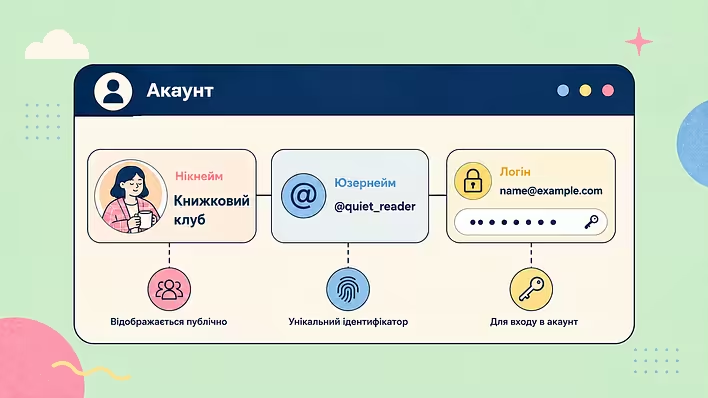
For example, a person can log into a site using the email address [email protected], have the username @quiet_reader, and be called "Book Club" in their profile. All this data belongs to one account but is used differently.
The easiest way to distinguish the concepts is by their purpose:
- a nickname shows how the user wants to be called;
- a username helps to find and identify them in the service;
- a login is used for entry;
- an account combines data, settings, and user history.
On a specific site, these roles may partially overlap, so it is important to look not only at the name of the field but also at what it is needed for.
What is a nickname
Nickname, or simply nick, is the name under which a person presents themselves to other users. It serves as a pseudonym and does not necessarily have to match their real name.
A player might call themselves NightFox, an author of a book blog — "Literary Witch," and a forum participant — "Mr. Croissant." It is the nickname that will appear next to posts, comments, messages, or characters in a game.
In many services, a nickname does not have to be unique. Several people can choose the same name since the system distinguishes them by usernames, numbers, or internal identifiers.
A nickname can usually be changed. It can also contain spaces, emojis, Cyrillic, and other characters that are not always allowed in logins or usernames.
Instead of the word "nickname," settings may use the terms display name, profile name, or the English display name.
What is a username
Username is the user's name within a specific site, application, or other digital system. Its main task is to distinctly differentiate one account from another.
For example, in a social network, a user might specify:
- profile name — "Daryna about books";
- username — @daryna_reads.
The name "Daryna about books" can be used by other people, while the username @daryna_reads is assigned to only one account.
The username often appears in mentions, search results, and links to the page. If the profile address looks like site.com/daryna_reads, its last part is usually the username.
Due to technical purposes, there are often restrictions on usernames. The service may allow only Latin letters, numbers, dots, or underscores, prohibit spaces, and not accept already taken options.
Most often, the username is public, but not always. In a work, educational, or banking system, it may be a service name that only the user and the administrator can see.
What is a login
Login is the identifier by which the system recognizes the user during entry. It is entered together with a password, one-time code, access key, or other means of identity verification.
A login can be:
- an email address;
- a phone number;
- a username;
- a client number;
- a service code;
- a specially created name.
Therefore, a login is not necessarily a separate word that needs to be invented during registration. If the site asks for an email and password, the email address serves as the login.
A login can coincide with a username. This is often how forums, online games, and older web services work: the user enters one name both during authorization and while communicating with others. However, this is not a universal rule.
On many modern platforms, the login is hidden. Other users see the nickname or username but do not have access to the email address or phone number used for entry.
What is an account
Account, or profile, is the entire set of data and capabilities associated with a specific user in the service.
An account may include login data, contact information, settings, action history, messages, purchases, subscriptions, files, access rights, and profile information. Thus, login, username, and nickname are not different types of accounts but separate elements that can belong to one account.
For example, a person creates an account in a streaming service using an email address, connects payment to it, and stores viewing history. Within this account, there may be several profiles for different family members — each with its own name, avatar, and recommendations.
Therefore, the phrases "forget login" and "lose access to the account" mean different situations. The login is just one way to recognize the user, while the account encompasses all their data and actions in the system.
Nickname, username, login, and account: a brief comparison
Imagine a user who registered on a text publishing platform. Her account contains an email address, password, drafts, settings, and publication history. To log in, she uses her email — this is her login. The link to the page specifies the username @paperfox, and next to the articles, the nickname "Paper Fox" is displayed.
In this example, all concepts are easily separated. However, on real sites, such a clear system does not always occur.
Why login, username, and nickname can coincide
The difference between the terms is primarily determined by their function, not appearance. The same set of characters can simultaneously be a login, username, and nickname.
For example, a user registers on a forum under the name SpaceCat. They enter it during login, see it in their profile, and other participants see it next to messages. In such a system, SpaceCat performs three roles at once:
- login, as it is used for entry;
- username, as it denotes a specific user;
- nickname, as it is displayed as a public name.
In another service, these functions are separated. A person logs in using a phone number, has a unique username @spacecat27, but is publicly called "Cat in Space." The phone number is the login, @spacecat27 is the username, and "Cat in Space" is the nickname.
That is why one should not determine the type of data solely by its form. The name forest_owl can be a username in one social network, a login in a work system, and an ordinary nickname in a game.
The names of the fields also depend on translation and developers' decisions. What one site calls "username," another may label as "login," "nick," "pseudonym," "identifier," or username. Sometimes the Ukrainian interface translates the term "username" as both a public username and service data for entry.
To understand the purpose of a specific field, it is worth paying attention to the hints:
- "use for login" means that this is a login;
- "you can be found by this name" — most likely, a username;
- "will be displayed in the profile" — a nickname or profile name;
- "this option is already taken" usually indicates that the value must be unique.
How an account differs from a profile
Account and profile are often used interchangeably, but they are not quite the same.
An account is the entire record through which a user accesses the service. It may store login data, security settings, subscriptions, purchases, correspondence, files, and action history.
A profile is a part of the account that describes the user or presents them to others. A profile may include:
- name or nickname;
- username;
- photo or avatar;
- short description;
- place of work;
- links;
- publications and other visible activity.
Conditionally, an account can be compared to a personal cabinet, while a profile is like a business card placed inside it. Visitors see the business card but do not have access to the password, payment information, and private settings.
At the same time, a profile is not always public. For example, in a banking application, it may contain personal data of the client that only the account owner can see.
One account can sometimes contain several profiles. This is how some streaming platforms work: payment, email address, and security settings belong to a shared account, while each family member gets a separate profile with their viewing history and recommendations.
The reverse situation is also possible. One user may have several different accounts in one service — for example, personal, work, and thematic. Each of them will have its own data, settings, and profile.
What can be shown to others, and what is better not to disclose
A nickname and public username are usually created specifically to be shared. They are indicated in the profile, sent to friends, or used in links and mentions.
The situation with the login depends on what exactly serves its role. If a person logs in using a public username, there is no point in hiding it. But when the login is a personal email address, phone number, client number, or service identifier, it is better not to disclose it to outsiders without necessity.
A known login by itself usually does not grant access to the account, as a password or another means of confirmation is required for entry. However, it is part of the authorization data and can be used in phishing messages, attempts to guess passwords, or recover access to the account.
Passwords, one-time codes, backup codes, password reset links, and confirmation codes should not be shared with anyone. A legitimate support service may ask for the username or account address but should not require a password or a code just received in a message.
Frequently asked questions
Can an email address be a login?
Yes. In many modern services, the email is used for login. In this case, the user does not need to create a separate login.
At the same time, the email address is not necessarily a username. A person can log in using an email but have a completely different public name and unique username.
Can login and username coincide?
Yes. If the site allows logging in with a username, one value serves two functions: it identifies the user in the system and is used for authorization.
For example, the name bookfox7 may appear in the profile address and simultaneously be entered in the login form. However, on another site, bookfox7 will only be a public username, and entry will have to be done using an email address.
Do other users see my login?
Not always. A public username that is also a login is usually visible to everyone. An email address, phone number, or service code is most often hidden.
This can be checked in the privacy settings or by opening one's own profile in view mode for other users.
Can a nickname and username be the same?
Yes, if the chosen name meets the service's technical requirements and is not already taken. For example, PixelCat can simultaneously be a public nickname and username.
However, a nickname often allows for more freedom. It can look like "Pixel Cat 🐈," while the username will have to be written without spaces and emojis — for example, @pixel_cat.
What to enter in the "username" field?
It depends on the page where the field is located.
In the login form, "username" most likely means the login or username associated with the account. During registration, it may be a unique username. In the profile editor, it is sometimes referred to as the public name that others will see.
Understanding the purpose of the field is aided by examples inside it, explanations nearby, and messages about allowed characters.
Can a username be changed without creating a new account?
In many services — yes, but the rules vary. Some platforms allow changing the username at any time, while others set time limits or do not allow editing at all.
After a change, the profile address may change, and old links and mentions may sometimes stop working. Account data, subscriptions, and publications are usually retained since the username is just one of the elements of the account.
Can the same username exist on different sites?
Yes. The uniqueness of the username applies only within a specific service. The name @quiet_reader may belong to one person in a social network and to a completely different one on a forum or gaming platform.
The presence of the same username on multiple sites does not in itself prove that all profiles belong to one person.
Is the password part of the account?
The password belongs to the means of protecting the account but is not a login, username, or nickname. The login tells the system which account the person is trying to access, while the password helps confirm that they have the right to do so.
In modern services, one-time codes, biometrics, access keys, and two-factor authentication may be used instead of or alongside the password.