
This content has been automatically translated from Ukrainian.
Two designers together create the visual style of a brand, the director works with the screenwriter, and an experienced specialist helps a novice master a complex project. In all these cases, it can be said that people work in tandem. They do not just perform tasks alongside each other, but coordinate their actions, complement each other, and move towards a common result.
The word "tandem" has long gone beyond technique and sports. Today it is used in business, creativity, education, politics, and everyday communication. However, the initial meaning of the term was much more literal.
What is tandem in simple words
Tandem is a combination of people, devices, or other elements that act together and perform interrelated functions.
In a figurative sense, tandem most often refers to two people who interact well and work together on a specific task. One participant may be responsible for ideas, while the other is responsible for their implementation; one sets the direction, while the other notices weaknesses and helps to correct them.
At the same time, a tandem is not just two people who are in the same place or working on the same project. Their actions must be connected: one’s decisions affect the work of the other, and the final result depends on both.
Although a tandem is most often referred to as a pair, the initial meaning of the word does not limit the number of participants to two. The term can also denote several objects arranged one after another, or a group of people who work together harmoniously.
Where does the word "tandem" come from
The word is related to the Latin adverb tandem, which meant "finally," "eventually," or "after a long time." In the 18th century, it began to refer to a special way of harnessing horses: the animals stood not side by side, but one behind the other.
The new meaning arose as a kind of linguistic play. The Latin word, associated with duration in time, was humorously applied to the arrangement "in length." Such harnessing was narrow, so it could prove convenient on narrow roads and in tight passages.
Over time, tandem began to refer to other sequentially arranged elements, including seats on a bicycle. Later, the word acquired a figurative meaning — it began to refer to people or systems that act together harmoniously.
Thus, the same image is preserved at the core of the term: several participants make their own efforts, but move in the same direction.
What is a tandem bicycle
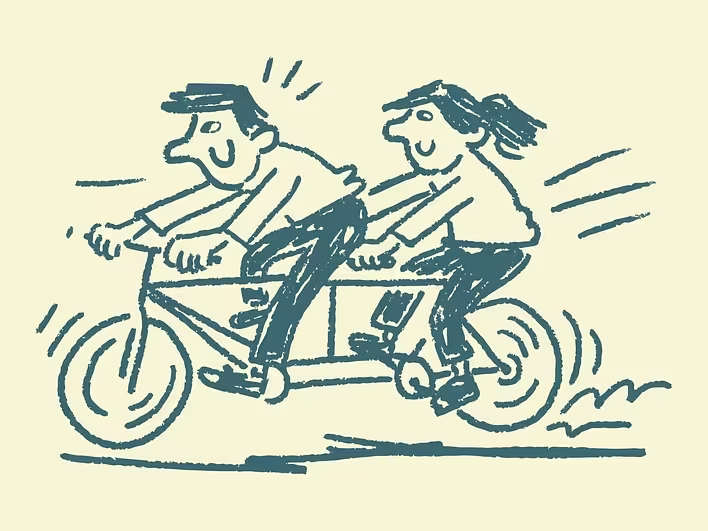
Tandem bicycle is a bicycle with two or more seats arranged one behind the other. The most common models are designed for two cyclists, although there are longer constructions.
The person sitting in front is usually called the captain or pilot. They steer the bicycle, shift gears, brake, and watch the road. The rear cyclist — the stoker — also pedals but does not steer the direction of movement. On most traditional tandems, the pedals of both participants are connected by a chain, so they rotate in a coordinated rhythm.
Riding such a bicycle requires mutual understanding. The captain must warn about starting, stopping, turning, or obstacles, while the stoker must avoid sudden movements and maintain a shared pace. If each acts on their own judgment, the ride will become uncomfortable or even dangerous.
The bicycle best conveys the figurative meaning of the word "tandem." Participants may have different roles, but their efforts are combined, and success depends on the coordination of actions.
What does "work in tandem" mean
Working in tandem means closely collaborating, coordinating actions, and moving together towards a specific result.
This expression is appropriate when the work of the participants is difficult to fully separate. Each has their own tasks, but they constantly exchange information, consider each other's decisions, and adjust their actions as needed.
For example, an author works in tandem with an editor on an article. The author formulates the idea and writes the text, while the editor checks the logic, facts, structure, and language. Their functions are different, but the final material is the result of joint work.
Similarly, a programmer can work in tandem with a designer. One is responsible for the technical part of the product, while the other is responsible for its appearance and usability. If they do not discuss decisions, a beautiful layout may turn out to be difficult to implement, and a technically sound product may be inconvenient for users.
Tandem does not necessarily mean an equal distribution of roles
Participants in a tandem do not always perform the same amount of work or have the same authority. Just like on a tandem bicycle, one may set the direction while the other maintains the pace and enhances the joint movement.
For example, in a creative tandem, one musician writes the melody, while the other writes the lyrics. During training, an experienced specialist may work alongside an intern: the former explains and checks, while the latter performs practical tasks. In film, the director determines the overall vision, while the cinematographer seeks ways to convey it through composition, light, and camera movement.
The key here is not an equal distribution of responsibilities, but interdependence. The contribution of one participant should complement the work of the other and bring both closer to a common goal.
How tandem differs from a regular team
A team can consist of many people whose work is divided into separate sections. Some participants may hardly interact directly. For example, a marketer, accountant, and system administrator can work in the same company and on the same project, although they perform different tasks.
In a tandem, the connection is usually closer. It often involves two participants or two sides that regularly coordinate their actions. Their roles may differ, but the work process remains shared.
Therefore, not every collaboration can be appropriately called a tandem. If people only perform separate tasks within one project and hardly influence each other's decisions, it would be more accurate to say they are working in a team. A tandem arises where there is constant interaction, coordination, and mutual complementarity.
Where the word "tandem" is used
The phrase "work in tandem" can be heard in a variety of contexts:
- "The marketer and designer are working in tandem on the advertising campaign."
- "The teacher works in tandem with the assistant."
- "The director and cinematographer created a strong creative tandem."
- "The new system works in tandem with the mobile application."
- "For recovery after an injury, the physical therapist works in tandem with the doctor."
A tandem can involve not only people. For example, two technologies work in tandem if one complements the capabilities of the other. In scientific and popular science texts, this is sometimes used to describe the interaction of organs, substances, or natural processes.
The word "tandem" also refers to the very pair that acts successfully together: creative tandem, political tandem, working tandem, acting tandem. In this case, the emphasis is not on the process of collaboration, but on the union of two participants.
When a tandem really works
A good tandem does not arise automatically just because two people have been assigned a common task. It requires clear roles, constant information exchange, and trust. Participants must know who is responsible for what, but at the same time see not only their own part of the work but also the overall goal.
Compatibility of working approaches is also important. If one person makes decisions quickly while another needs more time to check details, this does not necessarily become a problem. On the contrary, differences can balance the strengths and weaknesses of both. Difficulties arise when participants do not agree on the pace, hide important information, or try to steer the project in different directions.
Thus, working in tandem means acting not just alongside each other, but together and in agreement. Like on a shared bicycle: one can perform different roles and sit in different places, but reaching the goal will only be possible when everyone moves in the same direction.