This content has been automatically translated from Ukrainian.
The word coping can be found in two quite different contexts. In a psychological article, it will discuss the ways in which a person deals with stress. On social media, someone might write I'm coping after their favorite team loses or receive a short reply of cope. And nearby, the familiar meme copium will inevitably appear.
All these meanings are related, but not identical. To understand what coping is, it is worth starting with the ordinary English verb to cope.
What does coping mean
To cope means "to deal with," "to manage," "to overcome difficulties." Accordingly, coping is the process of overcoming a difficult situation or adapting to it.
For example, the English:
She is coping with stress.
can be translated as:
She is coping with stress.
And coping with loss will mean, depending on the context, "experiencing loss," "overcoming the consequences of loss," or "trying to cope with loss."
In psychology, the American Psychological Association defines coping as the use of cognitive and behavioral strategies to manage the demands of a situation that a person perceives as excessive or challenging, as well as to reduce negative emotions and stress.
Interestingly, the original meaning of the word cope was much more literal and even somewhat combative. It comes from the Old French couper, formerly colper, related to striking and conflict. In Middle English, cope could mean "to quarrel," "to fight," or "to engage in conflict," and by the 18th century, it developed a more modern meaning — to deal with something, to overcome difficulties.
Thus, a certain idea of "confrontation" in the word has been preserved: now a person fights not with a physical opponent, but with a problem, stress, or difficult circumstances.
What is coping in psychology
In psychology, coping refers to what a person does or changes in their behavior and thinking to manage a stressful situation and its consequences.
This is not a specific psychological technique.
Talking to a close person after a difficult day is coping. Making a plan to solve a problem is too. Distracting oneself with a series, going for a run, joking about the situation, trying to rethink it, or simply giving oneself time to experience strong emotions — all of these can serve the function of coping under certain circumstances.
Some of the early systematic studies of coping are associated with psychologist Lois Murphy, who in the 1950s and 1960s studied how children use their resources to overcome new and challenging situations. In 1962, her book The Widening World of Childhood: Paths Toward Mastery was published, where coping occupied an important place. Later, the research on stress and coping was significantly developed by Richard Lazarus and Susan Folkman.
It was Lazarus and Folkman who proposed one of the most well-known definitions of coping — as constantly changing cognitive and behavioral efforts aimed at overcoming internal or external demands that a person evaluates as exceeding their resources.
Today, the concept has become so entrenched in psychology that there is a whole group of terms: coping behavior, coping strategy, coping mechanism, coping resources.
What are coping strategies
Coping strategy is a specific way in which a person tries to cope with a difficult or emotionally tense situation. This can be a specific action, a sequence of actions, or a way of thinking that helps to endure stress or change one's reaction to it.
One person after a conflict will immediately try to solve the problem. Another will want to calm down first. A third will seek support from friends. Someone else will temporarily distance themselves from the situation.
In psychology, there are various classifications of coping, but one of the most well-known is the division into problem-focused and emotion-focused strategies.
The former are aimed at the problem itself: gathering information, making a plan, changing circumstances, seeking practical help.
The latter help to cope primarily with one's own reaction to what is happening: calming down, receiving emotional support, rethinking the situation, or accepting that it cannot be changed at the moment.
There is also avoidant coping (avoidance coping), or coping by avoidance, when a person tries to distance themselves from the problem, distract themselves, or not think about it.
This does not mean that any distraction is automatically "bad." Coping heavily depends on the circumstances. Temporarily switching off after an exhausting day can be beneficial; constantly avoiding a problem that needs to be solved is a completely different situation. In psychology, coping behavior can be adaptive or maladaptive depending on the situation and its consequences.
Is coping mechanism the same as «копінг-механізм»?
The English phrase coping mechanism is extremely common and does not always occur only in professional psychological literature.
In a broad sense, it is a way of adapting or a reaction that helps to reduce tension and anxiety in a stressful situation.
For example, physical exercise, humor, or communication with others can serve as a coping mechanism.
In Ukrainian, one can say копінг-механізм, but depending on the text, more natural phrases would be "a way to cope with stress," "a way to overcome difficulties," or "a mechanism for overcoming."
This clearly shows one feature of the term: the English coping easily fits into various constructions, while in Ukrainian, a literal borrowing is not always necessary.
How to say it right: coping, копінг, or опанування
In Ukrainian psychological texts, the form копінг has long been used as a term. You can find копінг-стратегії, копінг-поведінка, копінг-ресурси, копінг-механізми.
At the same time, there is no single Ukrainian equivalent that would equally well replace the borrowing in all contexts. Depending on the author and approach, you might encounter formulations like "поведінка подолання", "долаюча поведінка", "опанування", and other closely related options.
Therefore, the choice depends on the context.
In a psychological article, it is perfectly normal to write "копінг-стратегії". In a regular text, the sentence "music became a coping mechanism for him" can often be more simply expressed as "music helped him cope with stress."
And when it comes to English-language internet slang, the form coping is sometimes appropriate to leave in Latin script, as here the literal meaning is not only important, but also the meme context.
How coping turned into internet slang
This is where it gets interesting.
In English, the phrase I'm coping is perfectly normal: "I am managing," "I am trying to cope." But online, the words cope and coping have taken on an additional ironic meaning.
If a person, after an obvious defeat, concocts increasingly clever explanations for why they actually did not lose, they might simply be told:
Cope.
In this context, it is no longer a friendly "deal with the difficulties." On the contrary, it is mockery: about "keep comforting yourself," "keep making excuses," or simply "get over it."
As internet slang, this use of cope particularly spread in the late 2010s and early 2020s. The word began to be combined with seethe — literally "to boil with anger," from which the meme phrase cope and seethe originates. Later, longer absurd constructions like cope, seethe, mald appeared.
At the same time, coping can be used without mocking another person — as self-irony.
For example, a fan of a series knows that a continuation is unlikely to come out, but still finds "evidence" of a future announcement and writes:
Let me cope.
That is approximately: "let me live with this hope a little longer".
Here, the person understands that their arguments are not very convincing, and that is why the phrase works as a joke.
Is Coping and Copium the same thing?
Not quite.
Coping is a real English word and a psychological term. In its primary meaning, it is neutral and denotes overcoming difficulties.
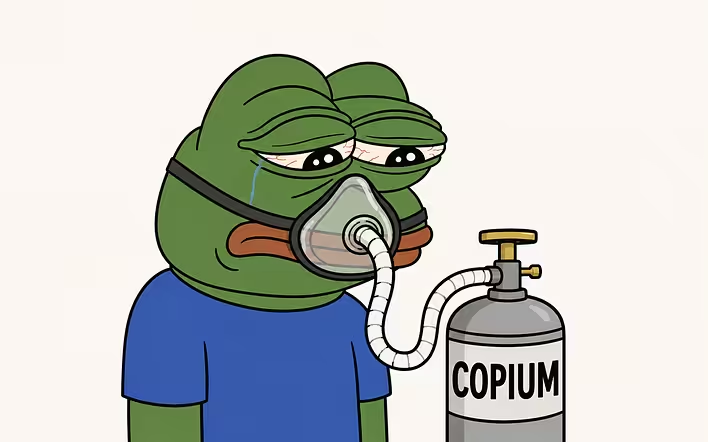
Copium is already a deliberately invented meme word, formed from cope + opium. It is an imaginary "substance" that supposedly helps a person cope with defeat or not acknowledge unpleasant reality.
Thus, a person can cope — that is, somehow manage the situation, while the internet joke turns especially desperate self-deception into "using copium." The meme use of cope and copium actively spread in the same internet communities in the late 2010s.
Because of this meme layer, in modern internet culture, the word coping is sometimes perceived more negatively than in psychology. However, this is an important distinction: coping as a psychological concept does not mean self-deception.
It encompasses a wide range of ways to adapt to difficult circumstances — from directly solving the problem to seeking support or regulating one's emotions. Self-deception or denial can only be individual reactions to stress, but do not define coping as a whole.
That is why one short English word today seems to live in two parallel worlds. In psychology, coping is a serious concept about how a person overcomes difficulties. In internet culture, it is also a convenient way to joke about how we sometimes really do not want to acknowledge that everything has gone completely off the rails.