

This content has been automatically translated from Ukrainian.
What is a narrative?
The word “narrative” has become one of the most commonly used terms in news, political discussions, social media, and even everyday conversations in recent years. It can be heard in the context of information warfare, journalism, literature, psychology, or marketing. However, not everyone understands what it actually means.
Narrative is not just a story or a tale. It is a way of presenting events so that they form a coherent picture and lead the listener or reader to a certain conclusion. In other words, a narrative not only answers the question “what happened?” but also offers explanations for “why did it happen?”, “who played the main role?”, and “how should these events be perceived?”.
Simply put, a narrative is a story with a specific idea or interpretation. It helps people understand complex phenomena, connect individual facts with each other, and form their own view of the situation.
For example, imagine a new park has opened in a city. One journalist might write that this is an example of successful urban infrastructure development. Another might emphasize that the construction was expensive and took longer than planned. The event is the same, but the story told around it is different. This difference is what constitutes different narratives.
For this reason, the word “narrative” is particularly often used in politics and media. When talking about a political or informational narrative, it refers not to a single fact, but to a comprehensive explanation of events that is regularly repeated and shapes a certain perception in the audience.
At the same time, narratives exist not only in the news. We constantly create them in our own lives. When telling friends about a trip, explaining the reasons for being fired, or reminiscing about childhood, we unconsciously choose which events are important, which details to omit, and what conclusions to draw. This is how a personal narrative is formed — a story through which a person makes sense of their own experience.
That is why the concept of “narrative” is used today in a variety of fields — from literary studies to psychology, from advertising to international politics. Everywhere it means roughly the same thing: a way of constructing a story that helps explain reality and give meaning to events.
The origin of the word “narrative”
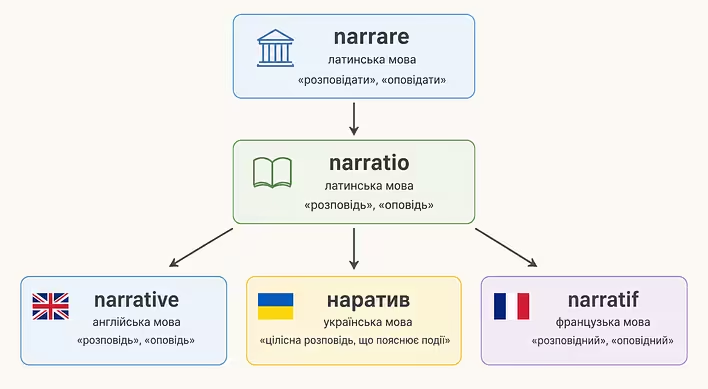
The word “narrative” has ancient roots. It comes from the Latin verb narrare, which means “to tell”, “to recount”, “to narrate a story”. From it, the noun narratio was formed — “narration” or “story”.
Later, this root transitioned into many European languages. In English, the word narrative appeared, in French — narratif, and from there the term gradually spread into scholarly literature and other languages, including Ukrainian.
Initially, the concept was used almost exclusively by literary scholars. For them, a narrative meant a way of constructing a literary tale: who the narrator is, in what order events are presented, how the author directs the reader's attention, and creates a plot.
By the end of the 20th century, the meaning of the term had significantly expanded. It began to be actively used by historians, sociologists, psychologists, political scientists, journalists, and communication specialists. Today, a narrative is understood not only as a literary account but also as any sequential story that helps explain events and shape a certain view of reality.
How has the meaning of the word “narrative” changed?
Today, the word “narrative” refers to a wide variety of stories — from the plot of a novel to the information campaign of an entire state. However, this has not always been the case. Over the decades, the meaning of this term has gradually expanded, covering increasingly new areas.
Narrative in literature
The concept of “narrative” remained a purely literary term for the longest time. It is still here that it retains its classical meaning.
In literary studies, a narrative is the way in which an author tells a story. It involves not only the plot but also who is telling the story, in what order events are presented, what information the reader receives, and how their attitude towards the characters is formed.
For example, the same story can look completely different depending on whether it is told by the main character, a third-party narrator, or several characters in turn. Not only the style of narration changes, but also the perception of all events.
That is why literary researchers often talk about the authorial narrative, unreliable narrator, non-linear narrative, or multiple narratives — all these concepts describe different ways of constructing a narrative.
Narrative in history
Gradually, this term began to be used by historians as well.
It might seem that history should be based solely on facts. However, even the same set of historical documents can be interpreted differently. Some researchers emphasize the role of individual personalities, others focus on economic reasons, and others on cultural or social processes.
Therefore, today historians often speak of historical narrative — the way in which society explains its own past.
For example, different countries may describe the same historical event differently. The facts may largely coincide, but the assessment of causes, consequences, and the roles of individual participants will vary. As a result, different historical narratives emerge.
That is why history is not just a list of dates and events, but a constant process of rethinking them.
Narrative in psychology
In the second half of the 20th century, the concept of “narrative” became important for psychology as well.
On this basis, a separate direction emerged — narrative psychology. Its main idea is that people perceive their lives as a coherent story.
Each person explains their past, present, and future through a certain narrative. We decide which events were decisive, what caused our successes or failures, and what conclusions should be drawn from the experiences we have lived through.
Interestingly, two people may experience almost identical life circumstances but form completely different personal narratives. One may perceive difficulties as valuable experiences, while the other sees them as a series of unfair defeats. This internal story significantly influences self-esteem, motivation, and attitudes towards the future.
For this reason, psychologists often work not only with individual memories of a person but also with how they interpret them and what story they create about themselves.
Narrative in marketing and branding
In the 21st century, the word “narrative” has increasingly begun to be used in business.
Modern brands sell not only products or services — they create stories with which customers can identify.
For example, a sportswear manufacturer may build its narrative around overcoming difficulties and strength of character, an organic cosmetics producer around caring for nature, and a family bakery around home comfort and traditions.
In all these cases, the customer remembers not only the product but also the story behind it. That is why today we often talk about brand narrative or corporate narrative.
What are political and informational narratives?
It is in politics and media that the word “narrative” is most frequently heard today. If it was previously used mainly by literary scholars, now this term can regularly be heard in news, analytical materials, statements by politicians, and international organizations.
The reason is simple: the modern information space consists not only of individual facts. Every day we receive a huge amount of messages, and almost always they are united by a certain logic or common idea. This is how a narrative is formed.
Political narrative
Political narrative is a coherent story or explanation of events through which politicians, states, parties, or public organizations attempt to form a certain view of the situation.
Its goal is not to invent new facts but to combine existing facts into a story that will be understandable and convincing for the audience.
For example, if the economy is growing in a country, one political force may explain this by the successful reforms of the government. Another may attribute it to the development of the global economy or the work of local businesses. The economic indicators may be the same, but the explanations for the causes will differ.
Thus, several political narratives are formed around one event.
Informational narrative
The concept of informational narrative is even broader.
It is a story or system of explanations that is repeatedly presented in media, social networks, blogs, or public speeches and gradually shapes a certain perception of reality.
The peculiarity of an informational narrative is that it consists not of a single message. On the contrary, it is constantly reinforced by new news, comments, examples, and publications that support the same main idea.
That is why informational narratives can exist for years and significantly influence public opinion.
Why do multiple narratives arise around one event?
People often wonder why different media report on the same event differently.
In fact, the reason is not always false information. Most often, the difference arises because journalists, experts, or politicians emphasize different details.
Imagine a new bridge has opened in a city.
One publication may write that the bridge has improved transportation and eased traffic congestion.
Another may focus on the cost overruns and delays in construction.
A third may discuss how the new bridge has impacted business development in the area.
All three articles may be true. However, each creates its own narrative as it explains the significance of the same event differently.
That is why critical thinking involves not only fact-checking but also understanding the overall story being constructed around these facts.
Narrative and propaganda — what is the difference?
Due to the frequent use of the word “narrative” in a political context, many people consider it synonymous with propaganda. In reality, this is not the case.
Narrative is a neutral concept. It describes a way of constructing a story or explaining events. Narratives exist in fiction, historical research, journalism, advertising, psychology, and even in everyday communication.
Propaganda is already a way of influencing the audience. It can use various tools: emotional appeals, repetition, selective presentation of facts, manipulations, or narratives.
In other words, a narrative is a tool for explanation, while propaganda is a tool for persuasion.
Therefore, any propaganda is almost always built around a certain narrative, but not every narrative is propaganda.
For example, when a writer tells the story of a hero, they also create a narrative. When a brand talks about its values — that is also a narrative. In these cases, the concept has no political coloring.
How does a narrative differ from a story, plot, and ideology?

Due to the popularity of the word “narrative”, it is often used as a synonym for the words “story”, “plot”, “ideology”, or even “opinion”. In fact, there are significant differences between these concepts.
Narrative and story
Most often, the word “narrative” is replaced with the word “story”. This is partially correct, but there is still a difference between them.
A story is a recounting of certain events. It can be simply a description of what happened.
A narrative, however, always has a broader meaning. It not only describes events but also connects them, shows causal relationships, and offers certain explanations.
For example, the phrase:
“The company opened a new office.”
— this is a story or fact.
Whereas the statement:
“The opening of the new office indicates the rapid growth of the company and its successful strategy.”
— is already a narrative, as it contains interpretation.
Narrative and plot
The plot is a concept primarily used in literature, theater, film, and other forms of art.
It describes the sequence of events in a work: the setup, the development of action, the climax, and the resolution.
A narrative is a much broader concept. It encompasses not only the events themselves but also the way they are presented, the narrator's point of view, the structure of the story, and the meanings received by the reader or viewer.
In other words, the plot answers the question “what is happening?”, while the narrative answers “how and why are we being told this?”
Narrative and ideology
Another common misconception is to equate narrative with ideology.
Ideology is a system of political, social, or philosophical beliefs.
A narrative, however, is a way of conveying these beliefs through stories, examples, and explanations.
For instance, two political parties may share similar values but use different narratives to explain them. Or conversely — have different ideologies but build their speeches on similar principles.
Therefore, ideology answers the question “what do we believe in?”, while narrative answers “how do we explain the world and persuade others?”
Synonyms for the word “narrative”
Finding a complete synonym for the word “narrative” is not easy, as its meaning changes depending on the context. That is why different words may be appropriate in various situations.
If it concerns fiction, the word “narrative” can often be replaced with account, story, or tale.
In journalism and politics, closer in meaning would be interpretation, event interpretation, way of presenting information, concept, or view of the situation.
In scholarly works, phrases like explanatory model, discourse, or frame of perception are sometimes used, although these concepts are not complete synonyms and have their own nuances of meaning.
Most often, the following words are used as synonyms or closely related terms:
- account;
- story;
- tale;
- plot (in a literary context);
- interpretation;
- explanation;
- concept;
- way of presenting information;
- view of events;
- explanatory model.
When choosing a counterpart, it is important to consider the context. For example, replacing the word “narrative” with “plot” in a political article would be incorrect, while in literary studies such a replacement is sometimes quite appropriate.
Frequently asked questions about narrative
What is a narrative in simple terms?
In simple terms, narrative is a story that not only describes events but also explains their meaning. It helps to understand why something happened, who was the main participant in the events, and what conclusions can be drawn from this.
For example, if several people recount the same situation, but each emphasizes different details, then each of them is actually creating their own narrative.
What is an informational narrative?
An informational narrative is a system of messages that together form a certain view of events.
It does not consist of a single news item or article. Usually, it is many materials, comments, publications, and statements that regularly repeat the same main idea. That is why informational narratives can significantly influence public opinion and the way events are perceived.
Can a narrative be false?
A narrative itself is neither true nor false — it is merely a way of constructing a story.
However, it can rely on both accurate facts and inaccurate, incomplete, or deliberately distorted information. That is why it is important to evaluate not only how the story is constructed but also to check the sources on which it is based.
Why is there so much talk about narratives today?
The popularity of this word is explained by the development of digital media and social networks.
Modern individuals receive a vast amount of information daily, and almost every message is presented in a certain context. Therefore, increasing attention is paid not only to the facts themselves but also to how they are interconnected and what perception of events they create.
Do all people create their own narratives?
Yes. When a person recalls their childhood, explains the reasons for an important decision, or recounts their life journey, they are actually creating a personal narrative.
It is through such stories that we make sense of our own experiences, identify significant events, and form our understanding of ourselves and the surrounding world.