

This content has been automatically translated from Ukrainian.
You've probably seen a message before a movie that says "All characters are fictional," under a YouTube video — a note that the expressed opinion is the author's personal position, and on websites — a warning about the informational nature of the materials. All these messages share a common name — disclaimer.
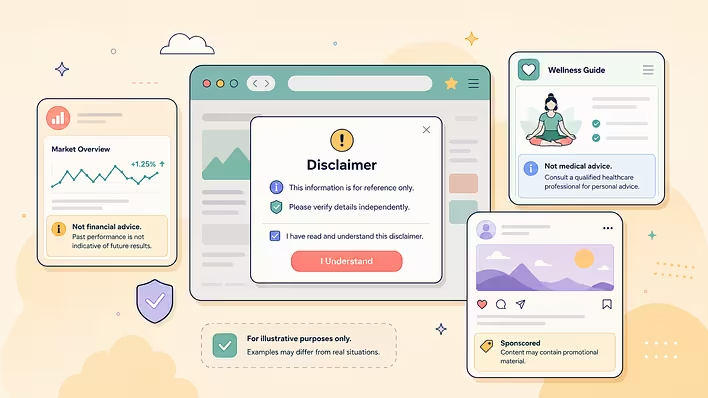
Today, disclaimers can be found almost everywhere: on websites, in mobile applications, social networks, books, advertisements, television programs, and even in responses from artificial intelligence. They help explain the context, warn about possible limitations, or provide important information before a person starts using a product or familiarizes themselves with the material.
What is a disclaimer?
A disclaimer is a special message that explains the terms of use of information, warns about certain limitations, or clarifies the responsibility of the author, company, or service.
In simple terms, a disclaimer is a clarification or warning that helps to correctly perceive information.
For example, if an article discusses financial investments, the author may note that the material is for informational purposes only and is not an investment recommendation.
If a blogger demonstrates a dangerous experiment, they may warn viewers not to replicate what they see without proper preparation.
And a manufacturer of dietary supplements often states that its products are not medicinal products.
In all these cases, a disclaimer does not change the main content of the material but helps the reader or viewer better understand its context.
What does a disclaimer mean in simple terms?
The simplest explanation is as follows:
A disclaimer is a warning or explanation added to information to avoid misinterpretation.
Its main goal is not to hide information but rather to make it clearer.
For example, if a medical article is published on a website, the disclaimer may state that the text does not replace a doctor's consultation.
If a company uses images created with computer graphics, it may note that the images are illustrative.
If an author expresses their own opinion, the disclaimer may clarify that it is not the official position of the organization they work for.
Thus, a disclaimer helps avoid false expectations and incorrect conclusions.
The origin of the word "disclaimer"
The word "disclaimer" comes from the English disclaimer.
It is derived from the verb to disclaim, which means "to renounce claims," "to not take responsibility," "to officially deny involvement," or "to make a reservation."
Initially, this term was primarily used in the legal field. It denoted an official renunciation of certain rights, claims, or responsibilities.
Over time, the meaning of the word has become much broader. Today, disclaimer is used not only by lawyers but also by journalists, publishers, bloggers, marketers, software developers, product manufacturers, and website owners.
In the Ukrainian language, the word "disclaimer" has been borrowed from English and has primarily established itself in the fields of media, the internet, advertising, and digital technologies.
Why is a disclaimer needed?
Many people mistakenly believe that a disclaimer exists solely for the author or company to avoid responsibility. In reality, its purpose is much broader.
First and foremost, a disclaimer helps correctly explain the context. It informs the reader or user how to perceive the information, for what purpose it was created, and what limitations it has.
In addition, a disclaimer can:
- warn about potential risks;
- explain the features of using a product or service;
- inform about the promotional nature of the material;
- clarify that the provided information is not professional advice;
- distinguish the author's personal opinion from the official position of the organization.
That is why today disclaimers have become a common element of the digital environment. They make communication more transparent, help avoid misunderstandings, and provide users with additional information before they start interacting with the material.
Where are disclaimers used?
Today, disclaimers can be found in almost any field where it is important to correctly explain information or warn the user about certain features of the material. They have long ceased to be purely a legal tool and have become a familiar part of modern communication.
Disclaimers on websites
Disclaimers are most often used on websites.
They may inform that the material is for informational purposes only, contains the author's opinion, or is not professional advice. Such messages are often seen on medical, legal, financial, educational, and informational resources.
For example, a health website may state that articles do not replace a doctor's consultation, while a financial blog may note that publications are not investment recommendations.
Disclaimers on YouTube and social networks
Bloggers, journalists, and content creators also regularly use disclaimers.
They may warn that a video contains the author's subjective opinion, demonstrates dangerous actions, is intended for entertainment purposes only, or contains advertising integration.
Such messages help viewers better understand the context and reduce the risk of misinterpretation of what they see.
Disclaimers in movies and television
A disclaimer is often seen even before the start of the movie itself.
For example, the authors may inform that all characters and events are fictional or that any resemblance to real people is coincidental.
Sometimes, before the screening, they also warn about scenes of violence, bright light effects, loud sounds, or other content that may be inappropriate for certain categories of viewers.
Disclaimers in books
In fiction literature, disclaimers also occur quite often.
Publishers may note that characters are fictional and that the plot is not related to real events. In popular science publications, it is sometimes explained that the examples provided are for illustrative purposes only or reflect the author's position.
Disclaimers in advertising
In advertising materials, disclaimers help convey important conditions that cannot be explained in detail in the main text.
That is why in advertising, messages about limited-time offers, additional conditions for receiving discounts, warranty features, or other important clarifications are often seen.
Such disclaimers help make advertising clearer and avoid misinterpretation of the terms of the offer.
Disclaimers in materials created by artificial intelligence
With the development of generative artificial intelligence, another common type of disclaimer has emerged.
Today, many companies inform users that text, images, videos, or software code were fully or partially created using artificial intelligence systems.
Such messages increase transparency, help correctly assess the origin of the material, and remind that information should be verified, especially if it concerns medicine, law, finance, or other important topics.
Does a disclaimer have legal force?
This is one of the most common questions related to this term.
The short answer is not always.
A disclaimer by itself does not exempt a person or company from responsibility simply because it is written on a website or in a document. Its legal significance depends on the legislation of the specific country, the content of the message itself, and the circumstances in which it is used.
For example, if a company breaks the law or misleads consumers, a simple statement "we are not responsible" does not negate its legal obligations.
At the same time, a disclaimer can have important practical significance. It helps inform the user about the features of the product, limitations of the service, or the nature of the information, and confirms that certain conditions have been communicated to them.
That is why a disclaimer should primarily be viewed as a tool for transparent communication. In many cases, it does indeed have legal significance, but its effect depends on the specific situation and cannot automatically replace legal requirements.
How does a disclaimer differ from a warning, disclaimer of liability, and terms of use?
Although these concepts are often used interchangeably, they serve different purposes. A disclaimer may contain elements of a warning or disclaimer of liability, but it is not a complete equivalent of either.
Disclaimer and warning
A warning informs a person about potential danger or risk.
For example:
- "Caution! Hot surface."
- "Contains scenes that may be inappropriate for children."
The main goal of a warning is to draw attention to potential danger or usage features.
A disclaimer has a broader purpose. It may contain a warning but also explain the context, limitations, or features of the material.
For example:
"The material is for informational purposes only and is not a medical consultation."
Here, there is no direct warning about danger, but there is an important clarification about how to perceive the information.
Disclaimer and disclaimer of liability
Another common misconception is to consider a disclaimer as a simple disclaimer of liability.
In fact, a disclaimer of liability is just one possible type of disclaimer.
For example:
"The author is not responsible for any consequences of using the provided information."
This message is indeed a disclaimer of liability.
But a disclaimer may not contain such formulations at all. It may only explain the origin of the material, inform about the promotional nature of the publication, or clarify that the expressed opinion is the author's personal position.
Thus, not every disclaimer is a disclaimer of liability, but a disclaimer of liability is often formatted as a disclaimer.
Disclaimer and terms of use
Terms of use are a separate document or section of a website that defines the rules of interaction between the user and the service owner.
They may describe:
- the rights and obligations of the parties;
- the procedure for using the service;
- the rules for processing personal data;
- the payment terms;
- the dispute resolution procedure.
A disclaimer does not establish such rules.
Its task is to briefly convey important information or explain the context, while the terms of use regulate the legal relations between the parties.
Examples of disclaimers
In practice, disclaimers can take various forms. Here are a few typical examples.
For an informational article
The material is for informational purposes only and is not professional advice.
For a medical website
The information is provided solely for informational purposes and does not replace a doctor's consultation.
For a financial blog
The material is not an investment recommendation. It is recommended to consult with a relevant specialist before making financial decisions.
For videos or social networks
The expressed opinions are the author's personal position.
For advertising material
The material contains promotional information.
For content created using artificial intelligence
Part of the material was created using artificial intelligence technologies. It is important to verify the relevance and accuracy of the information before use.
Table: What is the difference between similar concepts?
Synonyms for the word "disclaimer"
There is no complete synonym for the word "disclaimer" in the Ukrainian language. Its meaning depends on the context, so in different situations, various words or phrases may be appropriate.
The most commonly used words with similar meanings include:
- warning;
- explanation;
- note;
- message;
- warning;
- disclaimer of liability (only in certain cases);
- clarification;
- informational message.
At the same time, these words are not complete synonyms. For example, warning informs about danger, while disclaimer may only explain the context or features of using the information.
That is why in legal, media, and digital texts, the word "disclaimer" is most often used, as it most accurately conveys the meaning of this concept.
Frequently asked questions
Is it mandatory to include a disclaimer?
Not always. The law does not require adding a disclaimer to every material or website.
However, in many cases, its use is considered good practice. It helps avoid misunderstandings, explains the purpose of the information, and makes communication with users more transparent.
Does a disclaimer have legal force?
A disclaimer by itself does not negate legal requirements and does not automatically exempt from liability.
Its legal significance depends on the content of the message, the specific situation, and the legal norms applicable in each case. Therefore, a disclaimer should be viewed as an important element of informing users, rather than as a universal way to avoid responsibility.
Where are disclaimers most commonly used?
Today, disclaimers can be seen practically everywhere:
- on websites;
- on YouTube and social networks;
- in advertising;
- in books;
- in movies;
- in mobile applications;
- in materials created using artificial intelligence.
Their main task is to help a person correctly understand the context of the information.
How to write a disclaimer correctly?
A good disclaimer should be short, clear, and unambiguous.
It should not use complex legal formulations unless necessary. The user should immediately understand what the author wants to convey: to explain the nature of the information, warn about risks, or clarify certain limitations.
Can ready-made disclaimer templates be used?
Yes, but only as a basis.
Each website, product, or informational material has its own features, so there is no universal text that fits all cases. It is best to adapt the disclaimer to the specific situation and field of activity.