

This content has been automatically translated from Ukrainian.
What is a discounter
A discounter is a store format that operates on the principle of minimal costs and maximum affordable prices. Unlike a regular supermarket, it does not try to impress the customer with expensive decor, a huge selection, or additional services. Instead, the main focus is on selling everyday goods as cheaply as possible.
The low price in a discounter is not a result of poorer product quality. It is achieved through a different business model: the store reduces its own costs on store layout, advertising, staff, logistics, and assortment. As a result, the customer pays primarily for the product itself, rather than for the additional expenses of the chain.
Discount stores most often sell food products, household chemicals, home goods, hygiene products, and other everyday necessities. The assortment is usually smaller than in large supermarkets, but most necessary purchases can be made in one place.
Origin of the word "discounter"
The word discounter comes from the English word discount, which means "discount" or "price reduction." In English, stores of this type are called discount store or discount supermarket — literally "store with reduced prices."
The format began to actively develop in Europe after World War II, when customers sought ways to buy necessary goods as economically as possible. Among the most well-known companies that made the discounter model popular were the German chains Aldi and Lidl. Their approach proved so successful that it was later adopted by retail chains in many countries around the world.
Today, the word "discounter" is used not only for grocery stores. It can refer to any retail chains that build their operations around one main idea — to offer the customer the lowest possible price by optimizing their own costs, rather than by reducing the quality of the products.
How a discounter works
At first glance, it may seem that a discounter simply sells goods cheaper than others. In reality, lower prices are the result of a well-thought-out business model. Such stores try to cut all costs that do not directly affect product quality, and this allows them to keep prices at a competitive level.
Smaller assortment
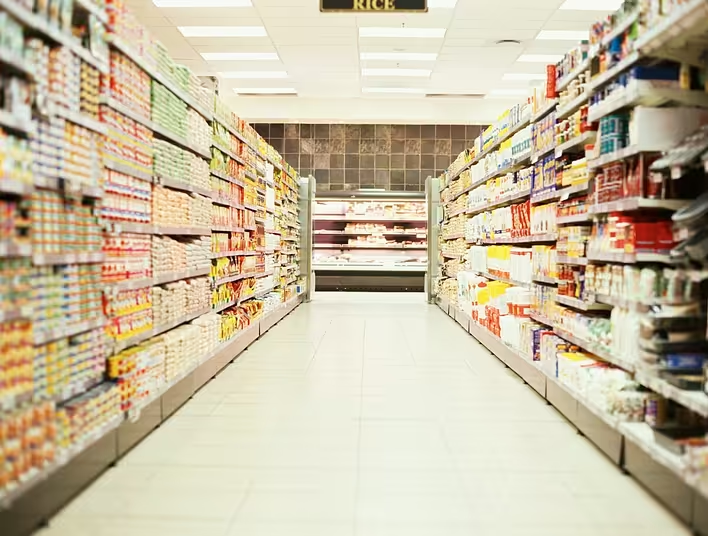
In a regular supermarket, you can find dozens of varieties of the same product: several dozen types of pasta, hundreds of beverages, or dozens of milk brands. Discounters operate differently. They keep only the most in-demand items that have stable demand.
A smaller selection means simpler purchasing, faster restocking of shelves, and lower storage costs.
Large purchase volumes
Discounters buy products in large batches. This is beneficial for manufacturers, so they are often willing to offer a lower purchase price. Part of this savings is passed on to customers.
Additionally, large chains have strong negotiating positions and can obtain more favorable cooperation terms from suppliers.
Own brands
One of the main features of discounters is a wide range of own brands (Private Label). These are products manufactured by third-party companies but sold under the brand of the retail chain itself.
Since own brands require almost no expensive advertising campaigns and have simpler packaging, their cost is often lower than that of products from well-known brands. At the same time, the quality often remains at the same level, as the manufacturers may be the same companies that produce goods for popular brands.
Simple store layout
Discounters usually do not spend significant amounts on interior design or expensive equipment. In many stores, some products can be seen directly on transport pallets or in factory boxes. This is not a coincidence, but a way to reduce costs on product display and speed up staff work.
Also, such stores rarely have large decorative areas, complex lighting, or other elements that do not affect the purchasing process itself.
Lower operating costs
Another important principle is the maximally efficient use of resources. Discounters often have more compact retail spaces, optimized logistics, and a small number of staff. This reduces daily expenses for maintaining the store.
All of this allows them to operate with a lower markup than many traditional supermarkets.
Why is it cheaper at a discounter, but not necessarily worse?
It is a common misconception that a low price means low quality. In the case of discounters, this is not always true.
The main savings are achieved not through cheaper ingredients or lower quality products, but through a special organization of the business. The store spends less on advertising, store layout, a wide assortment, and additional services, allowing it to sell goods at lower prices.
Of course, the quality of a specific product depends on the manufacturer, not on the store format. Just like in any supermarket, among the products there can be both very successful options and less quality ones. That is why it is worth evaluating not the name of the store, but the specific product, its composition, manufacturer, and customer reviews.
Hard discount and soft discount: what is the difference?
Not all discounters operate the same way. In retail, two main models are usually distinguished: hard discount and soft discount. Both have the common goal of maintaining low prices, but they achieve this in different ways.
Hard discount
Hard discount is the most economical store format. Its main task is to offer the customer the lowest possible price.
Such stores are characterized by:
- very compact assortment;
- large share of own brands;
- simple store layout;
- minimum staff;
- absence of unnecessary services.
This is how many European chains operate, including Aldi, Lidl, and Netto. Customers will not find hundreds of options for one product here — usually only a few tried-and-true items are offered.
Soft discount
Soft discount combines the principles of a discounter with those of a regular supermarket. Prices remain low, but the selection of goods is wider, and the store itself is more comfortable for customers.
In soft discount, you can usually see:
- more well-known brands;
- wider assortment;
- more promotions;
- more modern store design;
- additional categories of goods.
This format is especially common in countries where customers expect not only low prices but also a large selection of products.
How does a discounter differ from other stores?
Although discounters, supermarkets, and hypermarkets sell approximately the same categories of goods, their concepts differ significantly.
If you need to quickly buy a usual set of products at a good price, a discounter is often the best choice. However, if you need a wide assortment, delicacies, specialized products, or a large selection of brands, it is more convenient to visit a supermarket or hypermarket.
Are there discounters in Ukraine?
Yes, although the Ukrainian market differs somewhat from the Western European one. There are few classic hard discount chains that closely follow the Aldi or Lidl model in Ukraine. Instead, several large grocery chains use some principles of discounters.
For example, ATB is often referred to as a chain that operates on a model similar to that of a discounter. The company actively develops its own brands, optimizes costs, supports fast turnover, and focuses on affordable prices.
At the same time, most Ukrainian chains are not "pure" discounters. They combine elements of various formats: a wide assortment, regular promotional offers, own brands, and a level of service familiar to customers.
That is why in Ukraine, the term "discounter" is often used more broadly than in the professional classification of retail. People often refer to any store associated with consistently low prices as a discounter, even if it formally belongs to another format.
Advantages and disadvantages of discounters
Discounters have become popular for a reason. For many people, they are the most convenient place for regular shopping, but this format has both strengths and certain limitations.
Advantages
Lower prices. This is the main advantage of discounters. Due to cost optimization, they can often offer the same or similar products cheaper than stores of other formats.
Optimal assortment. Instead of hundreds of nearly identical products, the customer sees only the most popular options. This simplifies the choice and allows for quicker shopping.
Good price-to-quality ratio. The own brands of many chains are often produced in the same factories as products from well-known brands. At the same time, their price can be significantly lower.
Quick purchasing process. Compact stores and clear product placement allow for acquiring everything needed in a short time.
Disadvantages
Smaller selection of brands. If a customer is used to a certain brand, it may not be available in the assortment.
Limited selection of specialized products. Organic products, rare ingredients, imported delicacies, or niche products are more commonly found in larger supermarkets.
Fewer additional services. Discounters usually have fewer consultants, ready-made meals, large self-service areas, or other services that can be found in higher-priced stores.
At the same time, these features are not always disadvantages. If the main goal is to quickly buy everyday goods at an affordable price, a discounter often turns out to be the most practical choice.
Frequently asked questions
Is a discounter the same as a supermarket?
No. A discounter is a separate store format that primarily focuses on low prices and cost optimization. A supermarket usually offers a wider assortment, more brands, and additional services.
Why are products cheaper at a discounter?
The lower price is not necessarily explained by lower quality. The store saves on layout, logistics, advertising, staff numbers, and assortment width, allowing it to operate with a smaller markup.
Can own brands be trusted?
Yes. Own brands are not produced by the stores themselves, but by companies that specialize in producing the respective products. In many cases, they also manufacture goods for well-known brands. At the same time, like any other products, they should be evaluated based on their composition, manufacturer, and personal usage experience.
What are the most famous discounters in the world?
Among the most well-known chains are Aldi, Lidl, Netto, Penny, and Biedronka. In different countries, they may operate under somewhat different models, but they all share the goal of maintaining maximally affordable prices.
Are there true discounters in Ukraine?
In Ukraine, there are chains that use the principles of discounters, although most of them combine elements of several retail formats. Therefore, the term "discounter" in everyday speech is often used more broadly than in professional classification.