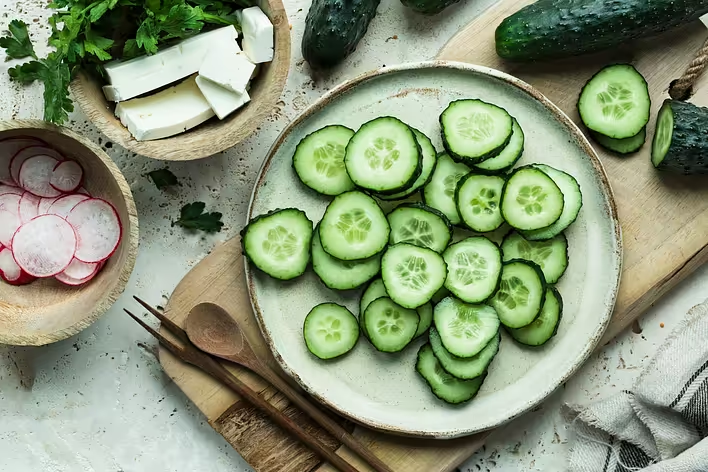

Cucumbers are one of the most beloved crops in any garden, as their crunchy fruits are perfect for salads, canning, or simply fresh consumption.
The company Dachnik offers a wide selection of cucumber seeds on the site https://dachnik.com.ua/ua/nasinnia/ovochi/ohirok/, so that every gardener can grow the harvest of their dreams. How to choose seeds that will guarantee healthy plants and a generous harvest? In this article, we will discuss the key aspects of selection, share tips on planting and care, and reveal the secrets of growing delicious cucumbers.
Why the quality of cucumber seeds matters
The quality of the seed material is the foundation of a successful harvest. Reliable seeds ensure high germination rates, disease resistance, and stable fruiting. Compare: seeds from trusted producers, such as Sunny March or Bejo Zaden, undergo rigorous selection, while those bought at spontaneous markets may be old or of poor quality, reducing the chances of success. By purchasing cucumber seeds in Ukraine, you are investing in your future harvest, so it is important to choose products from reliable suppliers.
Cucumbers are sensitive to temperature, humidity, and soil type. For example, in regions with short summers, it is better to choose early-ripening hybrids, such as Arctic Cucumber F1, while drought-resistant varieties, such as Field Cucumber Drought Resistant, are suitable for warmer areas.
Types of cucumber seeds
Cucumbers are divided into several types depending on their purpose and growing conditions. Salad varieties, like Cucumber Zozulya F1, have a tender skin and sweet taste, perfect for fresh dishes. Pickling varieties, such as Cucumber Ekol F1, are distinguished by their dense flesh, which retains crunchiness after canning. Universal varieties, like Cucumber Kurazh F1, are suitable for any purpose but may lag behind specialized ones in taste qualities.
Another important characteristic is the method of pollination. Parthenocarpic (self-pollinating) hybrids, such as Cucumber Kibria F1, are ideal for greenhouses where insect access is limited. Bee-pollinated varieties, like Cucumber Hektor F1, grow better in open ground where bees can work. The choice depends on your conditions and goals.
How to choose cucumber seeds correctly
To buy cucumber seeds in Ukraine, consider several key factors. Here are the main recommendations:
- Maturity period. Early-ripening varieties, like Cucumber Parker F1 (42 days), are suitable for short summers. Mid-ripening (Cucumber Arctic F1, 45–50 days) and late-ripening (Cucumber Chinese Miracle, 60–65 days) are better for warm regions.
- Growing conditions. Choose seeds for greenhouses (Cucumber Sonata F1), open ground (Cucumber Nadezhda F1), or balconies (Cucumber Puccini F1).
- Resistance. Hybrids, like Cucumber Chongsheng Disease Resistant, are protected from powdery mildew and other diseases.
- Purpose. For salads, choose varieties with tender skin, like Cucumber Zozulya F1; for pickling, choose dense ones, like Cucumber Ekol F1.
- Fruit size. From small gherkins (Cucumber Artist F1, 6–12 cm) to long fruits (Cucumber Chinese Miracle, 35–45 cm) — the choice depends on your preferences.
These criteria will help you select cucumber seeds that are perfect for your garden.
Preparing seeds for planting
Quality seeds require proper preparation. Check the expiration date: old seeds lose their germination. For testing, soak a few seeds in a damp cloth for 3–5 days — quality seeds will germinate quickly. Coated seeds, like Cucumber Amur F1, are already treated and do not require soaking. Uncoated seeds, such as Cucumber Vorghebirshtraube, should be soaked in a 1% solution of potassium permanganate for 15–20 minutes for protection against fungi.
The temperature for germination should be 22–26 °C, and humidity should be moderate to avoid rot. To accelerate growth, you can use stimulants, but strictly follow the instructions.
Planting cucumbers: the key to success
Cucumbers love warmth, moisture, and loose soil with a pH of 6–7. Compare: in a greenhouse, they are protected from cold but require ventilation to avoid fungal diseases. In open ground, they are more dependent on the weather but provide a richer taste. Seedlings are sown 20–30 days before planting in the ground, usually in April. After the first leaves appear, seedlings are thinned to strengthen the roots.
During planting, maintain distance: 20–30 cm for bush varieties, like Cucumber Little Hero F1, and 40–50 cm for climbing ones, like Cucumber Capricorn F1.
Caring for cucumbers: secrets of crunchy fruits
Caring for cucumbers includes watering, fertilizing, and shaping the bush. Water with warm water at the root every 2–3 days in heat and once every 5–7 days in cool weather. Compare: a lack of moisture makes fruits bitter, while excess causes root rot. Fertilize every 10–12 days: nitrogen fertilizers for green growth, potassium-phosphorus for fruiting.
For climbing varieties, like Cucumber Kibria F1, pinch off lateral shoots to direct energy to the fruits. Regularly loosen the soil to ensure the roots receive enough oxygen.
Protecting cucumbers from diseases and pests
Cucumbers are vulnerable to powdery mildew, root rot, and pests such as aphids or spider mites. Choose resistant hybrids, like Cucumber Bjorn F1. Regularly inspect the plants: at the first signs of disease, use biofungicides or folk remedies, like garlic infusion. Compare: chemical preparations act faster, but biological ones are safer for the fruits. Follow crop rotation, avoiding planting cucumbers after pumpkin crops.
Storing cucumber seeds
Proper storage preserves seed viability for up to 7–8 years. Store them in a dry, cool place (10–15 °C) in airtight containers. Compare: high humidity causes mold, while heat reduces viability. Home-collected seeds, such as from Cucumber Zozulya F1, should be washed, dried, and stored in paper bags labeled with the variety and year.
Why choose cucumber seeds from Dachnik
Quality seeds are the key to a crunchy harvest. Compare: cheap seeds can save money but lead to wasted time due to poor germination. Dachnik offers tested varieties and hybrids from leading producers, such as Sunny March, Rijk Zwaan, and NongWoo Bio, with a quality guarantee and detailed instructions.
The assortment includes seeds for any conditions: from greenhouse hybrids, like Cucumber Sonata F1, to varieties for open ground, like Cucumber Nadezhda F1. This is especially convenient for beginners who receive support in the form of consultations.
Tips for successful cucumber cultivation
Choosing cucumber seeds is a combination of practicality and your preferences. Consider the climate, soil type, and purpose of the fruits. Experiment with varieties, like Cucumber Chinese Miracle for exotic salads or Cucumber Ekol F1 for pickling, to find the perfect options. With quality seeds from Dachnik, you will get crunchy and tasty cucumbers that will become the pride of your garden!