
This content has been automatically translated from Ukrainian.
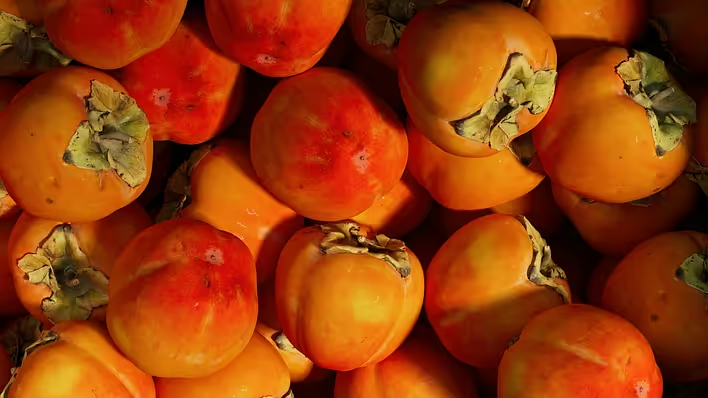
The persimmon may look perfectly ripe: bright orange, sweet, and juicy. But after the first bite, a sudden dryness appears in the mouth, the tongue feels rough, and the cheeks tighten from the inside. This is how the astringency caused by tannins manifests.
The amount of tannins in the fruit depends not only on ripeness but also on the variety, growing conditions, and pollination. Therefore, one persimmon can remain pleasant even when firm, while another can only be eaten when its flesh becomes almost jelly-like.
Why does persimmon dry out the mouth?
The characteristic sensation is caused by soluble tannins — natural polyphenolic compounds found in the flesh of the persimmon. During chewing, they enter the saliva and bind with its proteins.
Saliva moistens the mucous membrane and reduces friction in the oral cavity. When tannins interact with proteins, some of these proteins form insoluble complexes and can no longer perform their usual function. This leads to a sensation of dryness, roughness, and tightening in the mouth. We refer to this as an astringent taste, although in reality, astringency is primarily a tactile sensation rather than a distinct taste.
Tannins work similarly in strong tea, red wine, unripe fruits, and some other fruits.
Why is one persimmon astringent and another is not?
Persimmon varieties are divided into astringent and non-astringent. In non-astringent varieties, the amount of soluble tannins decreases even while the fruit is ripening on the tree. Such persimmons can be eaten when they are firm and crunchy. The most famous example is the "Fuyu" variety.
Astringent varieties, such as "Hachiya," can remain practically inedible even after turning orange. Usually, they need to ripen to a very soft state or undergo special treatment that removes astringency.
In fact, the classification of persimmons is somewhat more complex. In some varieties, the properties of the flesh depend on pollination and seed formation. Brown spots may appear next to the seeds, where tannins have already transitioned to an insoluble form. This is why one fruit can be sweet while another is astringent, even though they look almost identical.
The names "Korolek" and "Sharon" should not be taken as precise designations of two botanical varieties. "Korolek" may refer to various persimmons with brown flesh sold in stores, while "Sharon" is a trade name for fruits prepared for consumption without pronounced astringency.
Does astringency mean that the persimmon is unripe?
Often, but not always. As the fruit ripens, the amount of soluble tannins in many fruits decreases, so astringency weakens. However, some varieties remain astringent even when the skin has already turned bright orange.
In this case, color is not a reliable indicator. Astringent persimmons often need to ripen to a state where their flesh becomes very soft, almost transparent, and resembles jelly. For the appropriate varieties, this is normal and does not mean that the fruit has spoiled.
At the same time, a firm persimmon is not necessarily astringent. It may be a non-astringent variety or a fruit from which astringency has been removed after harvesting. During industrial processing, persimmons can lose astringency while retaining firm flesh.
How to remove astringency from persimmons at home
The easiest way is to let the persimmons ripen at room temperature. It’s best to lay the fruits out in a single layer and check them daily. Astringent varieties can become very soft before they can be eaten.
To speed up ripening, persimmons can be placed in a paper bag with a ripe apple or banana. These fruits emit ethylene — a gaseous plant hormone that accelerates ripening. The edge of the bag can be folded, but it should not be tightly sealed.
The fruits should be checked daily, as they spoil quickly after softening. One should not expect that an apple or banana will remove astringency overnight. Ethylene primarily speeds up ripening, and the result depends on the variety and initial state of the persimmon.
Does freezing help?
Freezing followed by thawing can significantly reduce astringency. Under low temperatures and during thawing, the structure of the fruit's tissues changes, and the proportion of soluble tannins decreases. The effectiveness of this method depends on the variety, temperature, and duration of storage.
Persimmons are placed in the freezer whole, and after they are fully frozen, they are transferred to the refrigerator and allowed to thaw gradually. The fruit can also be thawed at room temperature, but it is best to eat it immediately.
The main drawback of this method is the change in texture. After thawing, persimmons become very soft and sometimes watery. They are convenient to eat with a spoon, mash into puree, or add to porridge and desserts, but they will no longer be crunchy.
Freezing usually reduces astringency, but it does not guarantee the same result for all varieties. If the persimmon still dries out the mouth after thawing, it is better to let it ripen further.
How does treatment with carbon dioxide or alcohol work?
In industrial conditions, astringency in persimmons is often removed using carbon dioxide or ethanol vapors. They create conditions in the fruit's tissues where acetaldehyde accumulates. It interacts with tannins and promotes their transition from a soluble to an insoluble form. After this, tannins remain in the flesh but are no longer bound to saliva proteins, so the persimmon stops drying out the mouth.
Importantly, during such treatment, the fruit does not necessarily soften. This is why you can see firm persimmons in stores that would be very astringent without proper preparation.
Home advice sometimes recommends placing fruits in a closed container with a small amount of strong alcohol. There is a scientific basis for this method, but at home, it is difficult to determine the right amount of alcohol, temperature, and duration of treatment. Excess humidity and prolonged storage in a closed container can lead to mold or off-odors. Therefore, it is simpler and more predictable to wait for the persimmons to ripen or freeze them.
Does astringency disappear after cooking?
Regular heating does not guarantee that astringent persimmons will taste pleasant. Tannins do not automatically disappear during baking or boiling, so for pies, jams, and sauces, it is better to use already ripe or pre-treated fruits.
Adding sugar also does not remove tannins. Sweetness can partially balance the taste, but the sensation of dryness will remain.
In contrast, prolonged drying can indeed reduce astringency. During this process, the composition of the flesh changes, some tannins transition to an insoluble form, and natural sugars become more concentrated. However, drying whole fruits at home should be done using a tested technology to prevent spoilage.
How to choose a persimmon that won't dry out the mouth
If you want to eat persimmons while they are firm, look for non-astringent varieties and clarify their names rather than relying solely on color. The fruit should be free of cracks, mold, wet spots, and skin damage.
Astringent persimmons can be purchased with the expectation of further ripening. Very soft flesh in the appropriate variety is not a defect but a sign of readiness. At the same time, a sour or sharply alcoholic smell, leaking liquid, mold, and large watery spots indicate spoilage.
Astringency itself does not mean that the persimmon is of poor quality. Most often, it is a characteristic of the variety or a sign that soluble tannins have not yet transitioned to an insoluble form. Such a fruit needs more time, and if you don't want to wait — freeze it and eat it with a spoon after thawing or use it for dessert.