Ayni: the people of the north who preserved the memory of the land, spirits, and their own voice
Ainu - an indigenous people of Northeast Asia, most closely associated with Hokkaido, the northernmost major island of Japan. However, their historical homeland is much broader: it also included Sakhalin, the Kuril Islands, part of northern Honshu, and at c...
Ainu - an indigenous people of Northeast Asia, most closely associated with Hokkaido, the northernmost major island of Japan. However, their historical homeland is much broader: it also included Sakhalin, the Kuril Islands, part of northern Honshu, and at certain periods - territories around the Sea of Okhotsk and Kamchatka. The Ainu themselves referred to their land as Ainu Mosir - the world or land of people.
The word "ainu" in the Ainu language means "human." This is important because, in their worldview, a person was not the master of nature in the modern sense. They lived among rivers, forests, animals, wind, fire, and sea, which had their own power and will. That is why the history of the Ainu is not just a story about an ancient people of Japan, but also a story about a different way of seeing the world: through reciprocity, gratitude, and respect for all living things.
Where the Ainu lived and live
The most famous center of Ainu culture is Hokkaido. Until the 19th century, this island was often referred to by the Japanese as Ezo or Ezochi, meaning "land of Ezo." For the Ainu, it was not a periphery, but a familiar world of rivers, mountains, coasts, hunting grounds, and villages.
Historically, the Ainu lived in several large regions:
- in Hokkaido;
- in southern Sakhalin;
- in the Kuril Islands;
- in the northern part of Honshu;
- in areas associated with the Sea of Okhotsk and Kamchatka.
Today, most people of Ainu descent live in Japan, primarily in Hokkaido, but also in Tokyo and other regions. Some descendants of the Ainu live in Russia - in Sakhalin, Kamchatka, and the Khabarovsk region. It is difficult to specify the exact number: due to prolonged assimilation, many people have Ainu ancestry but do not always know about it or do not officially declare it.
Origins and early history
The origins of the Ainu are linked to ancient cultures of the northern Japanese archipelago. Their culture shows connections to the Jomon period, the Satsumon culture, and the Okhotsk culture. This does not mean that the Ainu are a "frozen fragment" of antiquity. On the contrary, their culture has developed over centuries, absorbing influences from neighbors while preserving its own foundation.
The Ainu were not an isolated people but active participants in northern trade. They exchanged furs, dried fish, feathers of birds of prey, seafood, and other goods for iron products, lacquered dishes, fabrics, rice, sake, and luxury items. Through Sakhalin and the Kurils, they interacted with the peoples of the Lower Amur, the Nivkh, the Ulchi, the Nanai, as well as with the Japanese and Russians.
In the Middle Ages and early modern times, the Ainu were important intermediaries between different worlds - Japanese, Siberian, Manchurian, and Russian. They are often imagined as a people of hunters and fishermen, but this is only part of the truth: they were also traders, translators, guides, and diplomats of the north.
Contacts with Japan and loss of land
The relationship between the Ainu and the Japanese was complex. Trade provided necessary goods but gradually turned into dependency. In southern Hokkaido, the Japanese Matsumae clan established itself, controlling trade with the Ainu. Over time, trade regulations became increasingly stringent, and the Ainu lost the ability to manage their resources independently.
In the 17th century, tensions led to major conflicts. The most famous was the Shakushain's uprising of 1669-1672, when part of the Ainu groups rose against the Matsumae authority. The uprising was suppressed, and the political independence of the Ainu significantly weakened.
After the Meiji reforms in the 19th century, Japan began actively colonizing Hokkaido. In 1869, the island was officially renamed Hokkaido, and the state set a course for its "development." For the Ainu, this meant loss of land, restrictions on traditional hunting and fishing, resettlement, Japanese schools, and pressure on their language, beliefs, and customs.
In 1899, a law was passed for the "protection of former natives of Hokkaido." The name sounded caring, but in practice, the policy was assimilationist: the Ainu were attempted to be transformed into "ordinary" Japanese peasants, severing them from their own culture. Traditional practices, including women's tattoos, rituals, and access to traditional natural resources, were banned or restricted.
Household: village, home, and daily work
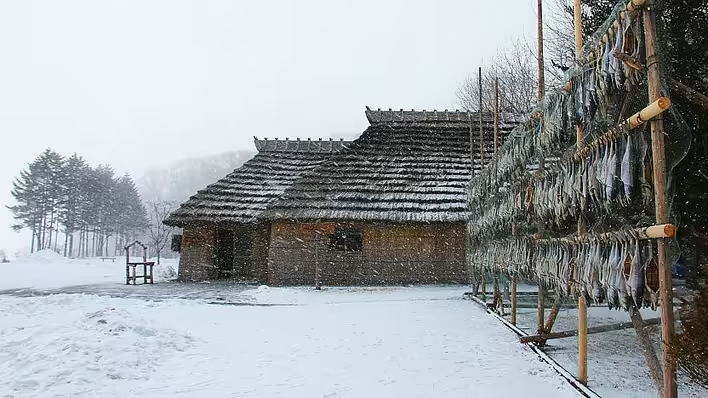
A traditional Ainu village was called kotan. It was built near rivers, lakes, or the sea, that is, where there were fish, game, edible plants, and convenient paths for movement. A kotan usually consisted of several dwellings, and the life of the community was tied to the seasons.
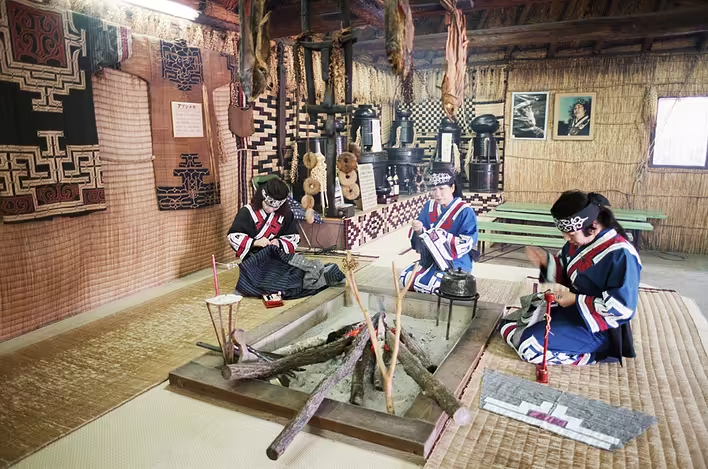
An Ainu home was called chise. It was a rectangular building made of wood, bark, reeds, grass, or bamboo grass, depending on the region. Inside, there was one large room with a hearth in the center. The fire had not only a domestic but also a sacred significance: through it, people addressed the goddess of the hearth, Kamuy-huchi.
In the house, there was a special sacred window through which, according to Ainu beliefs, kamuy - spirits or deities - entered and exited. Next to the house, there could be storages, a place for drying fish and meat, a ritual platform, and sometimes a cage for a bear cub, associated with the ceremony of sending the bear spirit away.
Daily life for the Ainu revolved around several activities:
- fishing, especially salmon catching;
- hunting deer, bears, hares, birds, and marine animals;
Salmon was one of the main products. It was eaten fresh, dried, frozen, and stored for winter. In Ainu culture, salmon held an almost sacred status: it was not just food, but a gift from the river and spirits.
Clothing, ornaments, and decorations
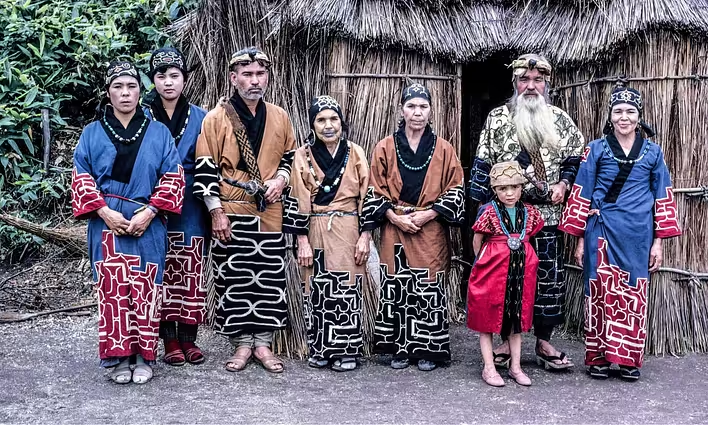
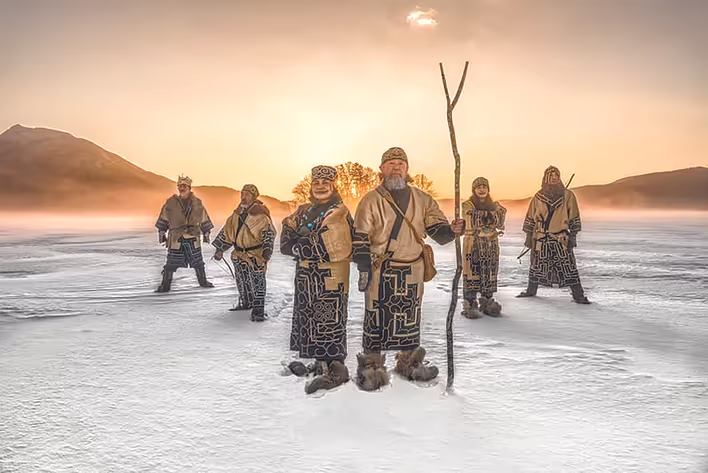
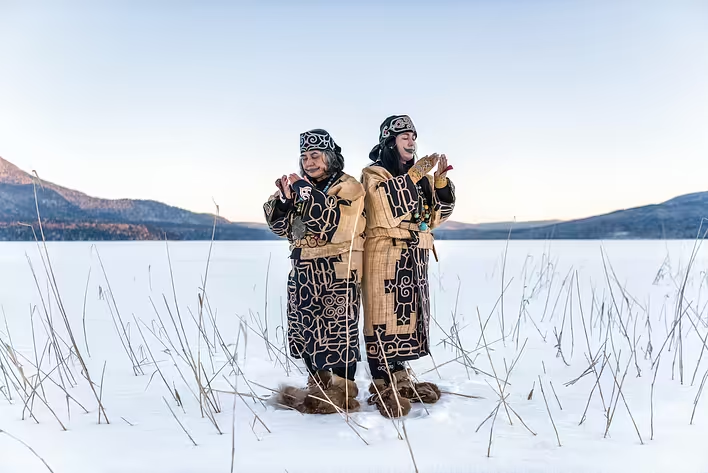
Traditional Ainu clothing is easily recognizable by geometric patterns. The most famous material is attus, a fabric made from the inner bark fibers of trees, primarily elm or linden. They also used nettle fibers, fur, animal skin, fish skin, and later - cotton, which they obtained through trade with the Japanese.
Festive clothing was adorned with appliqués and embroidery. The patterns had not only aesthetic significance. They were often perceived as protective charms that shielded a person from evil forces. Especially many ornaments were placed on the edges of sleeves, hems, and collars - where, according to beliefs, unwanted spirits could "penetrate" into the body.
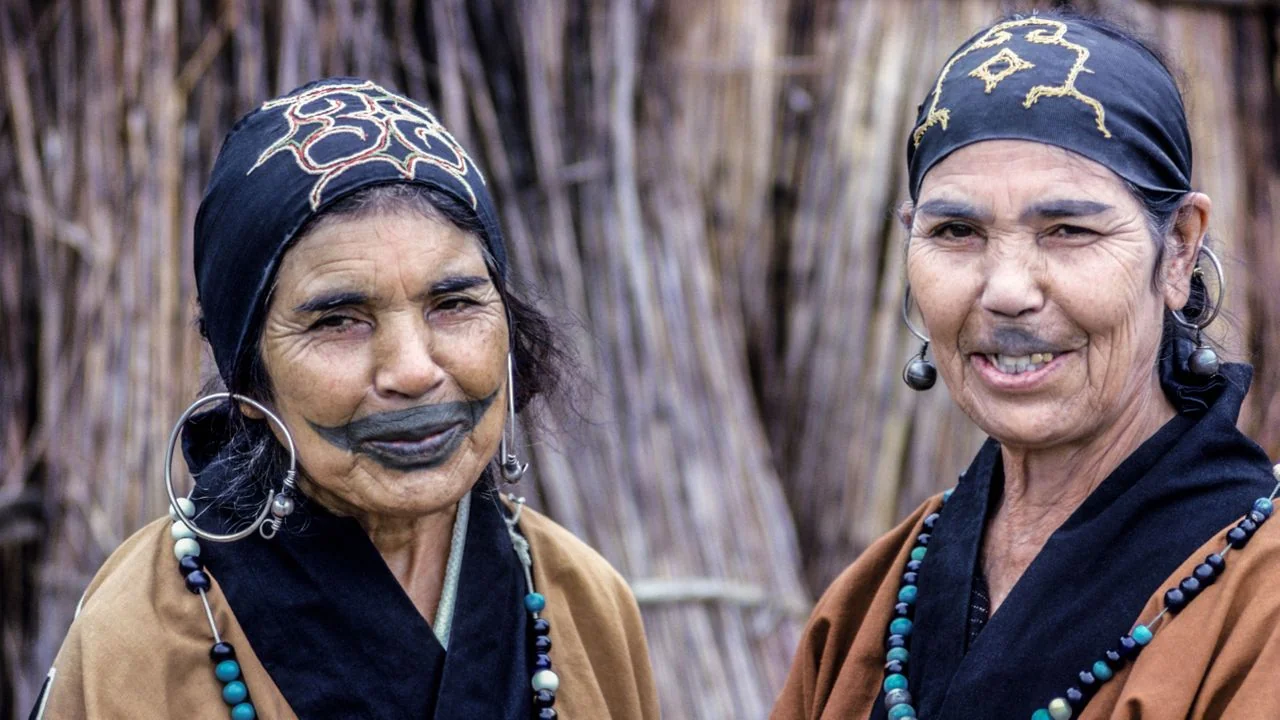
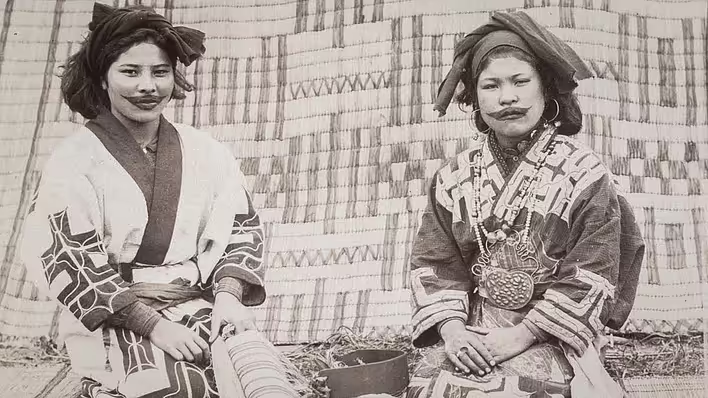
Women wore necklaces made of large glass beads, metal ornaments, and embroidered headbands. In the past, an important sign of adulthood and readiness for marriage was women's tattoos around the mouth and on the hands. To an outsider, they might seem unusual, but for the Ainu themselves, this was a sign of beauty, maturity, belonging to the community, and spiritual protection.
Food: soup, porridge, fish, and forest gifts
Ainu cuisine grew out of the northern climate. Food had to be nutritious, seasonal, and suitable for storage. The basis of daily nutrition often consisted of soups and porridge. Fish, meat, wild plants, seaweed, roots, and mushrooms were added to the soup. Porridge was made from millet, other grains, beans, sometimes with the addition of dried products.
Among characteristic dishes, rataskep is mentioned - a mixture of boiled plants, beans, or vegetables, dressed with oil and salt. Another well-known dish is ruibe, frozen salmon that was sliced and eaten after slight thawing. Today, ruibe is associated with Hokkaido cuisine in general, but its roots are linked to the Ainu tradition of preserving fish in a cold climate.
It is also worth mentioning chitatap - a dish made from finely chopped or pounded fish or meat. The name is usually explained as "what has been pounded." For chitatap, parts of salmon, game, or meat from older animals could be used, which, after such chopping, became easier to consume. The dish was seasoned with wild onions, dried seaweed, or salt, and if it lost freshness, it could be shaped into balls and added to soup.
Food for the Ainu was associated with ritual and gratitude, as the animal, fish, or plant was perceived as a gift, not as a silent resource. According to ethnographic descriptions, when there were guests in the house, the hostess could invite them to eat with the word "ipeyan" - "please eat." The guest would thank, and if the dish was particularly valuable, for example, bear meat, before starting to eat, they would raise it to their forehead as a sign of gratitude. After the meal, it was customary to say "hunna" - an expression of gratitude for the food.
Belief: the world of kamuy
At the center of the Ainu worldview is the concept of kamuy. It is often translated as "god" or "spirit," but more accurately, it is a force present in beings, objects, and phenomena. Kamuy were attributed to animals, trees, mountains, the sea, fire, tools, diseases, storms, food, and home.
For the Ainu, the world of humans and the world of kamuy were connected through exchange. The spirit comes into the human world in a certain form - for example, as a bear, salmon, or tree. People use its gifts but must behave respectfully, thank, and properly "send" the spirit back to its world.
Especially important were:
- Kamuy-huchi - the goddess of the hearth, a mediator between humans and other kamuy;
- Kim-un-kamuy - the spirit of the bear and mountains;
- Repun-kamuy - the spirit of the sea and marine animals;
- Kotan-kar-kamuy - the creator of the world in Ainu myths;
- ancestor spirits, who could support the family.
One of the most famous rituals was iomante - the ceremony of sending the bear spirit away. In the traditional understanding, the bear was not just prey. It was considered a powerful kamuy that came to people in the body of an animal and brought meat and fur. The ritual aimed to return its spirit to the world of gods with honors and gifts. Today, this ritual is the subject of complex discussions: for some, it is an important part of cultural heritage, while for others, it is a controversial practice from the perspective of modern attitudes towards animals.
Oral tradition, songs, and language
Ainu culture existed for a long time without its own writing system, so the memory of the people was preserved in oral tradition. The most famous genre is yukar, epic narratives about gods, heroes, animals, and the origins of the world. They were not just told but performed rhythmically, sometimes for hours. Through yukar, moral rules, historical memory, perceptions of nature, and the place of humans in the world were transmitted.
The Ainu language is a linguistic isolate: its relationship to Japanese or other languages is not proven. There were once various Ainu dialects - Hokkaido, Sakhalin, Kuril. Today, the language is endangered: very few speakers remain, and some dialects are already considered extinct.
At the same time, recent decades have brought a movement for the revival of the language. Courses are being opened, dictionaries and educational materials are being published, songs and tales are being recorded, and cultural programs for youth are being created. For the Ainu, language is not just a means of communication but a way to reclaim their own view of the world.
Customs, family, and community
Traditional Ainu society did not have a single centralized state. The basic unit was the kotan, and an elder or authoritative leader played an important role. He could conduct rituals, resolve disputes, and represent the community in relations with neighbors.
Marriage customs varied depending on the region. A well-known description of traditional matchmaking describes how a man would come to a woman, and she would offer him a bowl of rice. If he ate half and returned the rest, and she finished it - this meant consent. Such details illustrate how important symbolic actions were in everyday life.
Children were sometimes given temporary names at an early age, which were meant to scare away evil spirits or diseases. Only later did the child receive a permanent name. In upbringing, observation, imitation of elders, participation in work, and listening to stories were important.
Music, dance, and art
Ainu culture is rich in dances, songs, and decorative arts. Traditional dances were performed during rituals, festivals, gatherings, and everyday events. Some dances imitated the movements of animals or birds, while others were related to prayers, hunting, harvest, and remembrance of ancestors.
Among musical instruments, tonkori - a string instrument, especially associated with Sakhalin, and mukkuri - a jaw harp that creates a characteristic vibrating sound are well-known. Modern Ainu musicians combine traditional instruments with reggae, electronics, hip-hop, and other genres. Thus, the culture does not turn into a museum exhibit but continues to live.
Wood carving, ornaments on clothing, ceremonial sticks called ikupasuy, decorations, and fabrics are part of Ainu aesthetics. Many items had not only practical but also spiritual significance.
20th century: discrimination and the struggle for recognition
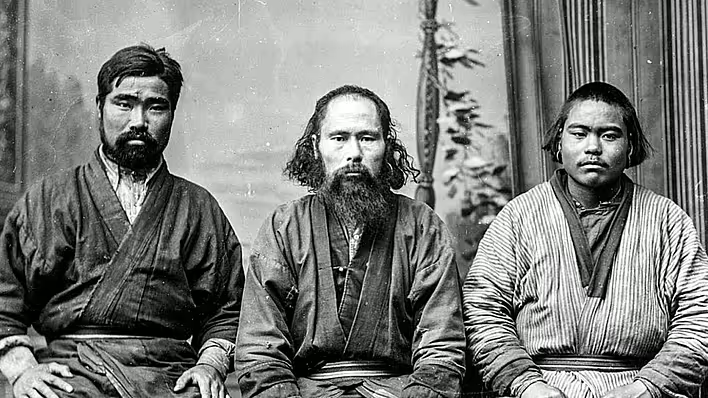
In the 20th century, the Ainu often faced discrimination. Their culture was long described as "backward," their language was displaced by Japanese, and many families hid their origins to avoid prejudice. This led to a painful rupture between generations: some younger Ainu grew up without knowledge of the language, rituals, and family history.
At the same time, it was in the 20th century that the movement for Ainu rights intensified. Researchers, activists, artists, and community organizations began to restore visibility to Ainu culture. An important figure was Kayano Shigeru - a linguist and cultural expert, collector of oral tradition, and later the first Ainu member of the Japanese parliament. He advocated for the preservation of the language and publicly used it in the political sphere.
In 1997, Japan passed a law to promote Ainu culture, which replaced the old assimilation law of 1899. In 2008, the Japanese parliament recognized the Ainu as an indigenous people in a political resolution, and in 2019, this was enshrined in a separate law. This recognition did not resolve all problems but became an important symbolic turning point.
The Ainu today: between memory and revival
Modern Ainu live very differently. Many lead ordinary urban or rural lives, work in various fields, and do not wear traditional clothing every day. But this does not mean a loss of identity. For modern Ainu, culture can manifest in language, dance, music, family memory, crafts, political activism, cuisine, research, or simply the right to call themselves Ainu without shame.
In 2020, the National Ainu Museum and Park Upopoy opened in Shiraoi, Hokkaido. The name "Upopoy" means approximately "to sing together in a large group." This place has become one of the centers for promoting Ainu culture: it showcases traditional dances, crafts, language, history, and daily life.
However, the revival of culture has its complex challenges. The Ainu still speak about rights to traditional fishing, the return of human remains and ritual items from museums and universities, overcoming stereotypes, access to education, and real participation in decisions concerning their heritage.
Why the history of the Ainu is important
The history of the Ainu dismantles the myth of Japan as a completely homogeneous country. It shows that the Japanese archipelago has always been a space of different peoples, languages, and cultures. The Ainu remind us that modernization often has a hidden cost: behind roads, cities, and state projects may lie lost lands, forbidden languages, and broken traditions.
At the same time, this is not just a story of loss. It is a story of resilience. Despite colonization, discrimination, and assimilation, the Ainu have preserved the memory of their kamuy, their songs, ornaments, rituals, place names, and the right to speak about themselves in their own voice.
The Ainu are interesting not because they are "exotic." They are important because their culture offers a different perspective on the connection between humans and nature, the past, and community. In a world where many peoples struggle for the right to be heard, the history of the Ainu sounds very contemporary: a people may lose much, but as long as they remember their words, their ancestors, and their land, their story is not over.
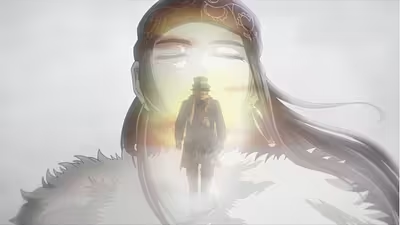
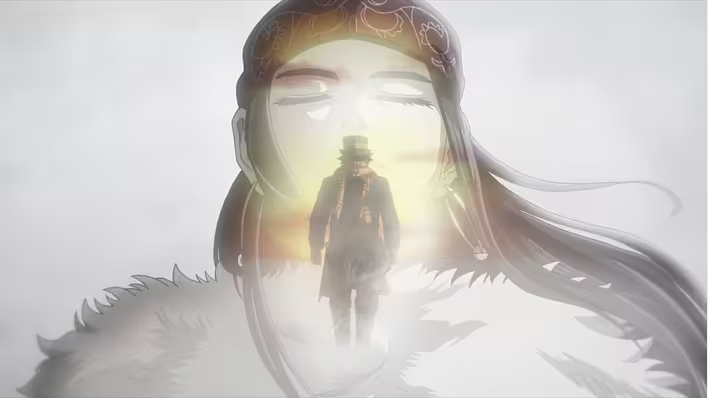
The anime "Golden Kamuy" is one of those titles that doesn't always grab you right away, but over time becomes a true favorite. It's hard to explain in just a few words. At firs...