
This content has been automatically translated from Ukrainian.
MIDI keyboard is one of the key tools of the modern music industry, used for creating, recording, and processing music in a digital environment. It is not a conventional musical instrument in the classical sense, as it does not produce sound by itself. Instead, the MIDI keyboard transmits digital signals that control software or external sound modules.
With the development of computer technology, MIDI keyboards have become an integral part of recording studios, home studios, and even live performances. They open up limitless possibilities for creativity and sound experimentation.
What is MIDI and how does it work
MIDI (Musical Instrument Digital Interface) is a standard for transmitting digital data between musical devices. It was developed in the 1980s and remains the foundation of digital music.
Unlike audio signals, MIDI does not transmit sound. Instead, it transmits information about:
- key presses (notes);
- velocity;
- duration of sound;
- use of pedals;
- parameter changes (modulation, pitch, etc.).
This data is processed by a program or synthesizer that generates sound.
Structure of a MIDI keyboard
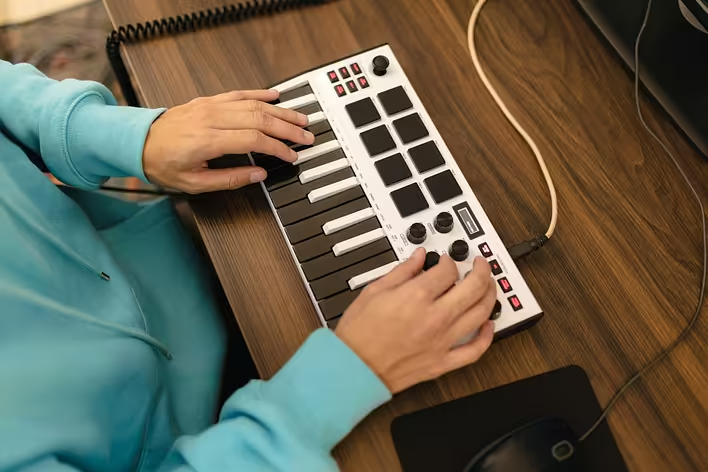
A MIDI keyboard may look like a regular piano, but its design is much simpler. The main elements are:
KeysCan vary in number (25, 49, 61, 88) and type (synth action, semi-weighted, weighted).
ControllersKnobs, sliders, buttons, and pads that allow control over sound parameters.
Pitch Bend and ModulationWheels or joysticks for changing pitch and modulation.
DisplayUsed in some models to show parameters.
Connection portsUSB, MIDI DIN, sometimes Bluetooth.
PedalsConnected separately and used to control sound.
Types of MIDI keyboards
There are several types of MIDI keyboards that differ in functionality:
CompactHave a small number of keys (25–37) and are suitable for mobile use.
Standard49 or 61 keys, an optimal choice for most musicians.
Full-size88 keys, closely resembling a piano.
Pad controllersEquipped with drum pads for creating rhythms.
Stage MIDI keyboardsDesigned for live performances and have extended control capabilities.
Advantages of MIDI keyboards
MIDI keyboards have many advantages that make them indispensable in modern music:
VersatilityCan be used to create any sounds, from piano to orchestra.
CompactnessMany models are easily portable.
AffordabilityThe cost is significantly lower than that of many traditional instruments.
FlexibilityThe ability to change sound parameters in real-time.
Integration with softwareEasy to connect to DAWs (Ableton Live, FL Studio, Logic Pro, etc.).
Disadvantages of MIDI keyboards
Despite the advantages, MIDI keyboards also have certain disadvantages:
- lack of inherent sound;
- dependence on a computer or external module;
- latency with incorrect settings;
- need for basic software knowledge.
Applications of MIDI keyboards
MIDI keyboards are used in various fields:
Music productionThe main tool for creating electronic and pop music.
Studio recordingUsed for recording MIDI data and controlling virtual instruments.
Live performancesAllow control of sound in real-time.
EducationHelp in learning music theory and composition.
Film and gaming industryUsed for creating soundtracks.
How to choose a MIDI keyboard
When choosing a MIDI keyboard, consider:
Number of keysDepends on needs; for simple tasks, 25-49 is sufficient, for full playing, 88.
Type of keysWeighted keys are better suited for pianists.
Presence of controllersImportant for working with sound.
CompatibilityCheck if the required software is supported.
PortabilitySize and weight are important for mobile musicians.
Brand and qualityWell-known manufacturers usually guarantee reliability.
Current trends
Modern MIDI keyboards are becoming increasingly intelligent. They are equipped with automatic integration with DAWs, touch panels, RGB lighting, and wireless connectivity options.
AI features are also actively developing, helping in music creation by suggesting chords and harmonies.
Compact models for mobile devices are emerging, allowing music creation literally anywhere.
MIDI keyboards are a powerful tool for modern musicians, producers, and composers. They open up broad possibilities for creativity, allowing work with any sounds and styles.
Thanks to their versatility, affordability, and integration with digital technologies, MIDI keyboards have become the standard in music production. Regardless of skill level, this instrument can be the key to creating one's own music and developing creative potential.