

This content has been automatically translated from Ukrainian.
Sometimes work just doesn't flow: thoughts scatter, every message distracts, and it takes ten minutes to form a simple sentence. Yet sometimes everything comes together almost effortlessly — words appear one after another, solutions come in time, and a few hours pass unnoticed. This state can be described as: “I caught the flow”.
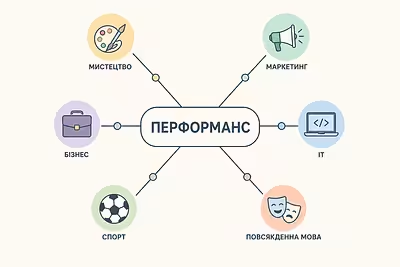
However, flow is not just about concentration. This word can be heard in rap, sports, design, programming, and everyday conversations. In each case, its meaning shifts slightly, but the common idea remains: something moves smoothly, consistently, and without noticeable obstacles.
What does the word "flow" mean
Flow comes from the English flow, which literally means “stream,” “current,” or “smooth movement.” In the Ukrainian language, the word has established itself as a slang or professional borrowing.
In its broadest sense, flow is the natural, continuous course of a certain process. It can be the rhythm of a musical performance, a state of deep concentration, a sequence of actions in an application, or simply the feeling that things are going smoothly.
The exact meaning depends on the context:
- catch the flow — to enter the right rhythm;
- be in the flow — to work or create with focus and ease;
- break the flow — to disrupt the pace, concentration, or natural course;
- good flow — a smooth, well-organized delivery or sequence;
- this flow doesn't work — the process is awkward, illogical, or interrupted somewhere.
The word flow is usually not declined: people say “there is no flow,” “stay in the flow,” “work on the flow.”
Flow in rap and hip-hop
It is thanks to hip-hop culture that the word flow became known far beyond the English-speaking environment. In rap, flow refers to how the performer arranges words, syllables, stresses, and pauses in relation to the beat.
Two rappers can read the same text over the same instrumental, but they will sound different. One will stretch the words, another will read in a choppy manner, and a third will change the tempo mid-line. All of this affects the flow.
It is shaped by several components:
- the rhythm and speed of reading;
- the placement of stressed syllables;
- pauses and syncopations;
- rhyme schemes;
- transitions between lines;
- the interaction of the voice with the beat.
Flow is often confused with delivery, although they are not quite the same. Delivery encompasses timbre, intonation, volume, emotions, and the overall manner of performance. Flow primarily concerns the rhythmic movement of the text. At the same time, these elements are so closely related that listeners often refer to flow as the entire manner of a rapper's delivery.
Therefore, the phrase “he has a strong flow” means that the performer masterfully works with rhythm, organically combines the text with the beat, and has a recognizable delivery style. And “change the flow” means to switch to a different rhythmic pattern, tempo, or way of placing stresses.
Flow as a state of deep concentration
In another common meaning, flow is a state in which a person is fully immersed in their task. They are hardly distracted, understand well what to do next, and may lose track of time.
The concept of flow state, or flow state, was developed by psychologist Mihaly Csikszentmihalyi. He studied situations in which people become so absorbed in an activity that it becomes a source of enjoyment for them. This state likely arises when the task is challenging enough to hold attention but also matches the person's skills. An overly simple task quickly becomes boring, while an excessively complex one can cause anxiety and confusion. Modern research on flow state also links it to deep immersion in an activity and a changed sense of time.
In everyday language, the word is used somewhat more loosely. The phrase “don’t distract me, I’m in the flow” does not necessarily mean a clearly defined psychological state. Often, a person simply says they have finally focused, found their working rhythm, and do not want to lose it.
In the flow, one can write text, draw, program, play chess, train, or assemble a complex model. The activity itself is not as important as the degree of immersion in it.
Flow in work and creativity
In work conversations, flow can refer to both personal rhythm and the smoothness of the entire process.
For example, a designer might say: “Today I caught the flow and created three mockups in the evening”. Here, it refers to concentration and a creative high. However, if a team says: “We need to improve the flow of work on the project”, it refers to the sequence of stages, distribution of tasks, and transfer of results between people.
In this sense, flow approaches the English workflow — the work process. However, the words are not identical. Workflow is an organized scheme of actions: who does what and after whom. Flow can be a less formal concept and convey a sense of smoothness, tempo, and absence of unnecessary obstacles.
Creative flow should also not be confused with inspiration. Inspiration provides the idea or desire to create something, while flow describes the state of work itself, where one action naturally leads to the next. A person can start writing without particular inspiration but gradually enter the flow.
What is user flow in design
In website and application design, user flow, or user scenario, is the sequence of steps a person goes through to achieve a specific goal. For example, finding a product, adding it to the cart, entering an address, selecting a payment method, and confirming the order.
This flow can be presented in the form of a diagram with screens, actions, and decision points. Designers use it to understand where a user might get confused, go back, or even leave the site. More details on the principles of building such scenarios are explained by Interaction Design Foundation in their material on user flow.
The phrase “this application has an inconvenient registration flow” means that the path from the first screen to account creation is too complicated, illogical, or contains unnecessary steps.
In this context, flow is no longer just youth slang but a professional term from UX design. It describes not the user's mood but the structure of their interaction with a digital product.
What does flow mean in IT
In IT, the word flow can relate to various processes, so its meaning depends on what developers, testers, or system architects are specifically talking about.
Control flow is the order in which a program executes commands. Typically, code moves from one instruction to the next, but conditions, loops, functions, and error handling can change this path. For example, the if...else construct directs the program to different actions depending on whether a condition is met. Such tools are described in MDN documentation on control flow.
Data flow shows where information comes from, through which components it passes, and how it changes. For example, a user fills out a form on a website, the browser sends the data to the server, the server checks it, queries the database, and returns a response. Understanding this flow helps find errors, design systems, and determine where to check or protect information.
A similar meaning applies to request flow — the path of an individual request through the system. When a page fails to load or a payment does not go through, developers may “check the request flow,” meaning they trace all the steps from the user's action to the server's response.
Flow can also refer to the order of work within a team. For example, a task first goes to a developer, then undergoes code review, testing, and only after that reaches release. In this case, “breaking the flow” means disrupting the established sequence, while “simplifying the flow” means removing unnecessary approvals or manual operations.
Separately in development, the terms Git flow and GitHub flow are used. They relate to the rules of working with code branches but denote different models. For example, GitHub flow is a lightweight process in which a separate branch is created for changes, commits are added, a pull request is opened, discussions and reviews occur, and then the finished code is merged with the main branch.
Thus, in IT, flow is not a single specific term. It can describe code execution, data movement, request paths, user actions, or team organization. The common idea remains the notion of a route: where the process starts, through which stages it passes, and how it concludes.
Flow in sports, dance, and video games
In sports, flow can mean a state where movements are performed almost automatically, without unnecessary doubts and constant deliberation over each action. A basketball player feels the tempo of the game, a dancer smoothly transitions from one move to another, and a skater seamlessly combines tricks into one sequence.
Here, two meanings of the word combine: psychological immersion and physical smoothness. A person is not only focused but also feels the rhythm of their own movements.
Similar experiences occur in video games. A player can “enter the flow” when they understand the rules well, react quickly to events, and hardly notice how time passes. If the level is too easy, it becomes boring; if the difficulty suddenly increases, the sense of continuous movement disappears.
Flow in conversational language
In modern slang, the word has gone far beyond professional spheres. It describes the overall rhythm of affairs, conversations, or even a day:
“I don’t want to plan anything — I’ll just go with the flow.”
“The conversation had a good flow, there were almost no awkward pauses.”
“After the call, I can’t get back into the flow.”
“Music helps me catch my working flow.”
In such phrases, the word can be replaced depending on the situation: rhythm, stream, tempo, sequence, smoothness, focus, or work process. However, no equivalent captures all nuances at once. That’s why the borrowing turned out to be convenient: it conveys movement, internal state, and the feeling that everything is coming together naturally.
Flow, vibe, and mood — what’s the difference
Flow is sometimes confused with vibe, as both words can describe the overall impression of music, a person, or a situation.
Vibe is the atmosphere, emotional tone, or feeling that something creates. Flow is movement, rhythm, or progression. A song can have a melancholic vibe but a fast and choppy flow. A conversation can start with a friendly vibe but lack flow due to long pauses and constant topic changes.
Mood also relates to emotions, while flow is more connected to the process. One can be in a less than ideal mood but still get into a good working rhythm.
Thus, flow is a polysemous word that almost always conveys the idea of movement or sequence. In rap, it is the rhythmic organization of text; in psychology, it is a state of complete immersion in a task; in design, it is the user path; in IT, it is the course of a specific technical or work process; and in everyday slang, it is a successful rhythm of work, creativity, or communication. To correctly understand the meaning of the word, it is enough to look at what specifically is “flowing” in a given situation: music, attention, information, movements, or the entire process.