
Compact discs, although they may seem somewhat outdated against the backdrop of modern digital technologies, still retain their value for many music lovers, collectors, and simply those who have important information recorded on them. Like any storage medium, CDs require proper care to serve long and reliably. So let's figure out how to properly care for these small but important discs. In the world of compact discs, you can also find discs from the year that still delight genre fans.

What is a compact disc and what types are there?
A compact disc (CD) is essentially a portable optical disc created for storing digital information. Most often, we are used to them as music carriers, but they are also used for storing data, software, and more. There are different types of CDs, each with its own features:
- CD-R (Recordable): Discs for one-time recording. Information can be written to them only once, but can be read many times.
- CD-RW (Rewritable): Rewritable discs. Information can be erased and rewritten, just like on a flash drive.
- VCD (Video Compact Disc) and SVCD (Super Video Compact Disc): Formats for storing video. VCD has lower quality, while SVCD has slightly better quality.
- Photo CD: A special format for storing photographs.
Sizes and memory capacity: everything you need to know
A standard CD has a diameter of 120 mm and can hold about 700 MB of data or 80 minutes of audio. As is known, this is enough for most music albums. There are also Mini CDs with diameters ranging from 60 to 80 mm, which are often used for CD singles or for distributing drivers for devices. For example, at one time, when buying a new graphics card, you could find such a mini-disc with drivers included.
What are CDs made of?
The main material for making CDs is polycarbonate plastic. It is durable, transparent, and well-suited for laser reading of information. The weight of one disc ranges from 15 to 20 grams. It may seem trivial, but when you have a large collection, every gram counts!
How does a CD work: the magic of the laser
Information on a CD is read using a laser. The laser beam reflects off the surface of the disc, and the intensity of the reflection changes depending on the presence or absence of pits (grooves) on the surface. These changes are converted into a digital signal, which is then decoded. In essence, the laser "reads" the microscopic irregularities on the disc.
Why is caring for discs important?
CDs are quite vulnerable to damage. Scratches, dust, dirt, sunlight – all of these can affect the quality of reading information or even render the disc unusable. Therefore, proper care is the key to the longevity of your discs.
Basic rules for storing CDs
Proper storage is half the battle. Here are a few important rules:
- Temperature: Avoid extreme temperatures. Do not leave discs in the sun or in a cold place. The optimal temperature is room temperature.
- Humidity: High humidity can lead to corrosion of the metal layer of the disc. Store discs in a dry place.
- Protection from sunlight: Ultraviolet radiation destroys polycarbonate. Store discs in a dark place or in cases.
How to properly hold a disc?
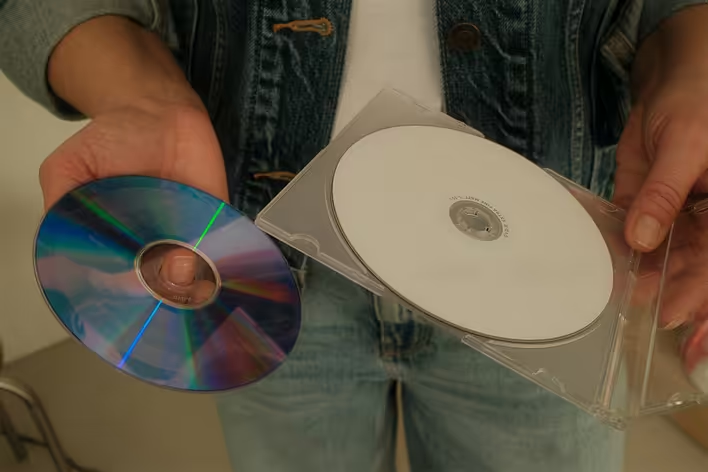
Hold the disc by the edges or by the central hole. Never touch the shiny surface with your fingers, as fingerprints leave greasy marks that attract dust and can damage the disc.
Cleaning discs from dust and dirt
To clean discs, use a soft, lint-free cloth. Microfiber is ideal. Wipe the disc from the center to the edge in straight motions. Do not use circular motions to avoid spreading dust across the surface.
Removing fingerprints
If there are fingerprints on the disc, dampen the cloth with isopropyl alcohol (medical alcohol) and gently wipe the surface. It is important that the alcohol is pure and free from impurities.
What to do with scratches?
Scratches are the biggest problem for CDs. Unfortunately, they cannot be completely removed, but you can try to reduce their impact. There are professional disc restoration methods that use special polishing machines. At home, you can try using toothpaste (without abrasive particles) or special plastic polishes. Apply a small amount of toothpaste to a soft cloth and gently wipe the scratch from the center to the edge. Then rinse off the remaining toothpaste with warm water and dry the disc.
Special care products for discs
There are special care products for CDs on the market that contain anti-static components and protect against dust. They can come in the form of sprays or liquids. Use them according to the instructions.
Transporting discs: protection above all
When transporting discs, use cases or protective sleeves. This will protect them from scratches and damage. It is especially important to do this if you often take discs with you on the go.
The impact of external factors on the lifespan of CDs
The lifespan of CDs is affected by many factors, including manufacturing quality, storage conditions, and intensity of use. On average, a quality CD can last 20-30 years, but with proper care, this period can be significantly longer.
Alternatives to CDs: DVD and Blu-ray Disc
With the development of technology, alternatives to CDs have emerged – DVD and Blu-ray Disc. They have larger memory capacity and better image quality. DVDs are used for storing movies, while Blu-rays are used for high-definition films.
Digitizing CDs: preserve your collection forever
The best way to preserve information from CDs is to digitize it. Convert your favorite albums into MP3 or FLAC files and store them on a hard drive or in cloud storage. This will not only protect your collection from damage but also make it more accessible.
Why choose the music online store "Lampala" for vinyl records, CDs, and DVDs?
"Lampala" is a reliable music online store where you can find a wide range of compact discs, including rare editions and new releases. The operator offers only quality discs and ensures fast delivery, making your shopping experience as comfortable as possible.