

This content has been automatically translated from Ukrainian.
What is an imam?
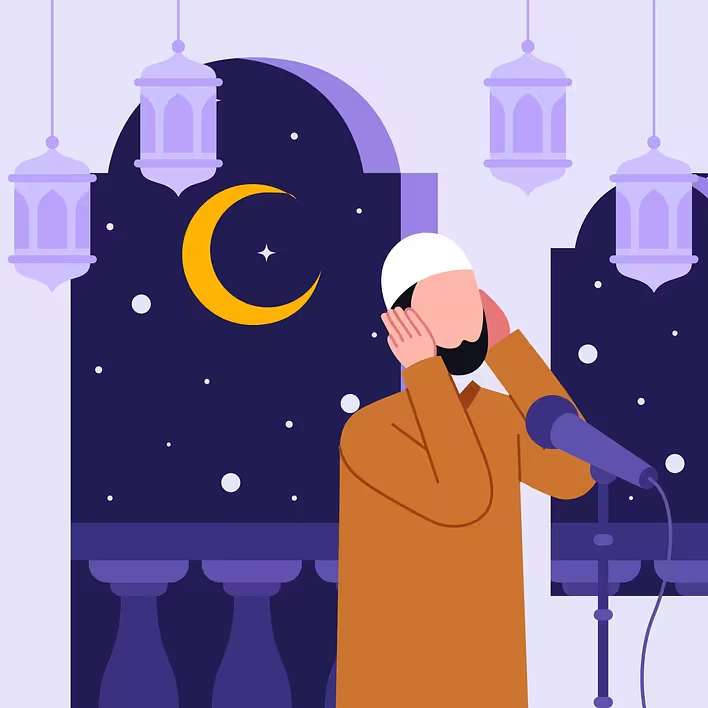
Imam is a Muslim religious leader who leads communal prayers, can deliver sermons, explain the norms of Islam, and serve as a spiritual mentor for his community. Depending on the country, traditions, and sect of Islam, his duties may vary, but most often the imam leads worship services in the mosque.
Unlike many other religions, in Islam, the imam is not a mediator between man and God. He does not have special spiritual powers that would allow him to forgive sins or perform rituals that are inaccessible to other Muslims. Primarily, the imam is a person who has a deep understanding of the Quran, Islamic law, and religious tradition and holds authority among the faithful.
In small communities, the imam may not only lead prayers but also teach children the basics of Islam, counsel families on religious matters, participate in charitable activities, and help resolve disputes among community members.
The origin of the word "imam"
The word "imam" comes from the Arabic إمام (imām), which literally means "one who stands in front", "one who leads", or "leader".
Therefore, in the broadest sense, an imam can be called a person who leads others. In a religious context, it primarily refers to one who stands in front of the faithful during communal prayer and directs its conduct.
With the spread of Islam, the word "imam" has entered many languages around the world almost unchanged. The Ukrainian language also borrowed it through Arabic tradition, so today this term is used as the official name for a Muslim spiritual leader.
What duties does an imam perform?
The most well-known duty of an imam is to lead communal prayer (namaz) in the mosque. During the prayer, he stands in front of other worshippers, recites verses from the Quran, and determines the sequence of prayer actions. This is where the name "imam" comes from — one who leads others.
However, his role is not limited to just conducting prayers. In many Muslim communities, the imam also:
- delivers the Friday sermon (khutbah);
- teaches the basics of Islam to children and adults;
- explains the provisions of the Quran and Sunnah;
- counsels on family life, inheritance, charity, and other aspects related to religion;
- participates in conducting religious rituals, including marriage (nikah) and burial.
In small communities, the imam is often also the organizer of mosque life: helping coordinate charitable events, maintaining communication among community members, and representing it in dealings with other organizations.
Is an imam a priest?
Often, an imam is referred to as a Muslim priest, but this comparison is not entirely accurate.
In Christianity, a priest is part of the church hierarchy and performs sacraments that, according to Church doctrine, can only be performed by ordained ministers.
In Islam, the situation is different. There are no intermediaries between man and Allah, and any Muslim who knows the order of conducting the prayer and is respected by the community can theoretically lead the communal prayer.
This is why an imam is primarily a religious leader, teacher, and scholar of Islam, rather than a priest in the Christian sense of the word.
At the same time, in everyday language, the word "priest" is sometimes used as a simplified explanation for people who are not familiar with Islam. However, from a religious studies perspective, it is more accurate to say "imam" or "Muslim religious leader".
Are all imams the same?
No. The meaning of the word "imam" depends on which sect of Islam is being referred to. For Sunnis and Shiites, this term has different meanings.
In Sunni Islam
In the Sunni tradition, an imam is a person who leads communal prayer, delivers sermons, and helps the community with religious matters. He is a spiritual mentor and a scholar of Islam, but is not considered infallible or endowed with special divine powers.
This is the meaning in which the word "imam" is most often used today when referring to mosque leaders in most Muslim countries.
In Shia Islam
For Shiites, the concept of an imam has a much deeper religious significance.
They believe that after the death of the Prophet Muhammad, the spiritual and political leadership of the Muslim community should have passed to his cousin and son-in-law Ali ibn Abi Talib and his descendants. These successors are called imams.
In the largest Shia sect — the Twelvers — they recognize the Twelve Imams, who are considered the legitimate spiritual leaders of the Muslim community. Shiites are convinced that they were chosen by God's will, had special spiritual authority, and are the best interpreters of the Quran and Islamic teachings.
The last, twelfth imam, according to Shia tradition, is in occultation (ghaybah) and will return at the end of times as the Mahdi to restore justice.
For Shiites, this is why the word "imam" means not only the leader of prayer but also the central figure of their theology.
Important: In most modern news, encyclopedic articles, and everyday conversations, the word "imam" usually refers to the leader of a mosque or a person who conducts prayer. Only when discussing the history or theology of Shiism does this term acquire a special meaning related to the Twelve Imams and the doctrine of their spiritual authority.
How does one become an imam?
There is no single universal order for appointing imams that applies worldwide in Islam. This is due to the fact that Muslims do not have a centralized religious structure similar to that which exists in some other religions. Therefore, the requirements for an imam may vary depending on the country, mosque, sect of Islam, and local traditions.
In most cases, an imam is a person who:
- has a good knowledge of the Quran and can read it correctly;
- possesses knowledge of Islamic theology and law;
- has authority among community members;
- leads a lifestyle that adheres to Islamic norms.
Many modern imams receive education at Islamic universities, madrasas, or other religious educational institutions. However, merely having a diploma does not make a person an imam — their knowledge, moral qualities, and the trust of the community are also important.
In some mosques, an imam is appointed by a religious organization or the spiritual administration of Muslims, while in others, he is elected by the local community.
Can any Muslim be an imam during prayer?
Yes, in certain cases — it is possible.
If there is no permanent imam, another Muslim who knows the order of conducting the prayer and can read the Quran correctly may lead the communal prayer. This is why the word "imam" sometimes refers not to an official position but to the role of a person leading a specific prayer.
However, when it comes to a mosque or a large community, the duties of an imam are much broader than just conducting the namaz. Such an imam not only leads prayers but also engages in religious education, delivers sermons, counsels the faithful, and participates in community life.
Frequently Asked Questions
Is an imam the same as a mullah?
Not quite. Imam is a religious leader who leads prayer and performs spiritual duties in the Muslim community. Mullah is a historical title for a Muslim theologian or religious scholar, primarily used in some countries of Central and South Asia, Iran, and the Caucasus. One person can be both a mullah and an imam, but these terms are not complete synonyms.
Can an imam marry people?
Yes. In many Muslim communities, the imam conducts the religious marriage ceremony — nikah. At the same time, the legal formalization of marriage depends on the legislation of the specific country.
Does an imam receive a salary?
This depends on the country and the specific community. Some imams work in mosques on a permanent basis and receive a salary from a religious organization or community. Others perform these duties voluntarily or combine them with another profession.
Are there imams only in mosques?
No. Imams can serve in Muslim military chaplaincies, educational institutions, hospitals, prisons, and other establishments where there are Muslim communities.
Who is the chief imam?
There is no single "chief imam" for all Muslims. Unlike some other religions, Islam does not have a single global leader. Each community or religious organization has its own governance system, and the authority of individual theologians is based on their knowledge and recognition among the faithful, rather than on a single centralized position.