This content has been automatically translated from Ukrainian.
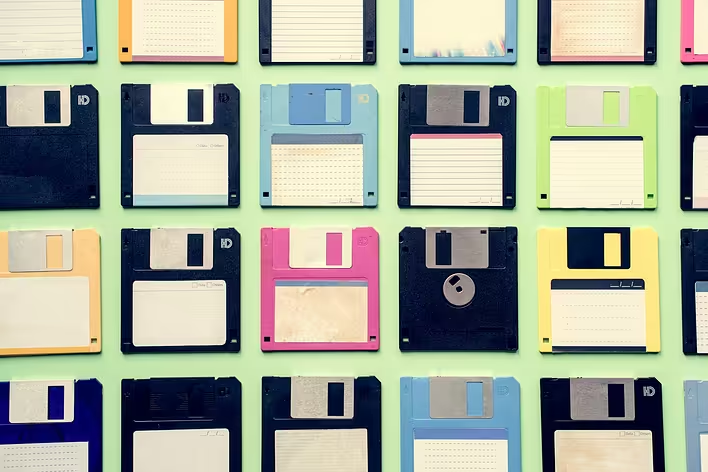
A small blue square with a white label still means "Save" in text editors, graphic programs, and other applications. For older users, it is a recognizable floppy disk. For younger ones, it is just a symbolic sign, the origin of which may not be immediately understood.
This symbol has outlived the object it represents. Computers have long been produced without disk drives, files are synchronized automatically, and photos and documents are stored on remote servers. However, the floppy disk has not disappeared completely: it has transformed from a physical medium into a part of digital language.
What is a floppy disk
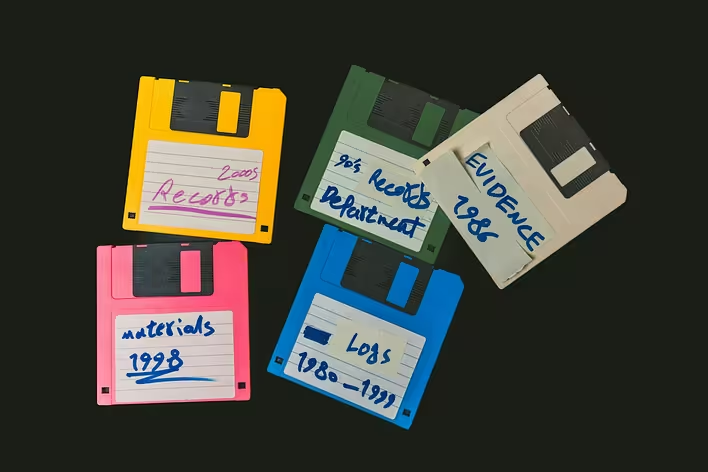
A floppy disk is a removable magnetic medium designed for recording, storing, and transferring digital data. Inside its casing is a thin round disk made of flexible material coated with a magnetic layer. It is this flexibility that gave the medium its English name floppy disk — literally "flexible disk."
The first floppy disks, created by IBM, had a diameter of 8 inches (approximately 20.3 cm). They began to be used in the early 1970s primarily for loading programs and data into large computer systems. The initial version could hold about 80 kilobytes — an amount that was then compared to the information on three thousand punch cards.
Eventually, more compact 5.25-inch floppy disks (approximately 13.3 cm) appeared, and later the more familiar 3.5-inch disks (approximately 8.9 cm). The latter already had a hard plastic casing and a metal shutter that protected the working surface. The name floppy remained, as the magnetic disk inside was still flexible.
The most common 3.5-inch floppy disk could store 1.44 megabytes of data. By the standards of the 1980s and 1990s, this was enough for text documents, small programs, educational works, or a few simple images. Today, a single photo from a smartphone often takes up more space than an entire floppy disk.
A medium that made files portable
The floppy disk was not the first method of storing computer information. Before it, punch cards, punch tapes, and magnetic tape reels were widely used. As early as 1956, IBM introduced RAMAC — the first commercial computer system with a hard magnetic disk storage. However, such devices were large, expensive, and belonged not to an individual but to an entire organization.
The main merit of the floppy disk was not only its capacity. It gave the user the ability to take their data with them. A document could be saved on one computer, the floppy disk could be placed in a pocket or folder, and then the file could be opened on another machine.
Along with this, new everyday problems arose. Floppy disks were afraid of dust, moisture, strong magnetic fields, and mechanical damage. A file might not open due to a scratch, deformation of the medium, or a reading error. And when a program took up more space, it had to be split across several numbered floppy disks, which had to be inserted into the drive one by one during installation.
Storing data at that time was a tangible physical action. The amount of information could literally be seen as a box or a stack of media.
Compact discs: hundreds of floppy disks on one medium

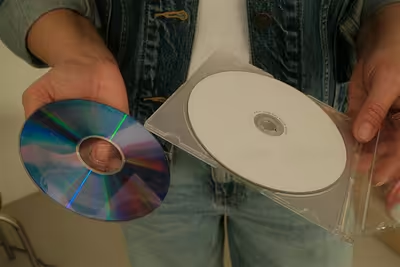
The next significant milestone was optical discs. Unlike the floppy disk, information on them was read by a laser. A standard CD-ROM or CD-R could hold about 650 megabytes of data — hundreds of times more than a standard 3.5-inch floppy disk.
Operating systems, large programs, games, music collections, and electronic encyclopedias began to be distributed on compact discs. One disc replaced an entire stack of floppy disks, and the data recorded on it could not be accidentally erased by a magnet.
At the same time, optical media had their own weaknesses. The surface could get scratched, cheap discs could stop being readable over time, and a special drive was needed for writing. The emergence of DVDs increased the standard capacity of a single layer to 4.7 gigabytes, but the principle remained the same: information was still stored on a separate item that needed to be carried around.
Flash drive: a floppy disk without a disk
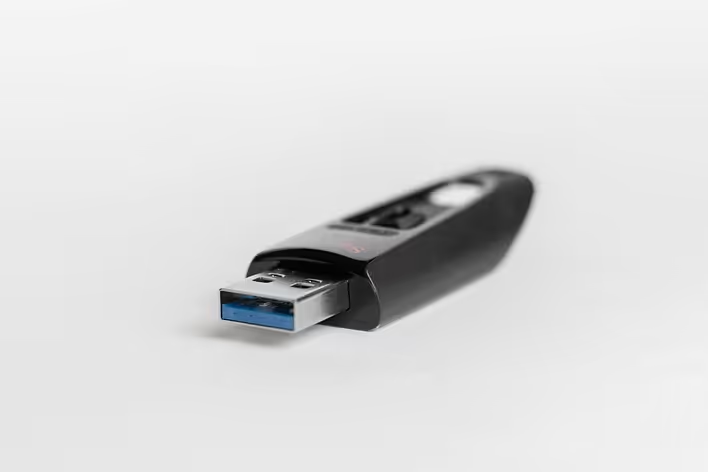
In the late 1980s, flash memory began to spread — a semiconductor technology that stores data without moving parts and does not lose it after power is turned off. Based on it, memory cards, solid-state drives, and USB flash drives later appeared.
The first commercial USB drives hit the market in 2000. One of the early models had a capacity of 8 megabytes, but even it was more compact, durable, and convenient than a floppy disk. A flash drive did not require a separate drive, allowed data to be rewritten multiple times, and gradually began to hold not just individual documents but entire collections of photos, music, and videos.
In fact, the flash drive inherited the main function of the floppy disk — transferring personal files between devices. The material changed, the capacity increased, the speed grew, but the habit remained the same: the user still carried data in their pocket.
The cloud: when carrying the medium is no longer necessary

Cloud storage changed not so much the structure of the storage medium as the way of interacting with information. Files are stored on the service provider's servers, and the user accesses them via the internet from a computer, smartphone, or tablet.
Importantly, the "cloud" is not a bodiless place where data exists on its own. Behind it are real data centers, servers, hard drives, SSDs, backup systems, and networking equipment. The cloud is primarily an access model: necessary resources can be obtained over the network without managing a specific physical storage medium.
Previously, when leaving home, a person would check if they had taken a floppy disk, compact disc, or flash drive. Now they need a device, a network connection, and access to an account. Data is no longer tied to a single item, and changes to a file can automatically synchronize across multiple devices.
It is here that the history of storage makes the biggest turn: we have gradually stopped transferring the files themselves and started transferring the ability to connect to them.
Why the "Save" button is still marked with a floppy disk
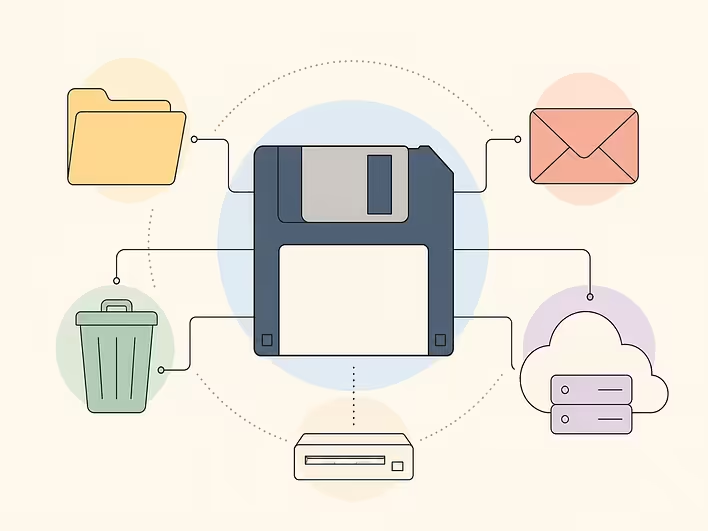
When graphical interfaces became mainstream, the floppy disk was a familiar way to save and transfer files. Therefore, its image served as an understandable visual cue: pressing the button meant saving the created document to the medium.
This technique is called skeuomorphism — the use of images borrowed from the physical world in a digital environment. A folder represents a directory of files, a trash can represents deletion, an envelope represents email, and a floppy disk represents saving. Familiar objects helped people master unfamiliar computer actions.
Over time, the connection between the image and the actual action weakened. The program no longer saves the document specifically to a floppy disk but can save it to an SSD, network server, or in the cloud. However, the symbol has become independent. Users recognize it not as a specific object but as a command.
Replacing such an icon creates a complex design problem. A downward arrow may signify downloading, a checkmark may signify confirmation, and a cloud may signify synchronization or network storage. The floppy disk has become outdated as a technology, but it still remains one of the most unambiguous symbols of saving.
Interestingly, some users know this silhouette only as a button. For them, a real floppy disk may not look like the source of the icon but rather like its three-dimensional physical version.
New media do not always eliminate the old
The history of data storage can easily be imagined as a sequence of complete replacements: the floppy disk gave way to the compact disc, the compact disc to the flash drive, and the flash drive to the cloud. In reality, different technologies often continue to exist in parallel because they solve different tasks.
Magnetic tape, which appeared before the floppy disk, is still used for long-term archives and backups of large volumes of data. Hard drives remain advantageous for large storage, SSDs provide fast access, flash drives are convenient for transferring files without the internet, and cloud services are for synchronization and collaboration.
Therefore, the path from the floppy disk to cloud storage is not just a story of increasing capacity. It is a transition from data tied to a fragile plastic square to information accessible from almost anywhere. The floppy disk itself has remained on screens as a digital fossil — a trace of a technology that is almost gone, but whose gesture we repeat every time we press "Save."