Dogs Playing Poker: How Coolidge's Humorous Series Became a Kitsch Icon
"Dogs Playing Poker" is often referred to as a single painting, although this is not entirely accurate. This is an informal name for a group of works by American artist Cassius Marcellus Coolidge, created in the late 19th to early 20th century. The most fam...
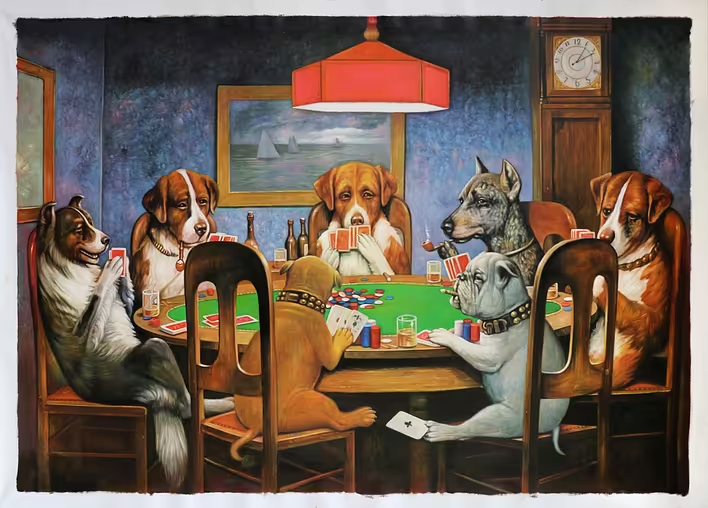
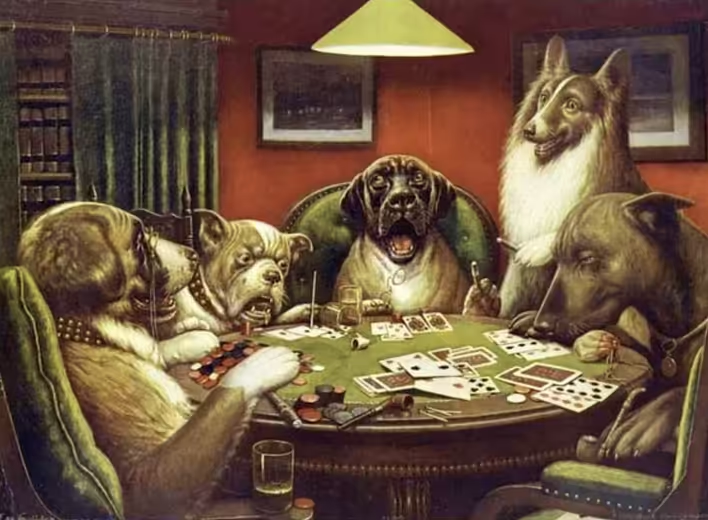
"Dogs Playing Poker" is often referred to as a single painting, although this is not entirely accurate. This is an informal name for a group of works by American artist Cassius Marcellus Coolidge, created in the late 19th to early 20th century. The most famous of these is A Friend in Need from 1903: the very scene where a bulldog discreetly passes an ace to another dog under the table.
These paintings have long existed on the border of art, advertising, humor, and home decor. They have been ridiculed as kitsch, copied onto posters, referenced in series and films, used as a symbol of bad taste or, conversely, as an example of a very enduring folk icon. And therein lies their intrigue: sometimes an image that museums are slow to recognize as great turns out to be more influential than many "proper" canvases.
картина A Friend in Need
What is "Dogs Playing Poker"
Dogs Playing Poker is the collective name for a series of paintings by Cassius Marcellus Coolidge, where anthropomorphic dogs behave like humans: playing poker, smoking, drinking, arguing, cheating, relaxing, dancing, or participating in various social situations. The most famous works are indeed related to poker, but not all paintings in the series depict the card game.
It is important to distinguish a few things. In 1894, Coolidge created Poker Game - an early painting featuring dogs at a poker table. Then in 1903, the company Brown & Bigelow, which specialized in advertising calendars and other promotional products, commissioned the artist to create a series of sixteen oil paintings featuring dogs in human roles. These works became the foundation for the image's mass popularity.
Thus, "Dogs Playing Poker" is not an academic title for a single work, but a convenient folk name for an entire visual world. In it, the dogs do not just sit with cards. They parody the behavior of adult men from the early 20th century: club culture, gambling, status, conspiracies, ostentatious seriousness, and petty fraud.
Pinched with Four Aces
Who is Cassius Marcellus Coolidge
Cassius Marcellus Coolidge was born in 1844 in New York State. In his family, he was called Cash or Kash, and he sometimes signed his name with the humorous variant Kash Koolidge. He had little formal artistic education, but he had the practical instinct of a person who knows how to work with the public.
Before becoming the creator of America's most famous poker dogs, Coolidge worked as a caricaturist, sign painter, newspaper artist, banker, entrepreneur, and creator of commercial images. This is important for understanding his works. He was not a salon-type artist who painted for academic exhibitions. His element was mass imagery, humor, advertising, a recognizable scene that could be quickly read.
One of his interesting inventions was the so-called comic foregrounds - comedic photo backdrops where a person could insert their head into a painted body or scene. Today, such stands seem commonplace at fairs, amusement parks, or tourist spots, but Coolidge was one of those who helped popularize and patent this format in the 19th century. This further shows that he was interested not only in art as a canvas but also in art as entertainment.
Brown & Bigelow and the Birth of a Mass Icon
The great popularity of the series is associated with the company Brown & Bigelow. In the early 20th century, it produced advertising calendars and other printed materials that people saw in offices, shops, bars, workshops, and homes. A painting in such a format did not need to end up in a museum to become famous. It was enough for it to hang in front of people's eyes every day.
That is why Coolidge's works became part of mass culture. They were reproduced, gifted, hung on walls, transferred to souvenirs, parodied. This was not elite fame, but everyday fame. The dogs at the poker table did not require the viewer to have knowledge of art history. They worked immediately: a funny scene, an understandable intrigue, familiar excitement.
Over time, this became the reason for both love and disdain. For some, "Dogs Playing Poker" is a humorous classic of American humor. For others, it is a symbol of kitsch, that is, a mass image that is easy to consume and equally easy to ridicule. But it is this dual position that has made the series enduring.
A Bold Bluff
А Waterloo
Other Paintings in the Series
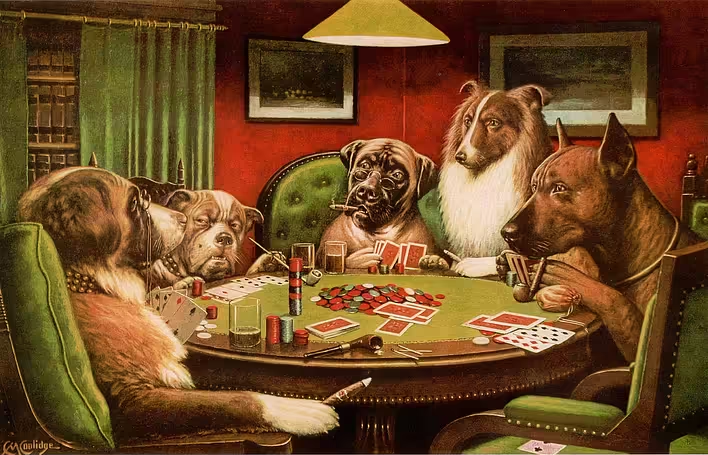
A Friend in Need is the most famous, but far from the only work by Coolidge from this world. In A Bold Bluff, a St. Bernard holds a weak hand and tries to convince others that he has a strong one. In Waterloo, the story continues: the bluff worked, and the same dog takes the winnings. Together, these two paintings read almost like a short comic about risk and self-control.
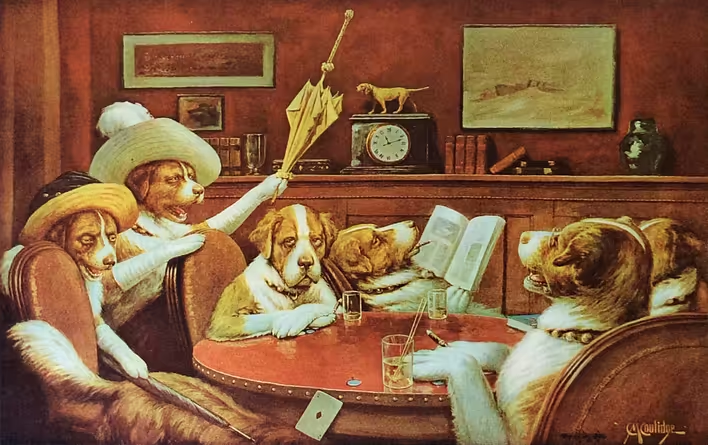
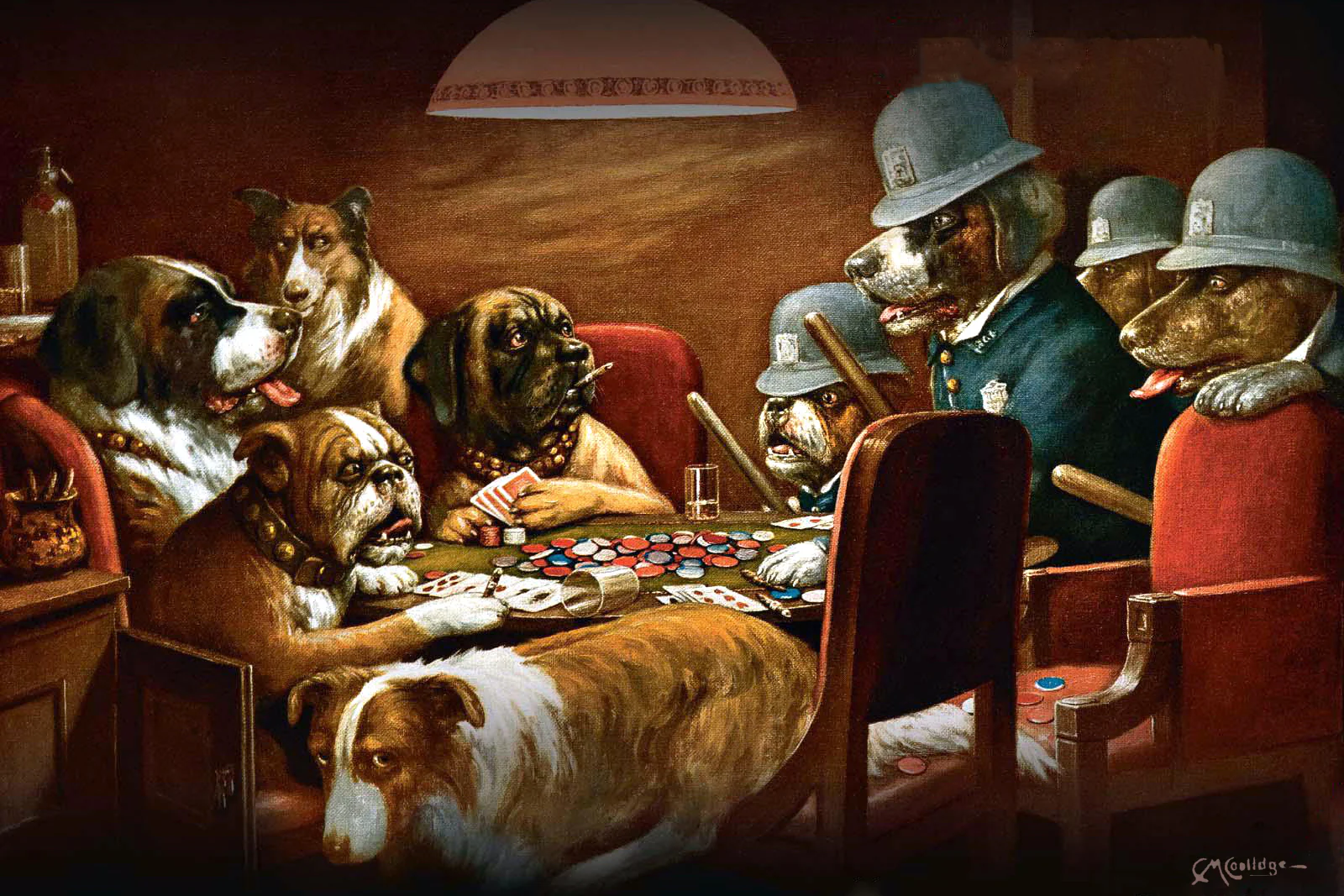
Poker Sympathy shows dogs in the moment of play, where not only the cards matter but also the reactions around the table. Pinched with Four Aces works with the theme of illegal gambling and exposure. Sitting up with a Sick Friend adds a domestic plot: the dogs are supposedly sitting with a sick friend, but in reality, they are spending the night playing poker.
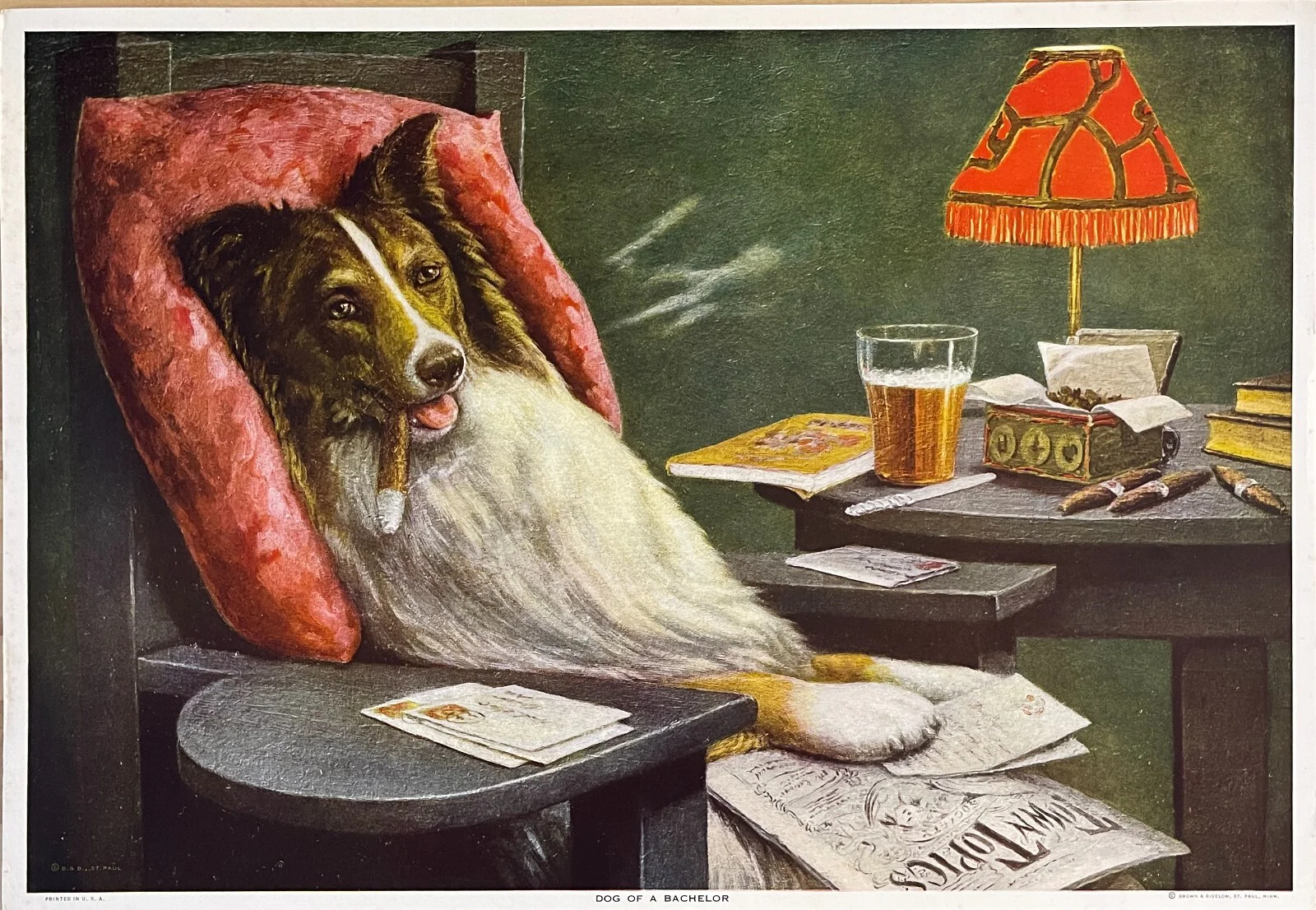
A Bachelor's Dog
Not all works by Brown & Bigelow were about poker. A Bachelor's Dog shows a bachelor dog reading mail. New Year's Eve in Dogville transports dogs to a ball scene. One to Tie Two to Win depicts a baseball plot. Ten Miles to a Garage works with the theme of a car adventure and breakdown. Riding the Goat parodies the rituals of fraternal societies. Coolidge built an entire dog theater of American life, where animals played the roles of humans in recognizable social situations.
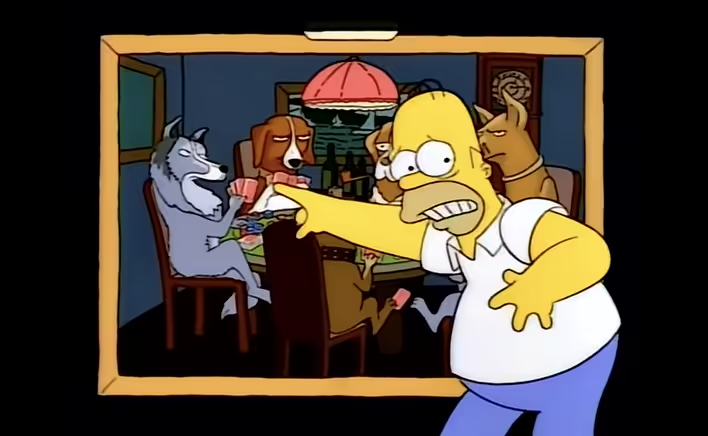
Сімпсони 5 сезон, 5 серія
Kitsch, Parody, and Cultural Resilience
In an art historical sense, "Dogs Playing Poker" is often labeled as kitsch. This word can sound like an insult: implying that what we have before us is not high art, but a mass-produced, somewhat funny, sentimental, or overly obvious image. But with Coolidge, things are more interesting. His works do not claim the depth of Rembrandt or the complexity of Cézanne. They are created for quick recognition and comedic effect. However, it is precisely because of this that they have become extraordinarily influential.
Kitsch does not always mean failure. Sometimes it is a form of cultural memory. People may not know the name A Friend in Need, not remember Coolidge's name, but they immediately recognize the dogs at the poker table. The image has become so firmly embedded in the mass imagination that it can be quoted without explanation.
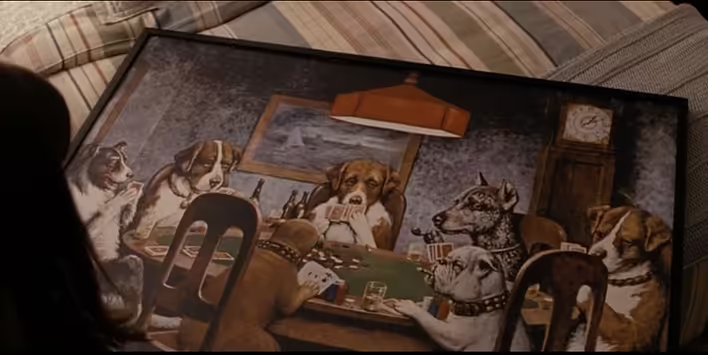
The series has been referenced and parodied in films, series, cartoons, advertisements, covers, and comics. The Simpsons, Family Guy, Cheers, The Thomas Crown Affair, The Accountant, and many other works have used this motif as a ready cultural sign.
фільм Аудитор 2016 р.
Ainu - an indigenous people of Northeast Asia, most closely associated with Hokkaido, the northernmost major island of Japan. However, their historical homeland is much broader:...