

This content has been automatically translated from Ukrainian.
The day changes into night, after spring comes summer, after the tide comes the ebb, and after an economic boom, a downturn often follows. Many processes in nature, society, and the economy repeat over and over again. Such phenomena are called cycles.
However, there are entirely different changes. For example, the development of digital technologies, the increase in human life expectancy, or the gradual rise in the use of renewable energy do not return to the starting point. They have a different nature and are described by the concept of trend.
Because both terms are related to changes, they are often confused. In fact, a cycle and a trend describe different ways of event development. Understanding this difference helps to better explain the phenomena we observe in nature, the economy, history, and everyday life.
What is a cycle
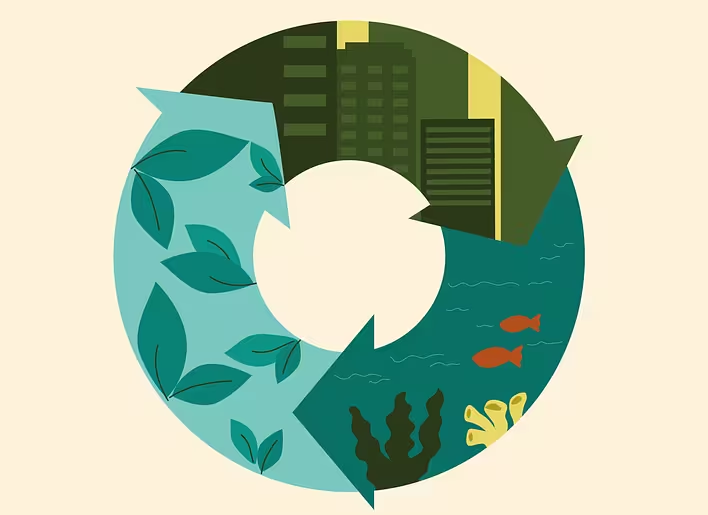
In simple terms, a cycle is a sequence of events or stages that regularly repeat in a certain order.
The main feature of a cycle is that after completing one round, the process starts again. It is the repetitiveness that distinguishes a cycle from most other types of changes.
There are countless examples of cycles around us. The Earth continuously rotates around its axis, changing day and night. The rotation around the Sun determines the change of seasons. In nature, there are cycles of plant development, the water cycle, seasonal migrations of animals, and even human biological rhythms.
A similar principle can be seen in society. Economists talk about economic cycles, historians discuss periods of rise and fall of states, and producers refer to the product life cycle, which goes through stages of creation, growth in popularity, maturity, and gradual decline in demand.
Despite the significant differences between these phenomena, they all share a common feature — their development occurs through repeated phases.
Origin of the word
The word “cycle” comes from the ancient Greek κύκλος (kyklos), which means “circle” or “circular motion”.
This origin very accurately conveys the essence of the concept. If we imagine changes as a straight line, that would be a trend. However, if the path returns to the starting point and repeats again, we have a cycle.
That is why the concept of a cycle is widely used in various sciences — from astronomy and biology to economics, history, psychology, and even literary studies.
Why the world is built on cycles
Humans began to notice cyclicality long before the emergence of science.
Our ancestors observed how the Sun rises and sets, how the seasons repeat, how the phases of the Moon change, and how periods of rain or drought come. It was thanks to these observations that the first calendars, agricultural systems, and methods of timekeeping were created.
Later, scientists discovered that cyclicality is inherent not only to nature. Similar patterns can be found in the development of the economy, demography, ecology, technology, and even culture.
At the same time, not every process in the world is cyclical. This is where the main difference between a cycle and a trend begins, which we will explore further.
Cycle and trend: what is the main difference
At first glance, a cycle and a trend may seem very similar. In both cases, we observe changes that occur over time.
However, there is a fundamental difference between them.
A cycle implies repetition. After completing one stage, the process returns to the starting point over time or goes through the same phases again.
A trend, on the contrary, describes the overall direction of development. It does not necessarily repeat and does not require a return to the original state. Its main characteristic is a gradual movement in a certain direction.
If we imagine these processes graphically, a cycle would resemble a circle or a wave, while a trend would be a line that gradually rises, falls, or remains stable.
This distinction is key to understanding many natural, economic, and social processes.
Why people often confuse a cycle with a trend
The reason is quite simple: we almost never see the whole picture at once.
A person evaluates events based on what is happening now or what has happened recently. Because of this, short-term changes can easily be perceived as the beginning of a new trend, even though they may just be another phase of a cycle.
For example, after several years of rapid economic growth, it may seem that it will continue indefinitely. However, history shows that the economy develops unevenly. Periods of growth are often followed by slowdowns or downturns, after which the cycle starts again.
A similar situation occurs in nature. An unusually warm summer or a very cold winter does not necessarily indicate a long-term climatic trend. An individual season may just be part of natural variability, while scientists analyze data over many decades to assess climate changes.
That is why researchers always try to separate temporary fluctuations from processes that truly change the overall picture.
Can a cycle and a trend coexist
Yes, and this is what makes analyzing the real world so complex.
Most major processes combine both cyclicality and long-term changes.
For example, the economy develops through repeating cycles of growth and decline. However, if we compare the level of economic development of different countries over several decades, we can also see general trends — increasing labor productivity, digitalization of production, development of new technologies, or changes in the labor market structure.
Similar observations can be made in nature. Seasons repeat every year, but at the same time, scientists record long-term climate changes that are not cycles in the usual sense.
That is why a cycle and a trend do not contradict each other. Very often, they operate simultaneously: a cycle describes short-term repeated changes, while a trend shows the overall direction of development.
How to distinguish a cycle from a trend
There are several simple questions that help to understand the nature of any process.
The first is does it repeat? If after completing a certain stage, events go through the same phases again, it is most likely a cycle.
The second is does the system return to the initial state? For cycles, such repetitiveness is natural, while a trend usually leads to a gradual accumulation of changes.
The third is what time scale are we analyzing? Short-term fluctuations may just be part of a cycle, while long-term observation often allows us to see a trend that remains unnoticed over short time intervals.
That is why scientists, economists, and analysts rarely draw conclusions based on a few isolated events. To understand the nature of changes, it is necessary to observe the process over a long period.
And here another interesting feature emerges: sometimes a long-term trend can change the cycle itself or even lead to its disappearance.
Can a trend change a cycle
At first glance, it may seem that a cycle and a trend exist separately. In fact, they constantly interact.
Long-term trends can gradually change even those processes that have seemed unchanging for centuries.
For example, the seasons remain a cyclical phenomenon, but climatologists are recording a long-term trend of increasing average temperatures on the planet. The cycle does not disappear, but its individual characteristics change: warm periods become longer, precipitation patterns change, and extreme weather events occur more frequently.
Similar processes occur in the economy. Economic cycles do not disappear, but digitalization, automation of production, the development of global trade, and new financial instruments gradually change their nature.
This clearly shows that even repeated processes do not remain absolutely unchanged.
Can a cycle give rise to a new trend
The opposite is also true.
Sometimes, it is the repeated occurrence of a certain phenomenon that becomes the beginning of a new long-term trend.
For example, if cities increasingly face periods of extreme heat over many years, this prompts changes in urban planning approaches. More green spaces are created, trees are planted, new materials for construction are used, and public space cooling systems are developed.
That is, a repeated phenomenon gradually shapes a new direction of development.
Similar processes can be observed in medicine, transportation, education, energy, and many other fields. This is how cycles and trends often interact with each other.
Why it is important to understand the difference
The ability to distinguish a cycle from a trend is useful not only for scientists.
For entrepreneurs, it helps to assess whether changes in the market are temporary or indicate a long-term restructuring of the industry.
For investors, it provides a better understanding of the nature of economic fluctuations and helps avoid confusing short-term downturns with sustainable changes.
For journalists and analysts, it allows for more accurate explanations of events, avoiding hasty conclusions.
And in everyday life, this skill allows for a more critical reception of information. Not every sharp rise or fall indicates the beginning of a new trend. And not every long-term change will repeat cyclically.
Frequently asked questions
What is a cycle in simple terms?A cycle is a process that goes through the same or very similar stages and regularly repeats.
How does a cycle differ from a trend?The main difference is that a cycle returns to previously passed phases, while a trend describes the overall direction of development without mandatory repetition.
Can one process be both a cycle and a trend?Yes. In many natural, economic, and social phenomena, cyclical changes occur simultaneously with long-term trends.
Why do people often confuse these concepts?Because short-term fluctuations can easily be perceived as the beginning of a new trend. To understand the true nature of the process, long-term observations and data analysis are needed.
A cycle and a trend are two different ways of describing changes.
A cycle helps to understand processes that repeat: the change of seasons, economic fluctuations, biological rhythms, or life stages of various systems.
A trend shows the overall direction of development — of technologies, society, the economy, or culture. It does not necessarily repeat, but it helps to see where changes are gradually heading.
In the real world, these phenomena almost always exist together. It is the combination of repeating cycles and long-term trends that shapes the processes defining the development of nature, science, the economy, and human civilization.
Understanding this difference allows for more accurate event analysis, avoiding hasty conclusions, and better seeing the patterns behind daily news and changes around us.