
This content has been automatically translated from Ukrainian.
In detective stories, a dossier often looks like a thick folder filled with photographs, biographies, and a few suspicious details. The hero opens it — and learns things about a person that they would prefer not to share. In everyday life, the meaning of the word is much broader: a dossier does not necessarily contain secrets and can relate to more than just a person.
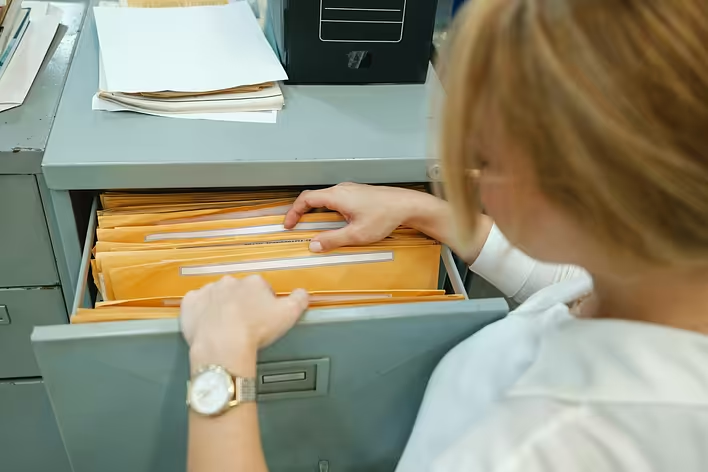
A dossier is a collection of documents and materials about a specific person, organization, event, case, or issue. This word also refers to the folder in which such documents are kept. The main point here is the common theme around which the information is gathered.
Where the word "dossier" comes from
The word is borrowed from French: dossier means, among other things, a collection of documents related to one case or person, as well as the folder containing them.
Its origin is linked to the French dos — "back." The connection becomes clearer when you imagine a folder of documents, on the back or spine of which it is noted what exactly it contains. The French Academy dictionary describes this very method of organizing materials. Interestingly, dossier in French also refers to the back of a chair or other seating.
In the Ukrainian language, the word has entered with a documentary meaning. The back of a chair in Ukrainian is not "dossier," even though in French both items share the same name.
What can be included in a dossier
The content of a dossier depends on why it is created. If it concerns a person, it may contain biographical information, education and work data, publications, interviews, photographs, and related documents.
A dossier on a company may combine information about its history, management, activities, financial indicators, and public projects. A dossier on a specific topic may include research, statistics, expert comments, and a chronology of events.
For example, a journalist is preparing material about the restoration of an old house. She collects archival photographs, previous projects, documents, and interviews. Together, these materials form a thematic dossier, even though there is no surveillance or search for compromising material involved.
A dossier does not have to be paper-based. It can exist as an electronic folder, a collection of files, or a record in a database with attached documents. The format changes, but the principle remains: materials are gathered around one object or issue.
Why a dossier is associated with secrets
This impression is supported by spy stories, criminal plots, and the very phrase "secret dossier." In this context, the folder can indeed contain closed information or investigation results.
However, secrecy is not inherent in the meaning of the word. A dossier can be compiled from open sources: official biographies, published documents, speeches, and interviews.
Similarly, a dossier is not synonymous with compromising material. Compromising material refers to information that can discredit a person or organization. A dossier can contain neutral, positive, and negative information — depending on the topic and purpose of gathering.
The name also does not guarantee accuracy. Even a convincingly presented collection may contain errors, outdated data, or unverified claims. It is important to look at the sources, dates, and whether facts are separated from assumptions.
How a dossier differs from a questionnaire, resume, and personal file
A questionnaire takes the form of questions or fields to fill out. It helps obtain information according to a specific scheme and can become one of the documents in a dossier.
A resume is a concise summary of professional experience, education, and skills, usually prepared for job searching. A dossier can be much broader and contain materials from various sources.
A personal file is an organized set of documents about a person, maintained by an institution for specific official needs. In a certain context, it can be described as a dossier, but these names should not be automatically substituted for one another: an official document has its own purpose and established name.
Thus, a dossier is the broadest of these concepts: it refers to a collection of materials, while a questionnaire, resume, or personal file specifies their form or function.
How to correctly write and use the word "dossier"
In Ukrainian, we write "досьє" — with a soft sign and the letter "є", without an apostrophe. It is an indeclinable noun of neuter gender: "full dossier," "new dossier," "the dossier contained important information."
The form of the word does not change: "to familiarize oneself with the dossier," "to add materials to the dossier," "to find an error in the dossier." In the plural, the spelling also remains the same: "several dossiers," "collected dossiers."
The phrase "to compile a dossier" means to select and organize materials. "To study the dossier" means to familiarize oneself with them. And when someone jokes, "You have a whole dossier on me!", it usually means that the interlocutor remembers an unusually large number of details — even if no folder actually exists.