The scent of time: why old books smell so pleasant
There are scents that instantly transport us to the past. The smell of rain after a heatwave, a wooden wardrobe in a grandmother's house, an old attic, or a library where books with yellowed pages have stood on the shelves for decades. But the smell of old ...
There are scents that instantly transport us to the past. The smell of rain after a heatwave, a wooden wardrobe in a grandmother's house, an old attic, or a library where books with yellowed pages have stood on the shelves for decades. But the smell of old books is special. It is warm, dry, slightly sweet, with notes of wood, vanilla, dust, and something ungraspably familiar.
Many people intuitively love this scent, although they rarely think about where it comes from. In fact, it is not just "the smell of paper." It is the result of slow chemical processes that take place over the years. A book ages, its materials gradually change, and the pages release microscopic molecules into the air. It is these molecules that create the scent we recognize from the very first breath.
This phenomenon has long intrigued scientists. The smell of old books is studied by chemists, restorers, museum workers, and cultural heritage preservation specialists. For some, it is a source of nostalgia, while for others, it is an important clue about the condition of the paper, its acidity, degree of degradation, and storage conditions.
A book smells not of "age," but of chemistry
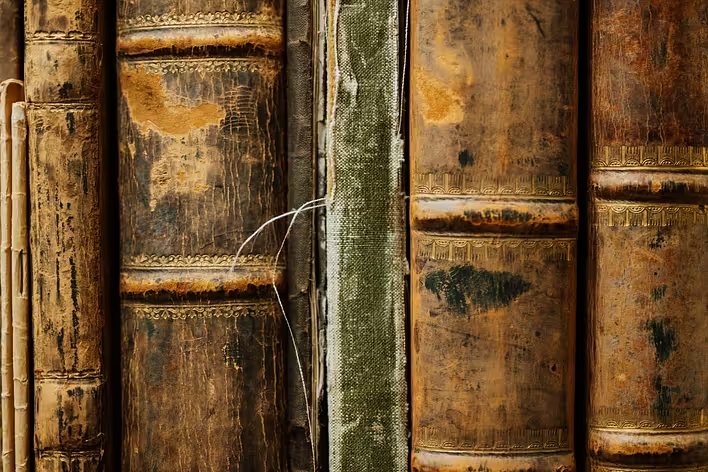
To understand the origin of this aroma, it is worth first looking at what a book is made of. Most publications contain paper, ink, glue, cardboard, fabric, leather, or other binding materials. All of these undergo natural changes over time.
The base of paper is cellulose — a natural polymer that makes up the cell walls of plants. Many types of paper, especially those made from wood, also contain lignin — a substance that provides strength and rigidity to wood.
It is lignin that plays one of the main roles in forming the characteristic smell of old books. Over time, it oxidizes and gradually decomposes, forming volatile organic compounds. These easily evaporate and enter the air, and we perceive them as the familiar book scent.
Thus, the smell of an old book is not something mystical, but a kind of chemical "portrait" of its aging.
Lignin, vanilla, and yellowed pages
Lignin is responsible not only for the smell but also for the yellowing of the paper. It is because of it that old newspapers, cheap books, and other publications printed on paper with a high content of wood fibers darken over the years, become brittle, and acquire a characteristic yellowish tint.
During the decomposition of lignin, aromatic compounds can form, including vanillin — the same aldehyde that gives vanilla its characteristic scent. This is why many people detect subtle vanilla notes in old books.
Of course, a book does not smell like vanilla in the same way that baked goods or desserts do. Rather, it is a soft sweet undertone that blends with the aromas of wood, dry leaves, and paper.
Additionally, depending on the composition of the paper, ink, glue, and storage conditions, the scent may contain notes of almond, hay, caramel, wood, or even a slight acidity.
What substances create the smell of an old book
In 2009, researchers published a paper Material Degradomics: On the Smell of Old Books, which showed that the smell of old books is formed by a whole complex of volatile organic compounds. Scientists studied which molecules are released during the aging of paper and how their composition can be used to assess the condition of book collections.
Among the most characteristic compounds are vanillin, benzaldehyde, furfural, toluene, ethylbenzene, and other organic substances. Each adds its own nuance: vanillin — sweetish, benzaldehyde — almond-like, furfural — warm woody-caramel, while other components can create grassy, dusty, or slightly sour notes.
Together, they form a complex aromatic bouquet that cannot be described in one word. It is not just the smell of paper or dust, but a combination of wood, time, and slow natural changes of materials.
This is why different books smell different. A 19th-century publication, a Soviet textbook, a library novel from the 1970s, or an ancient folio in a leather binding will never have the same scent.
Why new books smell different
New books also have a characteristic aroma, but it is quite different.
It has a stronger presence of printing ink, modern glues, cover coatings, fresh cellulose, and substances used during paper production.
This scent is usually sharper and "fresher." It arises not from aging, but from the evaporation of components that remain after printing and book production.
The aroma of an old edition develops over decades, making it seem much softer, deeper, and more complex.
The scent as a biography of the book
By the scent of a book, one can sometimes guess its history. Was it stored in a dry library, or did it lie in a damp attic? Did it stand next to wooden furniture, or did it spend many years in a closed cupboard?
A book not only releases its own volatile compounds but also gradually absorbs the scents of its surroundings. Therefore, its aroma is a combination of internal chemical processes and a long history of storage.
This is why restorers pay special attention to scent. If a book starts to smell sharply of dampness or mold, it may be a sign of paper damage and the development of microorganisms.
Why we like this scent
Chemistry explains the origin of the smell of old books, but it does not fully answer the question of why it seems so pleasant.
Here, the human brain plays a role. Smell is directly linked to centers of memory and emotions, so scents can instantly evoke vivid memories. The aroma of an old book can take us back to a childhood library, a parent's bookshelf, a university reading room, or evenings with a favorite novel.
Moreover, many substances that make up the book aroma remind us of scents that people traditionally perceive as pleasant: vanilla, almond, wood, or dry leaves. Even if we cannot consciously break down this aroma into individual components, the brain often perceives it as warm and cozy.
The smell of a library as cultural heritage
Today, the smell of old books is studied not only by chemists but also by cultural heritage researchers.
In 2017, scientists from the UCL Institute for Sustainable Heritage studied the aroma of the historic library of St. Paul's Cathedral in London. Visitors were asked to describe the smell of the room, and they most often mentioned wood, vanilla, smoke, earth, chocolate, and dust.
Based on these descriptions, researchers created a kind of "smell wheel of historical books" — a system that helps describe the aromas of old libraries and use them in the study of museum collections.
This serves as a reminder that cultural heritage is not just texts, paintings, or architecture. It can also include sounds, atmosphere, and even smells.
When a pleasant scent indicates decay
There is a certain paradox in this scent. What we perceive as the pleasant aroma of an old book is often the result of its slow decay.
Cellulose gradually breaks down, lignin oxidizes, and the paper fibers become increasingly weaker. Pages yellow, crumble, and lose strength.
For libraries, archives, and museums, this scent serves as a kind of indicator of the book's condition. Analyzing volatile organic compounds allows for assessing the degree of paper aging without damaging the publication itself.
How to store old books
If you have old books at home, it is essential to ensure proper storage conditions. High humidity, sharp temperature fluctuations, direct sunlight, dust, and mold are the most damaging to paper.
Books are best kept in a dry, well-ventilated room, away from heating batteries and damp walls. It is not recommended to tightly wrap them in polyethylene, as moisture can accumulate inside, creating favorable conditions for the development of fungi.
If a book has a pronounced smell of mold, dark spots, or signs of moisture, it is advisable to isolate it from other publications to prevent the spread of microorganisms.
Why this scent is almost impossible to reproduce
Today, there are perfumes, scented candles, and diffusers with the smell of a library or old books. Some of them quite successfully convey woody, vanilla, and paper notes. However, fully reproducing the scent of a genuine old book is almost impossible.
The reason is simple: it does not consist of a single substance. It is an extraordinarily complex mixture of hundreds of volatile compounds influenced by the age of the book, the composition of the paper, ink, and glue, the type of binding, temperature, humidity, storage location, and even the people who held it.
This is why each old book has its unique aroma — just like its own story. It is not only the result of chemical processes but also a kind of chronicle of the book's life that cannot be read but can be… felt.
In spring and early summer, the streets, gardens, and yards are filled with a sweet floral aroma. At this time, you can often hear: “The jasmine has bloomed.” However, in most c...