

This content has been automatically translated from Ukrainian.
Today, a flat roof is associated with minimalism, expensive villas, Scandinavian architecture, and modern office buildings. For many, it is a symbol of cutting-edge technology and design trends. However, surprisingly, the flat roof is one of the oldest architectural forms in the world. People began building houses with horizontal roofs long before the advent of tiles, attics, and even most known civilizations.
Its history is not the story of a single inventor. The flat roof emerged naturally in various corners of the world and has repeatedly gone through periods of oblivion and resurgence over the millennia.
The Oldest Flat Roofs: Mesopotamia, Egypt, and the Middle East
The first flat roofs appeared as early as the Neolithic era. Archaeologists find traces of them in settlements from the 7th–8th millennia BC. They became most widespread in Mesopotamia, Egypt, Persia, and throughout the Middle East.
The reason was quite simple. In a dry climate, there was no need for steep slopes to drain snow and heavy rains. On the contrary, a flat roof provided additional usable space, which was especially important in dense urban development.
The technology was quite simple. Wooden beams were laid on stone or mud-brick walls, on top of them were branches, reeds, straw, and a layer of clay or earth was poured and compacted on top. The resulting surface became strong and suitable for everyday use.
In ancient Egypt, people spent a significant part of the day on roofs. They dried grain, stored harvests, engaged in crafts, and rested after sunset when the heat subsided. In some regions, people even slept under the open sky.
When the Roof Was Another Floor
For the inhabitants of ancient cities, the roof was not just protection from rain. It actually served as an additional room.
Particularly interesting is the story of the settlement of Çatalhöyük in modern Turkey. This city is over nine thousand years old, and its houses were so closely located that there were almost no streets between them. People moved around on the roofs and entered their homes through openings in the ceilings using ladders.
Essentially, flat roofs formed a whole system of streets and public spaces. Modern architects often refer to Çatalhöyük as one of the earliest examples of a multi-level city.
Why Europe Preferred Sloped Roofs?
A flat roof was well-suited for dry climates, but in Northern and Central Europe, the situation was quite different. Abundant rains, heavy snowfalls, and prolonged frosts required a different solution.
Thus, the tradition of gabled and hipped roofs gradually formed. Snow did not accumulate on them, and water quickly drained away. Moreover, the wooden structures of medieval houses worked better with sloped roofs.
For many centuries, flat roofs remained a rarity in European architecture. They could mostly be seen in Mediterranean countries, North Africa, and the Middle East.
Ancient Rome and the Concrete Revolution
The Romans already knew concrete well and could span large spaces. They created the famous domes and vaults that still impress with their engineering perfection.
Although most residential buildings in Rome had sloped roofs, flat ceilings were found on the terraces of wealthy villas and public buildings. They became a kind of precursor to modern usable roofs.
After the fall of the Roman Empire, many building technologies were lost, and sloped roofs once again dominated European architecture.
The 19th Century: The Birth of the Modern Roof
A true revolution occurred in the 19th century with the advent of steel, cement, and reinforced concrete. New materials allowed for covering large areas without complex wooden structures.
However, the main problem remained — waterproofing. Old flat roofs often leaked, and repairs were expensive and complicated.
Only the emergence of bituminous materials and new insulation technologies in the late 19th to early 20th century made the flat roof truly reliable.
Le Corbusier and the Return of the Flat Roof
If ancient peoples created the flat roof, then Swiss-French architect Le Corbusier brought it back into fashion.
In the 1920s, he formulated his famous "Five Points of Modern Architecture." One of them was the roof garden. The architect believed that a building should compensate nature for the space it occupies on the ground. Therefore, the roof should be transformed into a terrace, a place of rest, or even a small park.
His ideas had a huge impact on 20th-century architecture. Villa Savoye near Paris became one of the symbols of the new approach. The flat-roofed house looked almost futuristic and set the direction for the development of modernism for decades to come.
Bauhaus and the Cult of the Straight Line
In Germany, the Bauhaus movement developed in parallel, with its representatives rejecting ornate decor and historical stylizations.
Walter Gropius, Ludwig Mies van der Rohe, and other architects proclaimed the principle: form should follow function. Simple geometric volumes, large windows, and flat roofs became the new language of architecture.
Thanks to modernism, the flat roof began to be associated with progress, technology, and the future.
Despite the popularity of modernism, in many countries, people viewed the new architecture with skepticism. In cold regions, early flat roofs indeed had problems: they leaked, poorly withstood snow loads, and required constant maintenance.
This led to a stereotype among many that flat roofs were unreliable.
Partially, it was justified, but the problem lay not in the form itself but in the imperfection of the technologies.
The 21st Century: A Second Birth
Today, flat roofs are experiencing a true renaissance. Modern membranes, insulations, and drainage systems have made them much more reliable than a hundred years ago.
The roof is no longer perceived as just a simple "lid" for the house. It is transformed into a full-fledged living space.
On roofs, people create:
- terraces and lounge areas;
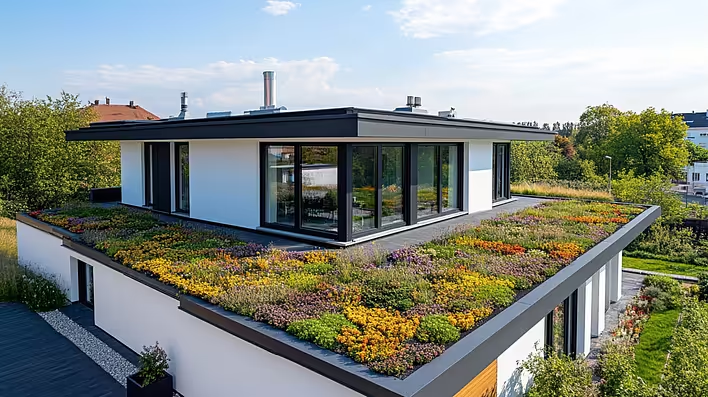
- gardens and green roofs;
- swimming pools;
- sports fields;
- cafes and restaurants;
- solar power stations;
- rainwater collection systems.
In large cities, where every square meter is valuable, the roof effectively becomes another floor.
An Architectural Form Thousands of Years Old
Paradoxically, one of the most modern architectural trends is also one of the oldest. From the mud-brick houses of Mesopotamia to futuristic villas and skyscrapers, millennia have passed, but the very idea has hardly changed.
The flat roof has always been more than just a roof. For the inhabitants of ancient Egypt, it was a place of rest; for modernist architects, it was a symbol of a new world; and for people in the 21st century, it is a way to reclaim a bit of space amidst concrete and glass.
That is why the history of the flat roof is not just a story of building technologies. It is a story of how humanity learned to use every meter of space above its own head.