
This content has been automatically translated from Ukrainian.
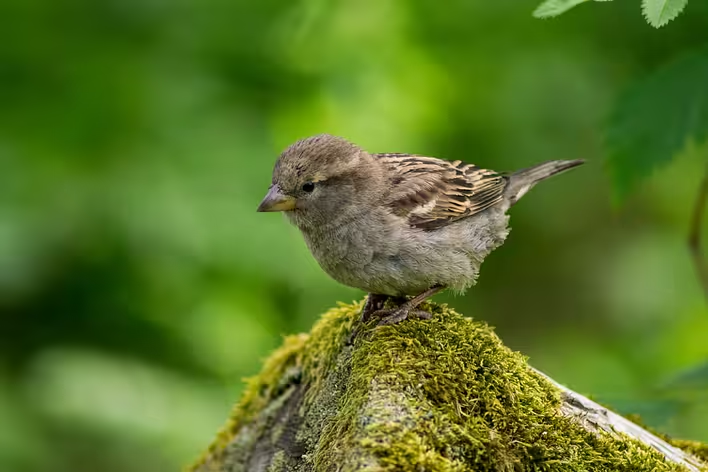
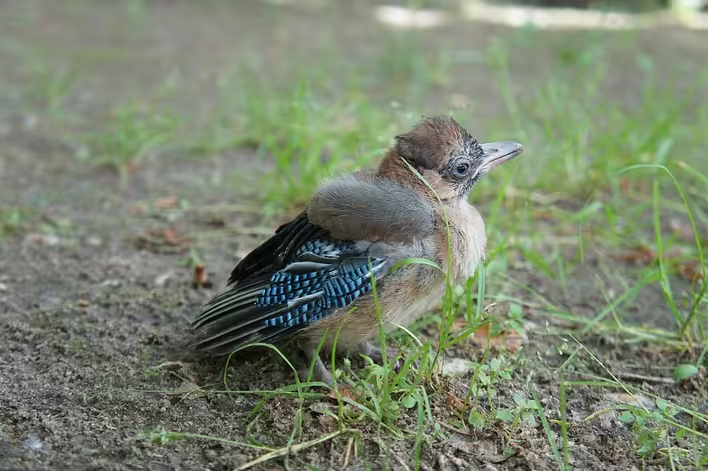
At the end of spring and the beginning of summer, in parks, gardens, and even in the yards of high-rise buildings, one can see an unusual sight: a small bird sitting on the ground, awkwardly hopping, chirping loudly, and showing no fear of people. Many feel a natural desire to help and take it home or take it to the veterinarian. However, in most cases, this is unnecessary. What you are likely seeing is not an abandoned chick, but a fledgling.
What are fledglings?
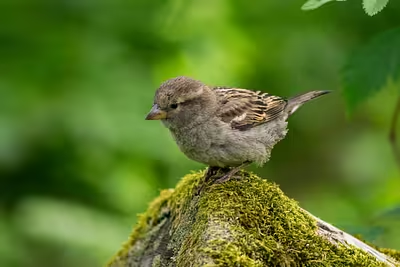
Fledglings are young birds that have already left the nest but are not yet fully independent. They are like "teenage birds." They are already covered in feathers, can stand on their feet, hop, and even fly a little, but they do so awkwardly for now.
For many species of birds, this developmental stage is completely natural. The parents no longer keep the chicks in the nest and allow them to gradually explore the surrounding world, find shelter, and learn to fly confidently.
That is why fledglings are often seen on the ground, on the lower branches of trees, or in bushes. This does not mean they have fallen from the nest or have been abandoned.
What does a fledgling look like?
A fledgling can be easily recognized by several characteristic features. It already has feathers, but its tail is still short, and there are noticeable yellowish edges around its beak — the so-called "baby lips." Such chicks often sit still or move with short hops and can make loud chirping sounds.
At first glance, they seem helpless, but this is just part of the natural process of growing up.
Most often, people find fledglings of thrushes, starlings, tits, sparrows, jays, and other songbirds.
Why are the parents often not visible?
Many people think that if there are no adult birds nearby, the chick has been left orphaned. In fact, the parents are almost always nearby; they just go unnoticed by humans.
Adult birds regularly come to their young with food but may deliberately keep their distance if a person is nearby. Therefore, it is worth stepping back and observing for at least 15–20 minutes. It is very likely that you will see one of the parents come to feed their young offspring.
Why should you not take a fledgling home?
The most common mistake is trying to rescue a perfectly healthy bird. A person acts with good intentions but actually takes the chick away from its parents.
Even if you feed a fledgling at home, it is very difficult to replace the adult birds. Young birds require a special diet, constant care, and gradual learning of survival skills. Most of these "rescued" chicks do not return to the wild.
It is no coincidence that ornithologists say: you are responsible for the chick you take. Therefore, the best help is not to interfere unnecessarily.
When does a chick really need help?
Intervention is only necessary in a few cases:
- the bird has wounds or bleeding;
- a broken wing or leg is visible;
- the chick is completely naked or almost featherless (this is no longer a fledgling but a nestling);
- it has been attacked by a cat or dog;
- the bird is lying on its side, almost unresponsive to the environment, or cannot stand;
- the fledgling is in the middle of the road or in another dangerous place.
In such cases, it is advisable to contact rehabilitation centers or organizations that deal with the rescue of wild animals.
What to do if a fledgling is in a dangerous place?
If the chick is on the roadway, a busy sidewalk, or in a place where it could be caught by cats or dogs, it can be carefully moved a few meters to the side — into a bush, onto a lower branch of a tree, or to another cozy spot nearby.
Do not worry that the parents will reject the chick due to human scent. In most songbirds, the sense of smell is poorly developed, and they will continue to care for their offspring.
The main rule is not to move the fledgling far from the place where you found it.
Fledglings may seem helpless, but this is actually a normal and important stage in the life of birds. They have already left the nest but are still under the care of their parents, learning to fly, find food, and avoid dangers.
So, if you come across such an awkward "teenage bird," do not rush to rescue it. In most cases, the best help is simply to allow it to grow up as nature intended.