Prevention of Alzheimer's disease: what activities do scientists recommend
The disease of Alzheimer’s is often perceived as something fatal: if there is a genetic predisposition or age, then nothing can be changed. In reality, modern science views this differently. It is impossible to completely “insure” against Alzheimer’s, but i...
The disease of Alzheimer’s is often perceived as something fatal: if there is a genetic predisposition or age, then nothing can be changed. In reality, modern science views this differently. It is impossible to completely “insure” against Alzheimer’s, but it is possible to reduce the risk or delay cognitive decline. And it is not about one magic pill, but about a lifestyle: movement, learning, social connections, sleep, nutrition, blood pressure control, hearing, and mood.
In 2024, the commission of the journal The Lancet on dementia prevention updated the list of risk factors and concluded that about 45% of dementia cases worldwide are potentially related to modifiable factors. Among them are low education level, physical inactivity, social isolation, depression, smoking, hypertension, obesity, diabetes, hearing and vision impairments, excessive alcohol consumption, head injuries, air pollution, and high levels of LDL cholesterol.
This means that the brain does not age in isolation. It is influenced by blood vessels, metabolism, sleep, stress, communication, movement, and whether it receives new challenges.
Movement: the simplest way to support the brain
Physical activity is one of the best-researched ways to maintain cognitive health. It does not necessarily mean going to the gym or marathons. What matters for the brain is regularity and moderate load: brisk walking, swimming, cycling, Nordic walking, gardening, dancing, light strength exercises.
Why does this work? Movement improves blood supply to the brain, helps control blood pressure, sugar levels, weight, and inflammatory processes. Moreover, physical activity is associated with better hippocampal health — a part of the brain important for memory.
Interestingly, modern reviews show that the effect of physical activity may not be dramatic for each individual, but at the population level, it is significant. Even if movement does not “cancel” the risk of dementia, it helps delay cognitive decline and supports overall brain health.
The best strategy is not heroic bursts, but daily mobility. For example, 30–40 minutes of brisk walking several times a week, short breaks throughout the day, and minimizing prolonged sitting.
Dancing: when body, memory, and sociability work together
Among all types of activities, dancing often appears particularly interesting. It combines physical exertion, coordination, memorizing movements, music, rhythm, and social interaction. This means that the brain is not just “moving the body,” but is constantly predicting, memorizing, adapting, and reacting.
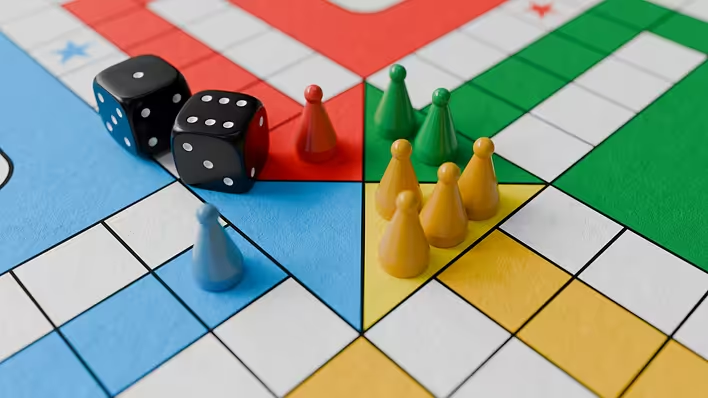
In a well-known study published in The New England Journal of Medicine in 2003, scientists observed elderly people and analyzed which types of leisure activities were associated with a lower risk of dementia. Among the activities that had a positive connection were reading, board games, playing musical instruments, and dancing.
Dancing is also interesting because it naturally engages emotions. It is easier for a person to regularly attend a dance class than to force themselves to perform exercises that do not bring joy. In dementia prevention, regularity is often more important than an ideal program.
Reading, board games, and learning: the brain needs challenges
The brain loves novelty. When a person reads, learns a language, plays chess, solves puzzles, writes texts, draws, or acquires a new skill, they train attention, memory, imagination, and the ability to build connections between ideas.
This is often explained by the concept of “cognitive reserve.” In simple terms, it is a reserve of brain flexibility that helps it cope longer with age-related changes or pathological processes. A person with a higher cognitive reserve can remain functionally active longer even when certain changes are already occurring in the brain.
Leisure studies show that cognitively active activities are associated with a lower risk of dementia. Reading, board games, music, writing, working with computers, crosswords, crafts, and learning are particularly frequently mentioned.
However, it is important not to reduce everything to “solving crosswords.” If a person spends their whole life solving similar tasks, the brain quickly shifts into automatic mode. It is more beneficial to give oneself new challenges: read more complex books, learn a foreign language, master photography, keep a diary, take courses, learn to use new programs or tools.
Music: playing, singing, listening attentively
Music is not just emotions. For the brain, it is a complex exercise: one needs to recognize rhythm, melody, structure, remember sequences, coordinate movements, listening, and attention. If a person plays an instrument, the load becomes even richer.
In studies, playing a musical instrument has repeatedly been associated with better cognitive health in older age. Meta-analyses have also shown an association between playing an instrument and a lower risk of dementia. This does not mean that one must necessarily become a professional musician. Even amateur music-making, singing in a choir, or regular vocal lessons can be valuable, especially if they are combined with learning and communication.
A separate advantage of music is that it is accessible at any age. A person can start with simple things: singing, learning new songs, playing the ukulele, piano, flute, drums, or any other instrument that brings joy.
Social connections: the brain is not made for isolation
Loneliness and social isolation are not just psychologically unpleasant states. They are associated with a higher risk of cognitive decline and dementia. Social life forces the brain to constantly work: listening, responding, reading emotions, remembering shared stories, planning meetings, negotiating, empathizing.
That is why not only “intellectual” activities can be beneficial, but also volunteering, interest clubs, choirs, dance groups, gardening communities, book clubs, board games with friends, and joint walks.
It is important that it is not about the number of contacts in the phone, but about the quality of connections. Regular live interaction, a sense of being needed, and belonging to a community can be just as important for the brain as learning or physical activity.
Crafting, gardening, and creativity: “quiet” activities with great benefits
At first glance, knitting, painting, sculpting, gardening, or cooking may seem just a pleasant pastime. But for the brain, these are multi-layered tasks. One needs to plan, maintain a sequence of actions, work with hands, correct mistakes, envision the outcome, and coordinate movements and attention.
Such activities are particularly valuable because they combine sensory experience, fine motor skills, and emotional satisfaction. Gardening also adds physical activity, exposure to light, contact with nature, and a sense of the cycle: planting, caring, observing, and harvesting results.
In large leisure reviews, creative and practical activities — crafts, sports, volunteering, social activities — have also been associated with a lower risk of dementia. Therefore, Alzheimer’s prevention does not necessarily have to look like “brain training.” Sometimes it can be a garden, watercolor painting, ceramics, repairing old furniture, or a board game club.
Nutrition is also important
Nutrition is not a one-time action, but a daily habit. The MIND diet has received the most attention in the context of dementia — a combination of the Mediterranean approach and the DASH diet for blood pressure control. It emphasizes leafy green vegetables, berries, whole grains, legumes, nuts, fish, poultry, olive oil, and limits red meat, butter, fried foods, sweets, and ultra-processed products.
The Rush Memory and Aging Project showed that higher adherence to the MIND diet was associated with a lower risk of Alzheimer’s disease and slower cognitive decline. Importantly, even moderate adherence to the MIND diet appeared promising in some studies.
Practically, this means: cook simple meals with vegetables, legumes, grains, fish, berries, and nuts more often; rely less on sausages, sweet snacks, fast food, and fried dishes. For the brain, this cuisine works not magically, but through blood vessels, inflammation, metabolism, and overall body condition.
Sleep: the nighttime “prevention” that is often underestimated
Sleep is not a passive pause, but a time when the brain sorts information, recovers, and regulates many biological processes. Chronic sleep deprivation in middle age is associated with an increased risk of dementia later in life.
In a large study published in Nature Communications in 2021, short sleep duration at ages 50–60 was associated with a higher risk of dementia. Particularly unfavorable was persistent short sleep over many years.
An activity that may seem “not serious” is to establish sleep. Go to bed and wake up at approximately the same time, reduce evening light from screens, avoid overloading oneself with news before sleep, treat sleep apnea if present, and not perceive constant fatigue as normal.
Control of blood pressure, hearing, and vision: not romantic, but very important
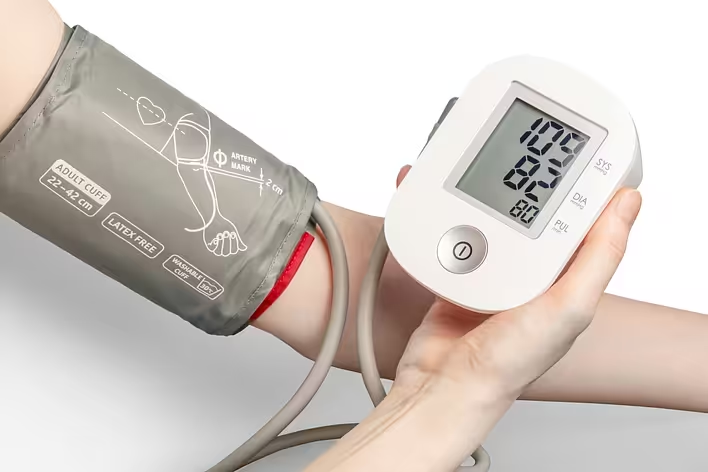
Some preventive “activities” do not look inspiring, but they have a strong foundation. Regularly measure blood pressure. Check hearing. Do not ignore glasses. Treat diabetes. Work on depression. Quit smoking. Limit alcohol.
Hypertension damages blood vessels, and the brain heavily relies on normal blood supply. In the SPRINT-MIND study, more intensive blood pressure control reduced the risk of mild cognitive impairment, although the results regarding probable dementia were more complex and required longer observation.
Hearing impairment is also important: when a person hears worse, the brain spends more resources on speech recognition, and social contacts may gradually narrow. Therefore, hearing aids, hearing checks, and normal communication are not just about comfort, but also about supporting cognitive health.
A combination works best, not a single activity
One of the most convincing examples is the Finnish FINGER study. In it, older adults at increased risk of cognitive decline were offered a comprehensive program: nutrition, physical exercise, cognitive training, and control of vascular risk factors. After two years, the intervention group had better cognitive outcomes than the control group.
This is a very important conclusion. The brain is not protected by one crossword, one walk, or one “superfood.” The best system works: moving, learning, communicating, sleeping well, eating without extremes, and monitoring the health of blood vessels, hearing, and mood.
So what to do right now?
The most realistic prevention of Alzheimer’s is not an ideal life, but a life in which the brain regularly receives movement, meaning, novelty, and support.
You can start small: walk briskly every day, dance or swim once a week, read books, meet people, learn a language, play board games, sing, plant, cook simpler and healthier meals, measure blood pressure, and finally check hearing or vision if you have been putting it off for a long time.
The best activities for the brain are those that a person can truly repeat for years. Because Alzheimer’s prevention does not start in the lab or in old age. It consists of everyday decisions: taking a walk, calling a friend, learning a new melody, preparing a vegetable dinner, going to bed on time, and leaving space for the brain to live.
There is no single answer to this question — and anyone who claims otherwise simply does not understand how language learning works. However, there are specific factors that det...