More than things: what really lies behind the desire to collect
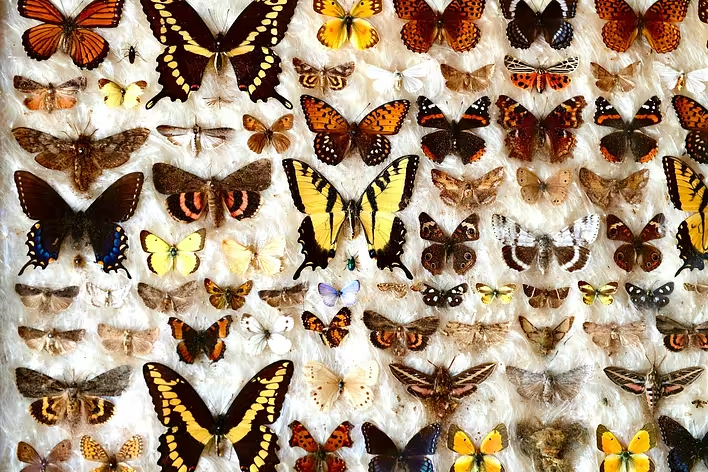
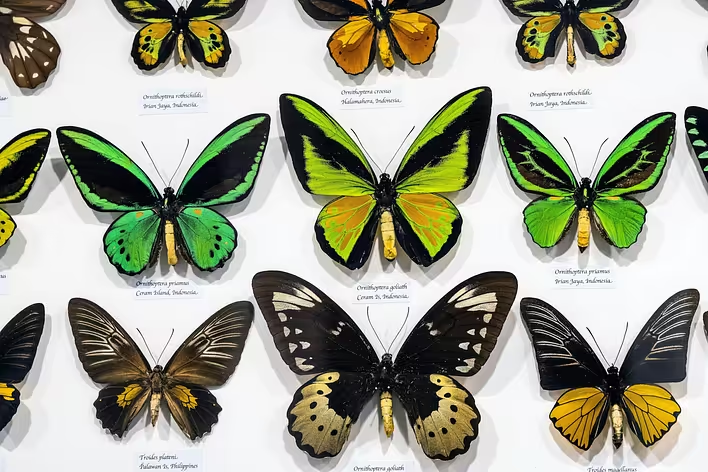
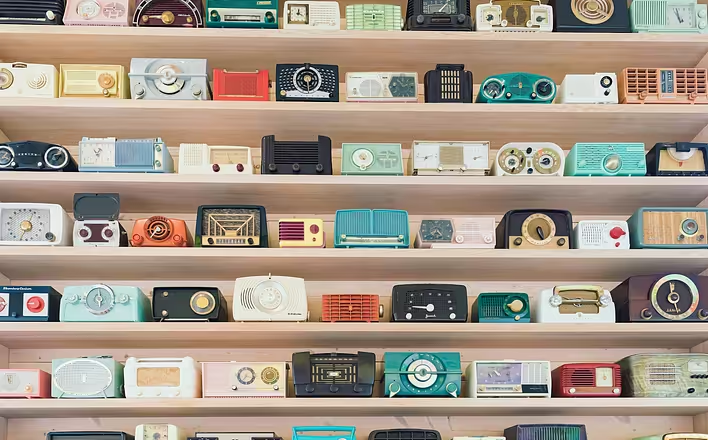
Collecting seems like a simple hobby: people collect stamps, coins, books, vinyl records, figurines, postcards, shells, old cameras, or even tickets from travels. But behind this activity often lies much more than the desire to have many similar items.A col...
Collecting seems like a simple hobby: people collect stamps, coins, books, vinyl records, figurines, postcards, shells, old cameras, or even tickets from travels. But behind this activity often lies much more than the desire to have many similar items.
A collection is not just a set of things. It is a story, organized according to a certain logic. It can tell about childhood, travels, passions, taste, profession, or even a person's way of explaining the world to themselves. That is why an old postcard may be just a piece of cardboard to an outsider, while for a collector it is a rare find, a memory, and a small victory at the same time.
Psychologists have long noticed: collecting combines memory, emotions, curiosity, the desire for order, the search for one's identity, and the satisfaction of completeness. This activity can be intellectual, aesthetic, nostalgic, thrilling, or almost exploratory. That is why it has accompanied humanity for many centuries.
A Collection as a Way to Organize the World
The human brain loves structure. We constantly group items by color, shape, origin, value, time, style, or significance. Collecting is one of the most vivid manifestations of this natural need.
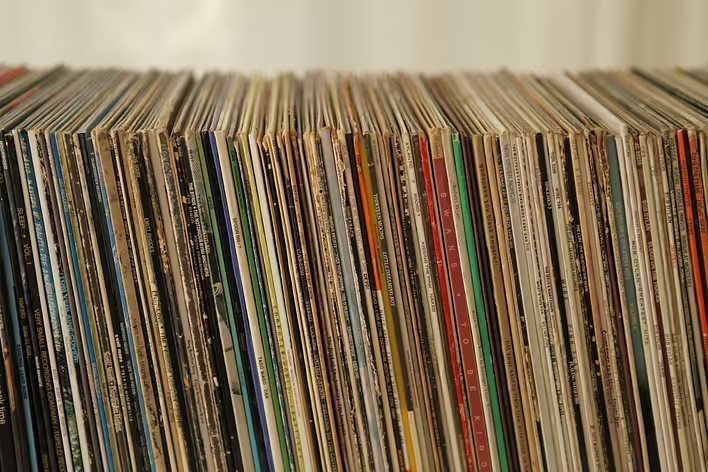
When a person collects items of a certain type, they are not just accumulating them; they are creating their own system. For example, coins can be organized by countries, years, metals, or historical periods. Books can be organized by authors, genres, publishers, or first editions. Vinyl can be organized by artists, recording years, or musical styles.
There is a special satisfaction in this. The world around is chaotic and unpredictable, while a collection creates a small space where everything can be organized, understood, and complemented. It is a small universe in which each item occupies its place.
That is why for many collectors, not only the items themselves are important, but also the catalogs, albums, boxes, shelves, labels, and the stories of each exhibit's origin.
The Joy of Searching and the Dopamine System
One of the main reasons why collecting is so captivating is the pleasure of searching.
A person may spend months looking for a specific book, a rare coin, an old postcard, a figurine from a certain series, or a vinyl record in the right edition. When the long-desired item is finally found, a strong feeling of joy arises.
This is related to the functioning of the brain's dopamine system. Dopamine is often called the "pleasure hormone," although it is actually largely responsible for motivation, reward anticipation, and goal pursuit. The strongest emotional uplift often occurs during the search, rather than after obtaining the desired item.
Therefore, collecting is not just about owning items. It is a kind of hunting. A person browses flea markets, auctions, second-hand bookstores, online platforms, or flea markets, compares options, checks authenticity, doubts, rejoices in a find, and already thinks about the next one.
Sometimes the next exhibit becomes more interesting than all the previous ones. It is the search process that maintains interest and turns collecting into a long-term passion.
Nostalgia and the Desire to Hold Time
Many collections are born from nostalgia.
People collect toys from childhood, old magazines, postcards, cassettes, badges, books from a certain publisher, or items that remind them of a specific era. Such items become a kind of material "anchors" of memory.
The smell of an old book, the sound of a cassette, the weight of a metal camera, or the cover of a favorite magazine can instantly transport one back to long-past events. A collection seems to allow one to touch time that will never return.
Research shows that nostalgia does not necessarily mean living in the past. On the contrary, it helps a person feel a connection between different stages of their life. That is why many items acquire a special value that cannot be measured in money.
Collecting and the Sense of Personal Identity
What a person collects often says a lot about them.
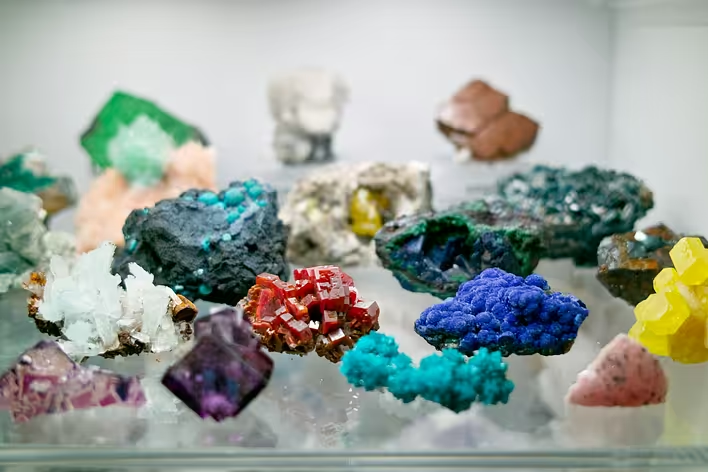
A collection can become an answer to the question: "Who am I?" A lover of old maps sees themselves as a historian, a vinyl collector as a music connoisseur, and a person who collects minerals as a nature explorer.
Through items, we show ourselves and others what fascinates us, which eras, ideas, or stories matter to us.
Thus, a collection can be compared to an autobiography written not in words, but in things. Each exhibit answers not only the question "what is this?" but also "why is this important to me?".
Rarity, Status, and the Desire to Own the Unique
In collecting, rarity is of great importance.
An item can be valuable not because it is beautiful or practical, but because it is extremely hard to find. Limited editions, printing errors, first editions, autographs, considerable age, or unusual condition significantly enhance its appeal.
People like to own something special. A rare item creates a sense of exclusivity. For many, it is not a matter of prestige, but the joy of having found a truly unusual item.
Moreover, rare exhibits require knowledge. To appreciate their true value, one needs to have a good understanding of history, materials, manufacturers, or the specifics of certain series. That is why many collectors eventually become true experts in their field.
A Collection as a Game with Completeness
Another powerful psychological mechanism is the desire to complete a set.
If a series consists of ten items and a person already has nine, the last one starts to seem the most valuable.
Psychologists associate this with the so-called Zeigarnik effect: the brain remembers better what has not yet been completed and strives to finish what has been started.
That is why collectors may search for the last missing exhibit for years, although it may seem almost the same as all the others to an outsider.
The Social Side of Collecting
Although collecting is often perceived as an individual hobby, it has a distinct social dimension.
Collectors exchange information, buy and sell items, attend exhibitions, fairs, forums, auctions, and interest clubs. They discuss the authenticity of exhibits, help each other find rare items, and share their experiences.
This gives rise to entire communities where not only the items themselves are important, but also the people who share the same passion.
This is especially noticeable today among fans of comics, board games, anime, or music, where a collection often becomes part of belonging to a certain cultural community.
Children's Inclination to Collecting
The desire to collect things often arises in childhood.
Children collect stones, shells, stickers, wrappers, cards, chestnuts, leaves, or small "treasures" found during walks. To an adult, this may seem trivial, but for a child, each item has its own story.
This activity helps learn to classify the world, compare items, notice details, and create a system independently.
It is in children's collections that the main feature of this hobby is best seen: the value of an item is determined not by its market price, but by the significance that the owner attributes to it.
Collecting, Control, and the Sense of Calm
For many people, collecting has another important function — it helps to feel calm.
When life seems chaotic, a collection remains a place where everything can be organized. It can be reviewed, cleaned, cataloged, rearranged, or supplemented.
This is especially noticeable where order is important: in stamp albums, coin capsules, bookshelves, or digital catalogs.
Such rituals can act almost meditatively. A person returns to a familiar structure where everything is clear and under control.
The Line Between Collecting and Hoarding
It is important to distinguish between healthy collecting and compulsive hoarding.
A collector usually has a clear theme, selection criteria, a storage system, and can explain why a particular item is part of the collection. Their passion brings satisfaction and does not interfere with everyday life.
Hoarding has a different nature. A person finds it difficult to part with almost any items, even if they have no practical or emotional value, take up living space, or create domestic problems.
The main difference lies in control. If a person manages their collection, it is a hobby. If items start to control the person and cause strong anxiety at any attempt to throw something away, such a situation may indicate a psychological problem.
Digital Collections: A New Form of an Ancient Need
Today, collecting has long gone beyond physical items.
People collect digital photographs, playlists, e-books, game items, saved articles, movie collections, screenshots, or virtual cards.
The nature of the items has changed, but the psychological mechanism remains almost the same.
A digital collection also provides a sense of order, helps preserve memories, and reflects a person's interests. A playlist can be just as personal an archive as a box of old cassettes, and a collection of photographs can serve as a kind of diary of lived moments.
Why Collections Outlive Their Owners
Collections often continue to live even after their owners.
They can turn into a family archive, a museum collection, a private library, or just a box of items that is hard to throw away because it seems to hold a piece of someone's personality.
This is one of the most interesting features of collecting. It leaves a material trace of human life. The collected items can reveal what a person was passionate about, what inspired them, what they considered beautiful, rare, or worth preserving.
A collection often tells more about its owner than dozens of photographs or diary pages. Each item in it is a small fragment of a large personal story that continues to exist even when the collector is no longer present.
Everyone has a hobby that they return to not out of work or obligation, but simply for pleasure. Such pastimes are what we call hobbies. They help to relax, develop new skills, ...