The tie and its knots: how the military scarf became a symbol of elegance
It is difficult to find a piece of men's wardrobe that has such an unusual history as the tie. Today, it is associated with business style, formal events, and official etiquette. However, its ancestor was not an accessory for office workers or diplomats, bu...
It is difficult to find a piece of men's wardrobe that has such an unusual history as the tie. Today, it is associated with business style, formal events, and official etiquette. However, its ancestor was not an accessory for office workers or diplomats, but an ordinary neck scarf worn by soldiers in the 17th century.
The history of the tie begins in Europe during the Thirty Years' War. Croatian mercenaries served in the French army, wearing colorful fabric scarves around their necks. They helped hold the collar of the shirt and simultaneously served as a kind of insignia of belonging to the army. The French liked this clothing element so much that they began to imitate the Croats. It is from the French word cravate, which comes from the name of the Croats (Croates), that the modern name "tie" originated.
The new accessory quickly became fashionable among the European aristocracy. In the 17th and 18th centuries, ties were much more elaborate than modern ones. They resembled lace scarves and complex neck wraps that could be tied in dozens of different ways. For some nobles, the ability to tie a tie beautifully was considered almost an art.
In the 19th century, the tie began to gradually take on the familiar shape we know today. With the development of business life and the emergence of office culture, there arose a need for a more practical accessory. Thus, the long narrow tie appeared, which has since become a classic of men's fashion.
However, the tie itself is only half the story. The evolution of knots is equally interesting. After all, the same accessory can look completely different depending on how it is tied.
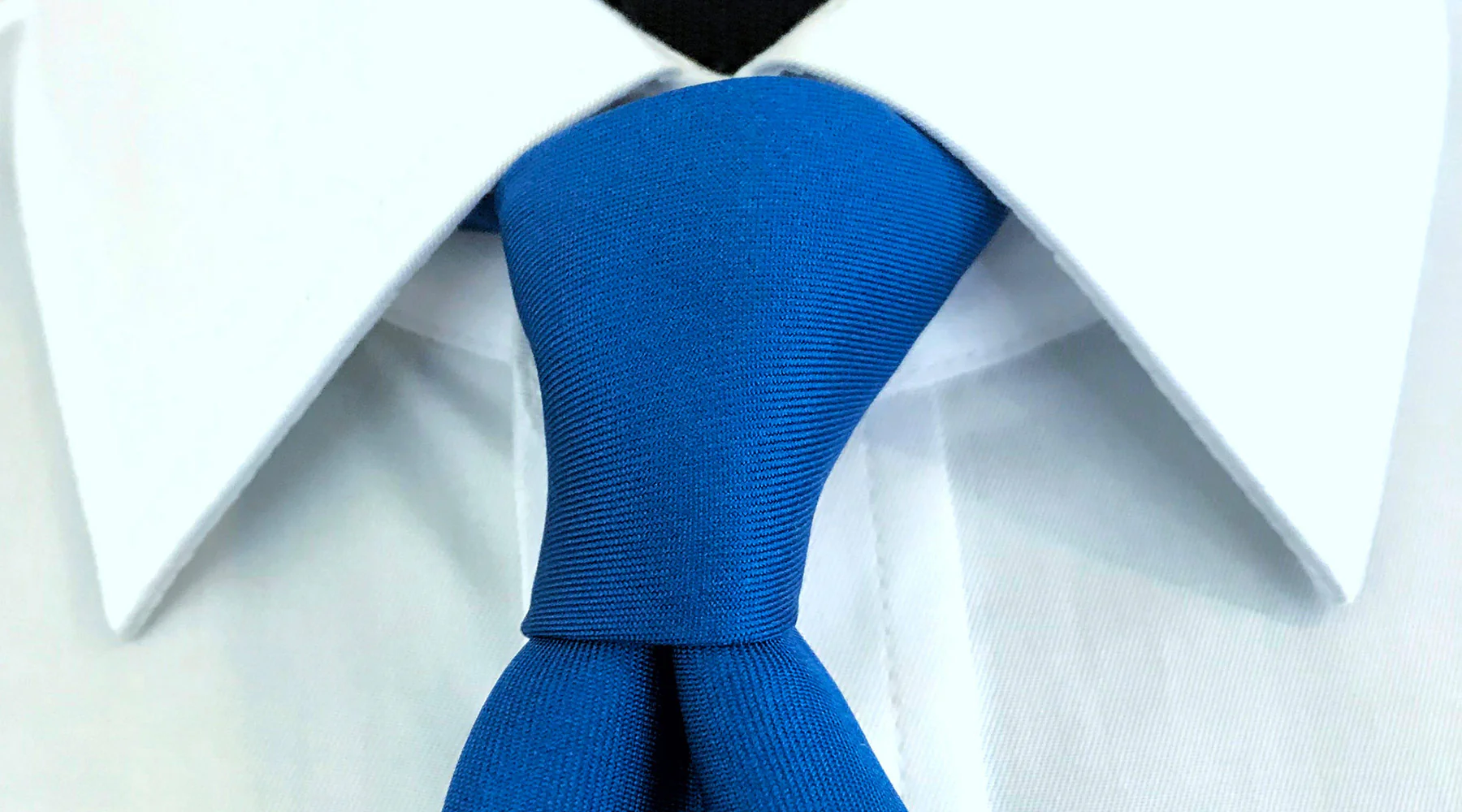
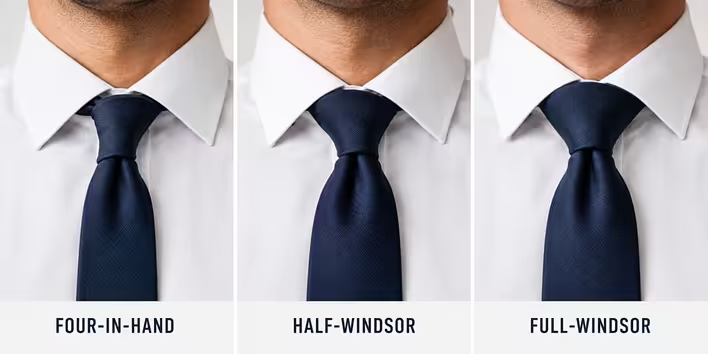
The simplest and most common today is the "Four-in-Hand" knot. It is believed to have received its name from a British coachmen's club in the 19th century. This knot is easy to tie, has a slightly asymmetrical shape, and goes well with almost any shirt. It is the one most often chosen by men who wear ties every day.
The "Windsor" knot has become a true symbol of business elegance. Its name is associated with the Duke of Windsor, who was renowned for his impeccable style. The knot is wide, symmetrical, and pairs well with shirts that have spread collar points. Due to its shape, it creates a sense of solidity and formality.
There is also a half-Windsor knot — a kind of compromise between the simplicity of the "Four-in-Hand" and the bulkiness of the full "Windsor." Many stylists consider it a universal option for most situations.
вузол четвірка, напіввіндзорський вузол та вузол віндзор
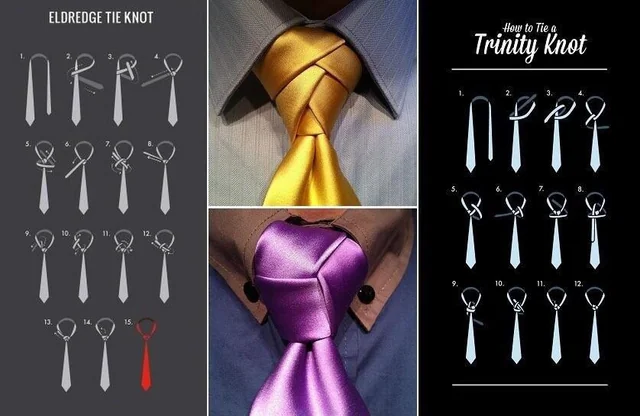
However, the imagination of tie enthusiasts does not end there. Throughout the 20th century, enthusiasts began creating increasingly complex knots. Some of them resemble geometric shapes, while others look like flowers or decorative braids. One of the most famous is the "Eldredge" knot, invented in 2007 by American Jeffrey Eldredge. Its complex structure looks almost like fabric origami and instantly attracts attention.
Even more complex is the "Trinity" knot, named after the symbol of the Trinity. Its shape resembles a shamrock or a Celtic ornament. Such knots are rarely used in everyday life, but they have become popular among men's fashion enthusiasts and participants in formal events.
зверху вузол «Елдредж», знизу вузол «Трініті»
Interestingly, mathematicians have also become interested in ties. In the 1990s, researchers Thomas Fink and Yong Mao analyzed the possible ways to tie ties and concluded that there are dozens of basic knots. Subsequently, other enthusiasts proved that the number of potential combinations is in the hundreds of thousands, although most of them look too strange for practical use.
Despite numerous changes in fashion, the tie continues to remain a symbol of neatness and respect for the event or conversation partner. It has survived the era of wigs, top hats, tailcoats, and even the emergence of casual office style. Moreover, in recent years, interest in unusual knots has surged again thanks to the internet, where millions of people learn new ways to tie and share their own discoveries.
Perhaps that is why the tie remains a unique accessory. It is not just a strip of fabric, but a rare clothing element that a person shapes by hand each time. And depending on which knot they choose, it affects not only their appearance but also the little story that their image tells.
Most people are convinced that caring for teeth is sufficient with just a toothbrush and toothpaste. Some additionally use dental floss or mouthwash. However, dentists have been...