

This content has been automatically translated from Ukrainian.
The Ukrainian language preserves many ancient words that are gradually disappearing from everyday use along with the traditional rural way of life. One such word is "tryna." Today, it can only be heard from older people in villages or found in old books and dictionaries. However, just a hundred years ago, the meaning of this word was understood by almost every resident of a Ukrainian village.
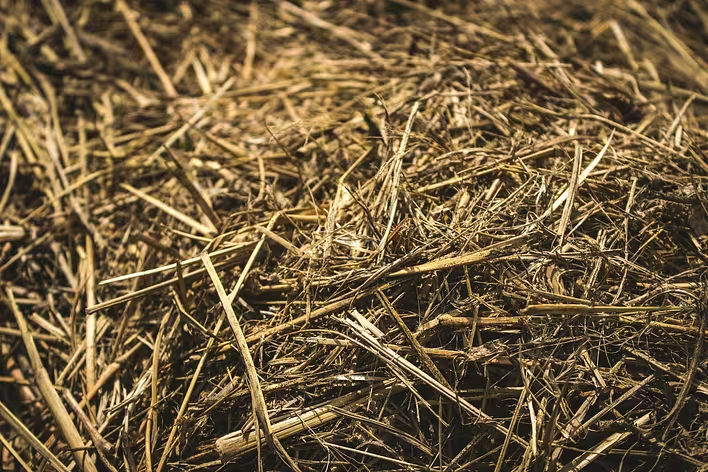
Tryna referred to the small remnants of hay, straw, or chaff that formed during the storage of feed, threshing, or feeding livestock. These were crushed dry plant remains that fell off over time, friction, and constant use. If, after winter, a small dry mass remained in the troughs for horses or cows, it could very well be called tryna. In some regions, the same term was used for chaff, husks, or other plant waste.
The very origin of the word is surprisingly expressive. Linguists associate it with an ancient Slavic root that meant "to grind." In other words, tryna is what has been worn down, ground up, or crumbled into small particles. It is no surprise that in various dictionaries, alongside hay chaff, you can find another meaning of the word — sawdust. In both cases, it refers to fine material that is formed as a result of the destruction or grinding of something larger.
For a modern person, tryna may seem like something unnecessary. However, in traditional farming, even such trifles had their use. It could be used as bedding for livestock, as filler, or simply added to feed. In times when every handful of hay was the result of hard work, nothing was thrown away without necessity.
Interestingly, the word "tryna" has left a noticeable mark in Ukrainian culture. Many have heard the expression "to be lost in tryn-grass" or "to go into tryn-grass." Today, these phrases mean something lost, neglected, or that has lost its significance. Although linguists still debate the origin of some such expressions, the association with something small, inconspicuous, and secondary is quite understandable.
The word "tryna" also reminds us of how closely language was tied to everyday labor. Our ancestors had separate names for dozens of varieties of hay, straw, grain waste, tools, and agricultural processes. What a modern person would simply call "garbage" or "remnants" could have its own name and practical significance for a peasant.
Today, tryna has almost disappeared from active vocabulary but continues to live in dialects, ethnographic records, and old dictionaries. Such words are unique linguistic artifacts that help us glimpse into the past and understand the lives of people who lived long before us.
Perhaps this is the true value of such words. They do not just name objects or phenomena. They preserve the memory of a way of life in which even a handful of ground straw was so important that it had a separate name — tryna.