

This content has been automatically translated from Ukrainian.
Every day we encounter forecasts without even thinking about it. Before leaving home, we check the weather forecast, read economic reviews, listen to crop or sports match predictions. Businesses forecast product demand, doctors forecast disease progression, ecologists forecast climate changes, and cities plan for future population numbers. Forecasting has become an integral part of modern life.
Despite this, many people perceive a forecast as an attempt to guess the future. In reality, it is neither a prophecy nor divination. A forecast is a scientifically or statistically grounded estimate of how events may develop under certain conditions.
What is a forecast
A forecast is a reasoned assumption about the future state of a phenomenon, process, or event, made based on available data, patterns, trends, and models.
The key word here is reasoned. If a person says, "I think next summer will be hot," that is merely an assumption. However, if such a conclusion is made after analyzing years of climate observations, satellite data, and results of mathematical modeling, it is already a forecast.
In other words, a forecast always relies on facts and analysis, not just intuition. The quality of the input data and the correct choice of methods largely determine the accuracy of the future forecast.
How people tried to predict the future in ancient times
The desire to glimpse into the future arose long before the advent of science. Thousands of years ago, people tried to understand what to expect from nature, harvests, or weather. To do this, they carefully observed the surrounding world.
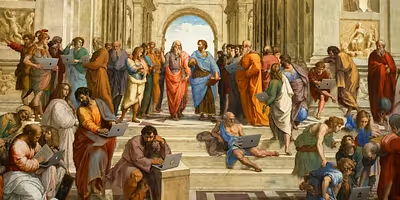
In Ancient Egypt, life largely depended on the annual flooding of the Nile. Priests recorded water levels for years, observed the starry sky, and tried to predict what the future harvest would be like. In China, they studied seasonal changes, animal behavior, and celestial phenomena. Ancient Greek thinkers sought patterns in nature, gradually moving from mystical explanations to rational observations.
Some of these attempts may seem naive today, but they laid the foundation for future forecasting. People first understood that the future is often linked to patterns that can be noticed if one observes the world long enough.
When forecasting became a science
The real development of forecasting began only when humanity learned to systematically collect data.
In the 17th and 18th centuries, statistics actively developed, and in the 19th century, the first international meteorological observation networks appeared. Over time, scientists began to use mathematical methods to describe natural and social processes.
A true revolution was brought about by the advent of computers in the 20th century. If previously complex calculations could take weeks or even months, modern supercomputers perform them in a matter of minutes. This made modern weather forecasts, economic modeling, epidemic analysis, and climate change forecasting possible.
Today, forecasting is a separate field of research that combines statistics, mathematics, computer science, economics, physics, and many other sciences.
What forecasts are based on
No forecast arises by chance. To create it, information about the past and present is used, as they help assess the most likely development of events.
Specialists analyze accumulated statistical data, identify trends, study patterns, consider cyclicality of processes, build mathematical models, and compare observation results.
For example, economists cannot say with absolute certainty what the currency exchange rate will be in a year. However, they analyze inflation, interest rates, production volumes, international trade, and dozens of other indicators. Based on this, a forecast is formed that shows the most likely development of the situation.
That is why forecasting is much closer to science than to guessing.
How a forecast differs from a prediction
In everyday speech, these words are often used as synonyms, but there is a fundamental difference between them.
A prediction may be based on intuition, personal experience, random assumptions, or even mystical beliefs. It does not necessarily require evidence.
A forecast, on the other hand, relies on verified data and logical analysis methods. It can always explain why a particular conclusion was made and what factors influenced it.
Another important distinction is that a forecast almost never asserts: "This is exactly how it will happen." Instead, it says: "Under current conditions, this development of events is the most likely."
What types of forecasts exist
Forecasting is used in almost all areas of human activity.
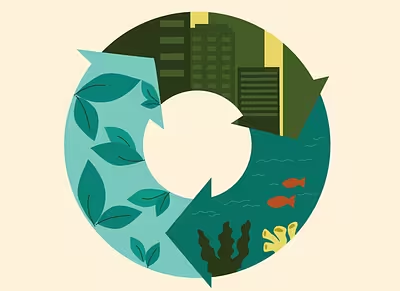
Meteorologists forecast temperature, precipitation, and wind strength. Economists assess inflation, unemployment rates, and economic growth rates. Demographers forecast population size and its age structure. Doctors evaluate the possible progression of diseases and the risk of complications. Ecologists model climate changes, the state of natural ecosystems, and the level of the World Ocean.
The methods in these fields may differ significantly, but the principle remains the same: analyzing current data helps assess the most likely future.
Why short-term forecasts are usually more accurate
Many have probably noticed that the weather forecast for tomorrow is usually much more accurate than the forecast for two weeks ahead. This applies not only to meteorology.
The reason is that over time, even small errors gradually accumulate. If the initial data differ even slightly from reality, each subsequent stage of calculations increases this difference.
That is why short-term forecasts usually have higher accuracy. Long-term forecasts help understand the general direction of event development but contain a significantly higher level of uncertainty.
For this reason, meteorologists confidently forecast the weather for the next few days, while climatologists work not with a forecast of a specific temperature twenty years from now but with scenarios of possible climate changes.
Why even good forecasts may not come true
Many believe that if a forecast turns out to be inaccurate, it was a bad one. In reality, this is not always the case.
Any forecast is created based on information available at a specific moment in time. If the situation changes sharply, the future outcome also changes.
For example, an airline may forecast a record passenger flow for the summer. But a massive volcanic eruption, natural disaster, economic crisis, or pandemic can completely change the situation.
That is why forecasts are regularly reviewed and updated as new information becomes available.
Why forecasts are needed
The main value of forecasts lies in the fact that they help make decisions even before an event occurs.
Farmers determine the optimal timing for the sowing campaign, energy companies forecast electricity consumption, manufacturers assess future product demand, and cities plan the construction of schools, hospitals, and transportation infrastructure according to the projected number of residents.
Without forecasting, most strategic decisions would have to be made almost at random.
Can the quality of a forecast be checked
The quality of a forecast is not assessed by whether it coincidentally matched reality once, but by its accuracy over a long period.
For example, meteorologists constantly compare their forecasts with actual weather conditions. Economists analyze how well the predicted inflation or economic growth indicators correspond to real data. If a model systematically makes errors, it is revised and improved.
In many fields, modern models are constantly refined, taking into account new data and results from previous forecasts. That is why the accuracy of forecasting gradually increases over time. For example, today, weather forecasts for a few days ahead are significantly more accurate than they were a few decades ago.
Can artificial intelligence predict the future
Modern artificial intelligence systems have significantly expanded forecasting capabilities. They can analyze vast amounts of information in a very short time and find patterns that would be difficult for a human to notice.
Today, algorithms are used to forecast traffic jams, product demand, the risk of industrial equipment failure, the spread of infectious diseases, agricultural yield, and even the energy consumption of entire cities.
However, even the most advanced algorithms cannot account for absolutely all factors. If the input data is incomplete or if an unexpected event occurs in the real world, the accuracy of the forecast inevitably decreases. Therefore, the quality of forecasting depends not only on algorithms but also on the completeness and reliability of the input information.
Forecast, forecasting, and scenario: what is the difference
These concepts are often confused, although they denote different things.
Forecast — is the finished result of the analysis. For example: "Next year, the city's population will grow by approximately 2%."
Forecasting — is the process of obtaining such a result. It encompasses gathering information, analyzing statistics, building models, and testing various factors.
Scenario — is one of the possible variants of event development. While a forecast usually describes the most likely course of events, scenarios can vary: baseline, optimistic, or pessimistic. Each is based on its own assumptions about future conditions.
In simpler terms, forecasting is the process, a forecast is its result, and a scenario is one of the possible paths of event development.
Why people will never stop making forecasts
Absolutely accurate forecasts do not exist, but this does not make them worthless. On the contrary, they help reduce uncertainty and better prepare for the future.
When meteorologists forecast heavy rain, people take an umbrella with them. When a city expects population growth, it plans the construction of new schools, roads, and hospitals in advance. When a company forecasts increased demand, it can expand production before the products start being actively purchased.
That is why forecasting is not an attempt to infallibly predict the future but a way to make more informed decisions today.
Conclusion
A forecast is not a guess about the future but a tool for assessing the most likely development of events. It is based on the analysis of facts, patterns, trends, statistics, and mathematical models, helping people make more reasoned decisions in science, business, medicine, economics, and everyday life.
At the same time, no forecast can guarantee absolute accuracy. The world is constantly changing, new factors and unexpected events arise that can influence any process. That is why a good forecast does not promise a hundred percent result but shows the most likely scenario under the conditions known at the time of its creation.
And although the future cannot be predicted with absolute precision, forecasting allows for better preparation for possible changes. As a result, people not only react to events but can also plan their actions in advance, reduce risks, and make more informed decisions.