
This content has been automatically translated from Ukrainian.
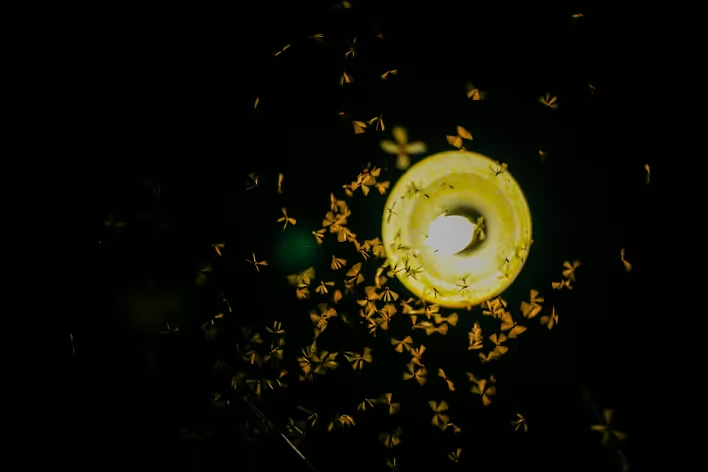
On a summer evening, it is enough to open a window and leave a lamp on for a while for butterflies, mosquitoes, beetles, and other nocturnal guests to appear around it. They flutter around the light, bump into it, fly away, and return again.
From the outside, it seems that the insect simply wants to reach the light. Hence the popular explanation: nocturnal moths navigate by the Moon and mistakenly take the lamp for it. However, modern experiments show a much more interesting picture.
At least near an artificial light source, the insect often is not so much flying towards the light as losing the correct sense of where is up.
Insects also need to know where the sky is
To fly stably, an insect needs to constantly monitor the position of its body in space. In nature, one of the important visual landmarks for this is the sky.
Throughout the evolutionary history of insect flight, the brightest large part of the surrounding space has usually been above. Even at night, the sky is often brighter than the ground and vegetation, especially in the short-wavelength part of the spectrum.
In many flying insects, there is a known reaction called dorsal light response (DLR) — literally the reaction of orienting the dorsal side of the body towards the light. During flight, the insect tries to keep the upper part of its body turned towards the brightest area of space.
In natural conditions, the rule is quite reliable: the brightest is above — therefore, there is the sky.
And then the lamp appears.
The lamp literally "flips the sky"
Imagine a moth flying in the dark and finding itself next to a bright lantern. An unusual situation arises for its orientation system: the brightest source may now be not above it, but to the side or even below it.
The insect continues to use the reaction that helps stabilize flight under natural conditions — it turns the dorsal side of its body towards the light.
This is where the problems begin.
If the lamp is located to the side, the insect tilts in its direction, causing its trajectory to distort. It may start to move around the light source instead of flying straight. In other situations, the insect sharply raises the front part of its body, gains altitude, slows down, and drops down. And while flying directly over the lamp, it may turn its back to the light so much that it actually flips over and goes into a sharp dive.
That is, the familiar circling around the lamp may not be a manifestation of an irresistible desire to "reach the light," but rather a consequence of disruption of the flight stabilization system.
How this was observed
One of the most interesting explanations emerged after an study published in 2024 in Nature Communications. Researchers used high-speed stereo video recording in natural conditions and motion capture systems in the laboratory to reconstruct the three-dimensional flight trajectories of insects near artificial light.
The result contradicted the simple idea that insects are simply aiming for the lamp.
They mostly did not fly straight towards the light source. Instead, during flight, they systematically tilted the dorsal side of their body in its direction. As a result, their movement often turned out to be almost perpendicular to the direction towards the lamp.
The researchers described three characteristic scenarios: circling around the light, sharp ascent with loss of speed, and flipping followed by falling. Such trajectories could also be reproduced in a computer model where the insect simply tried to constantly turn its back to the light source.
The authors concluded that the disruption of the dorsal light response best explains the strange flights of insects directly near artificial light among the models they tested.
And one last clarification here is important. The researchers do not claim that this mechanism explains absolutely everything. The paper separately notes that it did not investigate why insects might approach the light source from a great distance. Other mechanisms may also be at work there.
What about the Moon?
The hypothesis about the Moon did not arise out of nowhere.
Nocturnal insects can indeed use celestial landmarks for navigation. Hence the idea that they maintain a certain angle to a very distant light source — for example, the Moon. Since it is located extremely far away, this method allows them to roughly maintain their flight direction.
However, if instead of the Moon, a nearby lamp becomes the reference point, the geometry changes. Theoretically, trying to constantly maintain the same angle to it could spiral the insect's trajectory.
However, the flights recorded in the aforementioned 2024 study did not correspond well to this model. The researchers did not observe the expected systematic spiral approach to the light. Additionally, during the experiments, insects could change from which side of their body they held the light source, which also poorly aligns with the simple model of a celestial compass.
Therefore, the explanation "the moth takes the lamp for the Moon" can no longer be considered a universal answer today. At the same time, the authors of the study do not rule out that celestial navigation may be significant in other situations, particularly at greater distances.
Could it be that insects are attracted to heat?
This is another intuitive explanation, especially when recalling moths that get caught in flames.
However, heat itself does not explain the characteristic behavior near lamps. The authors of the same study point out that similar behavior occurs near LED sources, which emit very little infrared radiation compared to flames or incandescent lamps.
Moreover, the trajectory changes according to the position of the light, which aligns better with visual orientation than with a simple desire to get closer to heat.
Why some lamps attract more insects than others
Insects see the world differently than humans. Sensitivity to different wavelengths varies between species and even large taxonomic groups, so the color and spectrum of artificial lighting matter.
For example, an field study from 2023 showed that short-wavelength blue light generally attracted more insects than green or red, although the responses of different orders varied significantly.
A similar picture was observed in an study published in 2025 in Insect Conservation and Diversity. In this experiment, moths were most attracted to ultraviolet radiation, while diptera also reacted strongly to blue and green light. Red generally attracted fewer insects.
Therefore, there is no simple rule like "insects love blue." Both the wavelength and brightness, as well as the species of the insect and environmental conditions, are important.
And yet not every insect flies to every lamp
Even the phrasing "insects fly to the light" somewhat simplifies reality.
Different species react differently to artificial lighting. Even in the 2024 study, there were exceptions: some insects under certain laboratory conditions could fly over a bright source without the characteristic flipping or circling.
The reaction depends on the species, the spectrum and intensity of the light, its position, ambient lighting, and likely the physiological state of the insect itself.
This is why the modern explanation sounds more interesting than the old "the moth thinks the lamp is the Moon."
Artificial light creates a situation to which the insect orientation system is not adapted: the brightest part of the world can suddenly be to the side or even below.
And an ordinary light bulb on the terrace can actually mislead the insect about the wrong direction "up."
Why this is important not just for insects by the lamp
The problem of artificial night lighting is much broader than a few moths by the window.
A review of scientific data published in Biological Conservation links artificial light at night to disruptions in movement, feeding, development, and reproduction of insects, as well as changes in the risk of being caught by predators. The authors consider light pollution as one of the factors that can contribute to the decline of insect populations.
This does not mean that every lamp inevitably harms all insects equally. The scale of the effect depends on the spectrum, brightness, direction of lighting, duration of operation, and local species. This is why research today focuses not only on the color of lamps but also on their shielding and direction of light. In particular, experiments on directing artificial lighting show that reducing excess light scattering can significantly decrease the number of insects gathering near lamps.
And there is a certain irony here. At least some insects get trapped near our lamps not because artificial light is so attractive to them in itself. The problem becomes a very old and, under natural conditions, useful orientation system: the light side of the world should usually be above.