

This content has been automatically translated from Ukrainian.
“Polundra!” — one of those maritime exclamations that has long since transcended ships. In books, movies, or everyday conversation, it can be heard roughly meaning “watch out!”, “attention, danger!” or even jokingly “let's run, something's about to happen.”
However, the original meaning of the word was much more specific. Polundra was used to warn people below that something was falling or being thrown from above.
What “polundra” means
In modern Ukrainian, polúndra is a warning exclamation, characteristic primarily of sailors and port workers. Its meaning can be conveyed with the words “watch out!” or “danger!”. Over time, it expanded, and polundra began to warn about practically any threat.
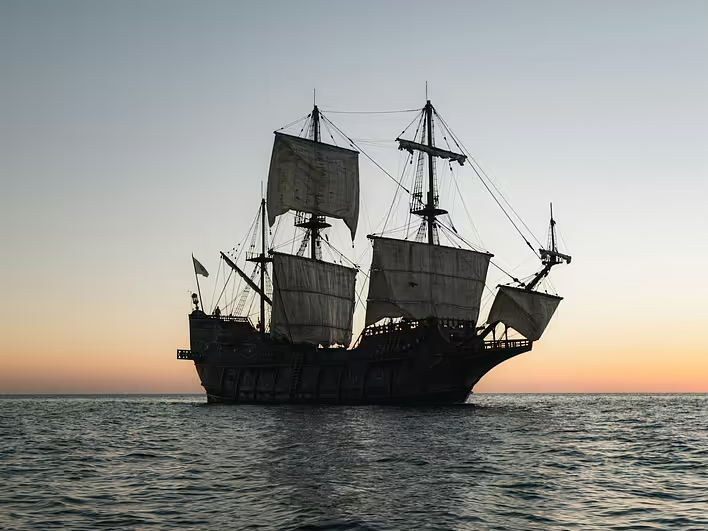
On a sailing ship, such a signal had a very practical purpose. Part of the work was done by sailors high above the deck — on masts, yards, and rigging. A tool, block, piece of rigging, or another object could fall or be thrown down. A person on the deck did not always see what was happening above them.
Therefore, a short loud shout meant approximately:
“Polundra!” = “Watch out below, something is flying down!”
That is why calling polundra simply a maritime equivalent of a general alarm is not entirely accurate. Originally, it was a much more specific warning about danger from above.
Where the word “polundra” comes from
The origin of the word traces back to the Dutch language.
The etymological dictionary of the Ukrainian language ultimately connects polundra with the Dutch phrase van onderen — literally “from below,” “from underneath.” In the process of borrowing, the pronunciation of the phrase changed significantly, and from it gradually formed the familiar form polundra.
At first glance, this may seem strange: why shout something with the meaning “from below” if the object is, on the contrary, falling from above?
The thing is, van onderen! was an address to those who were below. The sense of such a warning can be conveyed as “be careful down there!”.
This meaning is also confirmed by the borrowing database of the Dutch Language Institute. In it, van onderen is described specifically as an exclamation urging to step aside when something is falling from above. In old descriptions of maritime usage, it refers, in particular, to a situation when an object was about to be thrown from the tops or another part of the rigging onto the deck, and people below were warned to step aside.
There are also alternative explanations for the origin of the word. In particular, it has been attempted to link it with the Dutch val onder — roughly “fall down,” and in some old dictionaries — with the English fall under. However, the version with van onderen has significantly better linguistic justification and is supported by modern etymological sources.
Why the Dutch phrase
This origin fits well into the history of maritime vocabulary. In the 17th–18th centuries, the Netherlands was one of the leading maritime and trading nations in Europe. Dutch sailors, shipbuilders, and traders worked far beyond their country's borders, and along with maritime technologies, professional vocabulary spread.
Van onderen was not the name of a complex maritime maneuver, but a simple working warning. Such short commands are particularly easy to transfer from one language to another: they are constantly heard in a specific situation, so the meaning can be understood even without knowledge of the language itself.
Over time, the foreign phrase changed so much that it became an independent word — polundra.
Polundra was used not only by sailors
Although the word is primarily associated with ships, the logic of such a warning was useful on shore as well.
Polundra could be shouted by port workers when cargo was being moved or lowered from above. In a similar sense, the word was used during other work where a heavy object could fall on people below.
It is precisely port workers, alongside sailors, that modern Ukrainian dictionaries refer to, defining “polundra” as a warning of danger.
Thus, the main thing was not the presence of a ship itself, but the situation: someone above is throwing or dropping something, and people below need to step aside quickly.
How “polundra” became a universal warning
Over time, the connection with the object falling from above began to weaken. The word was short, loud, and well-captured attention, so it began to be used to warn about danger in general.
Hence the modern figurative meaning.
If someone jokingly shouts “Polundra!”, it no longer necessarily means that a rope or ship block is about to fall on their head. Depending on the situation, the exclamation can mean:
“be careful!”;
“attention, danger!”;
“let's run!”;
“something is about to start!”.
At the same time, the maritime origin of the word remains well recognizable. Therefore, “polundra” sounds particularly organic in adventure stories, maritime stylization, humor, and scenes where the author wants to create an atmosphere of chaos or sudden danger.
Polundra or palundra — which is correct
In old sources and various languages, one can encounter several close forms of this exclamation. Such variability is quite natural for a word that has been transmitted mainly by ear for a long time and comes from a foreign phrase.
In modern Ukrainian literary language, the normative form is polúndra — with the stress on the second syllable.
Thus, the exclamation familiar from books and films has a very practical origin. Initially, “Polundra!” was neither a pirate battle cry nor a universal alarm command. It was a short warning for those who were below: step aside — something is falling from above. Over time, the specific maritime meaning has almost faded, and the word has turned into a colorful and somewhat theatrical “watch out!”.