What is generative AI and how does it create content
Until recently, artificial intelligence was primarily expected to recognize faces in photographs, detect suspicious banking transactions, or suggest the next video to watch. Today, AI is capable of somewhat different tasks: writing texts, creating images, g...
Until recently, artificial intelligence was primarily expected to recognize faces in photographs, detect suspicious banking transactions, or suggest the next video to watch. Today, AI is capable of somewhat different tasks: writing texts, creating images, generating music, voicing videos, and assisting with programming code. Systems capable of producing such content are called generative artificial intelligence.
What does "generative AI" mean
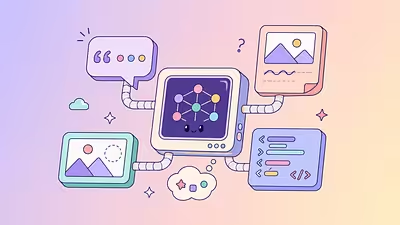
Generative AI, or generative artificial intelligence, is a technology that can create new content based on patterns learned during training. The result of its work can be text, images, audio recordings, video, programming code, a three-dimensional model, or a combination of several formats.
The word "generative" comes from the verb "generate," meaning to create or produce something new. This ability distinguishes such systems from many other types of AI.
For example, a standard recognition model can determine that a cat is depicted in a photograph. In contrast, a generative model can create a new image of a cat based on a textual description — for instance, drawing a ginger cat astronaut in the style of a children's book illustration.
Ілюстрацію згенеровано моделлю GPT Image від OpenAI за текстовим описом
How generative artificial intelligence works
Generative models are trained on large datasets. Depending on their purpose, these can include texts, images, audio recordings, videos, or snippets of programming code. During training, the system identifies patterns: connections between words, typical sentence structures, shapes of objects, color combinations, features of musical compositions, and so on.
The model does not store a ready-made answer to every possible question but generates a result immediately after receiving a request. For example, a large language model sequentially predicts the next tokens — words, parts of words, or other elements of text. Due to the vast number of learned connections, its response can be logical, coherent, and similar to that written by a human.
Image generation models may work differently. In particular, diffusion models are trained to restore images from noise, gradually transforming it into a picture that matches the user's description. In general, generative systems use neural networks to detect structures in the input data and create new content based on them.
The user provides the system with an prompt — a request or instruction describing the desired outcome. This can specify the topic, format, volume, style, audience, and other requirements. A clear prompt does not guarantee an ideal response but helps the model understand the task more accurately.
What generative AI can create
The most well-known generative systems work with text. They can explain complex concepts, summarize documents, translate materials, suggest ideas, create plans, or engage in conversation in a chatbot format.
However, the capabilities of the technology are not limited to texts. Generative AI is also used for:
creating and editing images;
generating music, voice, and sound effects;
writing and checking programming code;
creating videos and animations;
developing designs, presentations, and advertising layouts;
building three-dimensional objects;
modeling new molecules and materials.
There are also multimodal models that can work with several types of information. Such a system can analyze a photograph, answer questions about what it sees, write a textual description, or create a new image.
How generative AI differs from traditional AI
Traditional artificial intelligence systems often focus on classification, prediction, or anomaly detection. They can determine whether an email is spam, forecast demand for a product, or recognize a traffic sign.
Generative AI not only analyzes input data but also produces a new result. However, the boundary between these directions is not always clear. One service can simultaneously recognize objects, analyze information, and create content based on it.
It is also important not to equate generative AI with a search engine. A search engine primarily finds already published web pages, while a generative model composes a response according to the request. Some modern services combine both approaches: they search for relevant information on the internet and then summarize what they find.
Does AI really "create"
A generative model can produce results that did not previously exist in that form. At the same time, its creativity is not equivalent to human creativity. The system lacks personal life experience, intentions, tastes, or emotions. It generates results based on learned patterns and user instructions.
Therefore, it is more appropriate to view generative AI as a tool. It can accelerate the search for ideas, prepare a draft, suggest several options, or help overcome the fear of a blank page. However, the concept, evaluation of the result, and final decision usually remain with the human.
Why generative AI can make mistakes
A convincing response style does not guarantee its truthfulness. A language model predicts a plausible continuation of the text but does not always verify each statement against reliable sources. As a result, it may confuse dates, incorrectly explain a term, invent a quote, or reference a source that does not exist. Such errors are usually referred to as AI hallucinations.
The quality of the result depends on the training data, model settings, prompt formulation, and task complexity. Generative systems can also reproduce stereotypes and biases present in the materials on which they were trained.
Particular care should be taken to verify medical, legal, financial, and scientific claims. It is advisable not to provide chatbots with passwords, banking details, confidential documents, or personal data of other individuals.
Where generative AI is used
The technology is applied in education, programming, marketing, design, science, medicine, media, and the entertainment industry. It helps create prototypes, explain educational material, process large documents, and automate parts of repetitive tasks.
At the same time, generative AI raises complex questions regarding copyright, the origin of training data, privacy protection, and the spread of misinformation. Realistic artificial photographs, voices, and videos can be used not only in creativity but also for deception. Therefore, skills in verifying sources, critically evaluating information, and recognizing manipulation are becoming increasingly important.
Generative artificial intelligence has already transformed from an experimental technology into an accessible everyday tool. However, it is neither an infallible encyclopedia nor a full replacement for human thought. These systems work best when a person clearly sets the task, understands the limitations of the technology, and carefully checks the obtained result.
A person perceives the world in several ways at once. We can look at a photograph, read the caption below it, listen to explanations, and pay attention to the intonation of the ...