What is the game of go and why do its simple rules conceal incredible complexity
At the beginning of the game, players have an empty board in front of them, and only black and white stones in bowls. There are no kings, armies, or pieces with different abilities. All stones are the same, the rules can be explained in a few minutes, and t...
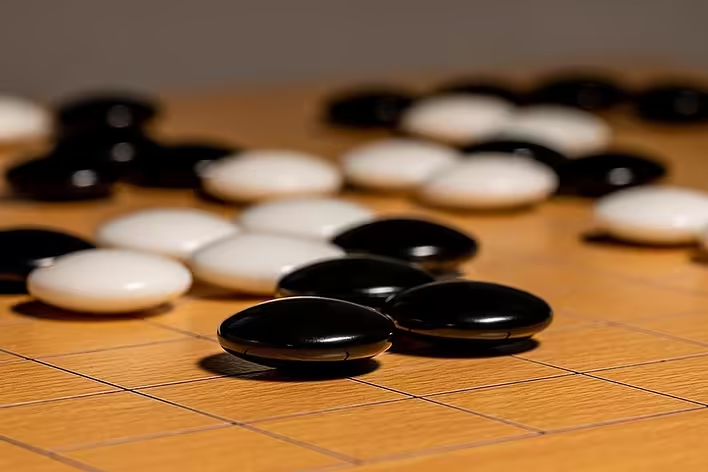
At the beginning of the game, players have an empty board in front of them, and only black and white stones in bowls. There are no kings, armies, or pieces with different abilities. All stones are the same, the rules can be explained in a few minutes, and the first move is accessible even to a child. However, behind this simplicity lies one of the most complex strategic games created by humanity.
Go has been played for over two and a half thousand years. During this time, professional schools, ranking systems, major tournaments, and an entire strategic culture have emerged around it. In China, the game is called Weiqi, in Korea Baduk, and in Japan Igo or simply Go. The Japanese name has spread into many Western languages.
Where Go Comes From
Go originated in Ancient China. The exact time and circumstances of its emergence are unknown, and legends attribute the creation of the game to mythical rulers and sages. It is more reliable to refer to written records that indicate it was known in China over 2500 years ago.
From China, the game spread to Korea, and later to Japan. There, it became an important part of the culture of educated and influential social classes. The Japanese tradition of Go particularly flourished during the Edo period, when government-supported schools and professional players existed.
In the 20th century, Go began to spread actively beyond East Asia. Today, it is played worldwide, and national associations, clubs, ranking systems, and professional leagues operate in various countries.
What the Go Board Looks Like
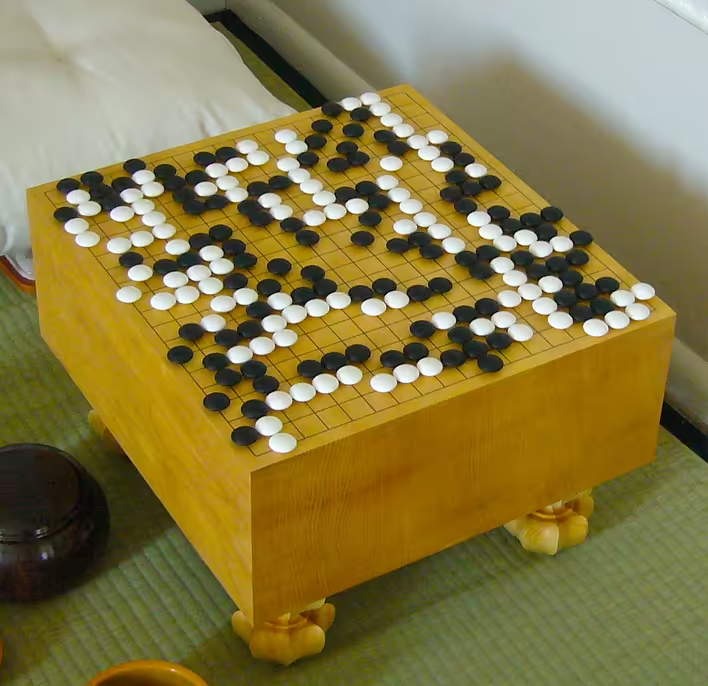
The standard board, called goban, consists of 19 horizontal and 19 vertical lines. They form 361 points of intersection. Stones are placed on the intersections of the lines, not inside the squares.
At the beginning of a typical even game, the board is empty. One player receives black stones, and the other receives white. Black plays first, after which the opponents take turns placing one stone each.
For teaching, smaller boards are often used — 9 × 9 or 13 × 13. The basic rules remain the same, but games last shorter, and a beginner can more easily see the consequences of their moves.
What the Goal of the Game Is
The main goal of Go is to score more points than the opponent. To achieve this, players surround empty areas of the board, create stable groups, and weaken the opponent's positions.
For this reason, Go is often called a game of territory. However, simply outlining a large area is not enough. If its boundaries turn out to be weak, the opponent can penetrate inside, create a viable group there, or force some stones to die.
Unlike chess, Go has no main piece whose capture ends the game. The struggle encompasses the entire board, and the winner is determined by the final score. A player can also resign earlier if they believe their position is hopeless.
How Stones Are Captured
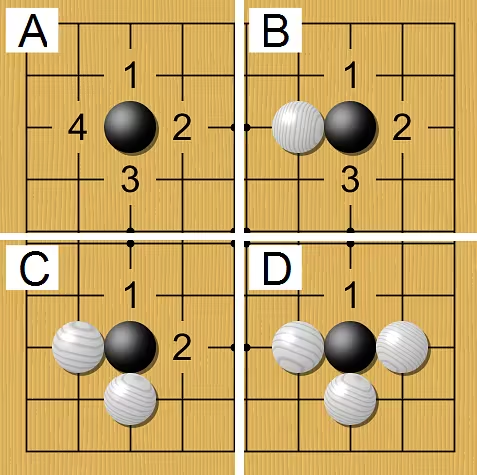
Each stone has liberties — adjacent empty points connected to it by lines vertically or horizontally. Diagonal points are not considered liberties.
A single stone in the center of an empty board has four liberties, three near the edge, and two in the corner. Stones of the same color, directly connected by lines, form a chain and share common liberties.
If the opponent occupies the last empty point of such a chain, all their stones are captured and removed from the board. A position in which a stone or chain has only one liberty and can be captured on the next move is called atari.
Placed stones do not move on the board. They remain in their places until the end of the game or until they are captured.
Коли в каменя залишається лише один ступінь свободи, він перебуває в атарі й може бути захоплений наступним ходом.
What Eyes Are and Why They Are Important
For an surrounded group to survive, it usually needs to form two separate internal empty spaces — eyes. The opponent cannot sequentially fill both, as the first such move will not capture the group and will leave the placed stone without liberties.
However, it is important that both eyes are genuine. Some empty points may only seem protected, but the opponent can destroy their shape or capture the surrounding stones. Such formations are called false eyes.
Therefore, a significant part of Go's tactics is related to the life and death of groups. A player must determine which stones will live, which are doomed, and which can still be saved.
There are also positions where both black and white groups do not have two independent eyes, but neither side can start capturing without putting their own stones at risk. This state of mutual life is called seki.
Can a Stone Be Placed Without Liberties?
In most common rule systems, a move cannot be made that would leave one's own stone or chain immediately without any liberties. Such a move is called self-destructive.
However, there is an exception: a stone can be placed in a completely surrounded point if this move takes away the last liberty of the opposing group. Captured stones are first removed from the board, so the newly placed stone gains empty adjacent points and remains on the board.
Some rule systems allow self-destructive moves under certain conditions, but Japanese, Chinese, and the rules of the American Go Association prohibit them. Differences between the main systems can be seen in the comparison of the rules of the British Go Association.
What the Ko Rule Is For
In some positions, players could endlessly capture the same stone, each time restoring the previous arrangement. To prevent the game from falling into an endless cycle, there is the ko rule.
After such a capture, the opponent cannot immediately take the stone in response if it would recreate the previous position. They must first play elsewhere. If the opponent also responds elsewhere, the fight for ko can be resumed.
This leads to so-called ko threats: a player makes a dangerous move in another part of the board that the opponent cannot ignore. A small local skirmish over ko can affect the position of the entire game.
The basic ko rule prohibits immediate repetition of a position. For more complex cycles, some systems apply the superko rule, which prevents certain previous states of the board from being recreated throughout the game.
How the Game Ends
A player is not required to place a stone on every turn — they can say "pass." When both opponents pass in succession, the game ends.
This usually happens when the boundaries of territories are already defined, and no useful moves are left. After that, players agree on which groups are alive and which would inevitably be captured. According to Japanese rules, dead stones are removed from the board and added to the prisoners. If players do not agree on the status of a group, the position must be played out or examined according to the chosen rule system.
There may also be neutral empty points left on the board between the holdings of black and white. These are called dame. According to Japanese counting, they do not belong to either player and do not score points.
How Points Are Counted
In Go, there are several rule systems, among which the most well-known are the Japanese and Chinese.
According to the Japanese system, a player scores points for empty points of territory they have surrounded. Captured stones of the opponent, including dead stones removed at the end of the game, are also taken into account.
According to the Chinese system, surrounded empty points are counted along with the player's own stones remaining on the board. Captured stones do not score points.
In most ordinary games, both systems determine one winner, although the final point count and occasionally the result itself may differ.
White also receives komi — additional points as compensation for the fact that black plays first. The size of komi depends on the system and rules of the specific tournament. A fractional value, such as 6.5 or 7.5 points, helps avoid a tie.
How Opponents of Different Levels Play
Go has a convenient handicap system. If one player is significantly weaker, they can start the game with several black stones already placed on the board. After placing the handicap stones, the first regular move is made by white.
The number and arrangement of such stones depend on the difference in players' strengths and the chosen rules. This way, even a game between a beginner and an experienced player can remain interesting for both.
How Go Differs from Chess
In chess, pieces have different abilities, move across the board, and the goal of the game is to checkmate the king. In Go, all stones are equal, once placed they do not move, and the struggle is for space and the viability of groups.
A chess game often focuses around a specific attack or combination. In Go, multiple distant skirmishes can develop simultaneously. A player constantly has to decide where their move will be most beneficial: to save a group, strengthen territory, weaken the opponent, or create influence for future battles.
Another important difference is the scale of choice. On an empty Go board, the first stone can be placed in 361 points. The number of possible positions is so vast that the game was long considered a particularly difficult challenge for computers.
Why AlphaGo's Victory Was Historic
Лі Седоль грає проти AlphaGo у Сеулі в березні 2016 року. Програма перемогла в матчі з рахунком 4:1.
In 2016, the program AlphaGo, created by DeepMind, played a match against Korean professional Lee Sedol — one of the strongest players of his generation. The system won with a score of 4:1.
This marked an important milestone in the development of artificial intelligence. Due to the extraordinary number of possible positions, AlphaGo could not simply enumerate all options. The system used neural networks, analyzed human games, and learned while playing against its own versions. Some of its moves initially seemed strange to professionals, but later influenced the modern understanding of Go strategy.
The computer's success did not make the game any less interesting for people. Go remains a game about balance, a sense of shape, and the ability to look at the whole board. Here, it is almost never possible to gain everything: one has to give up stones, choose between local victory and overall advantage, and understand when a small loss helps win the entire game.
Artificial intelligence is already helping to search for information, translate texts, create images, recognize faces in photographs, and plan routes. However, AI is not a singl...