This content has been automatically translated from Ukrainian.
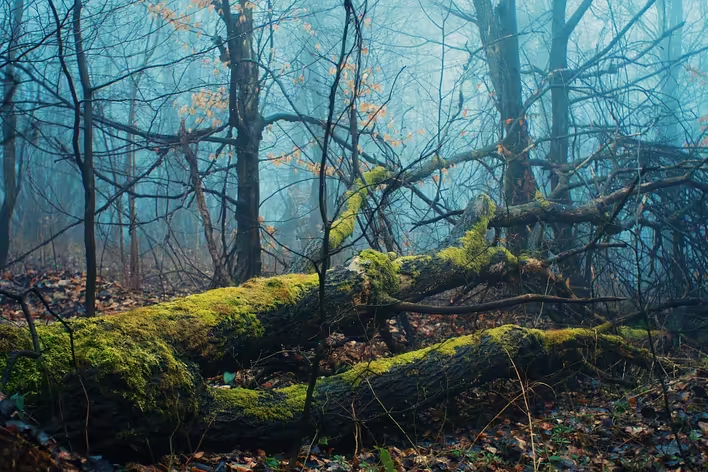
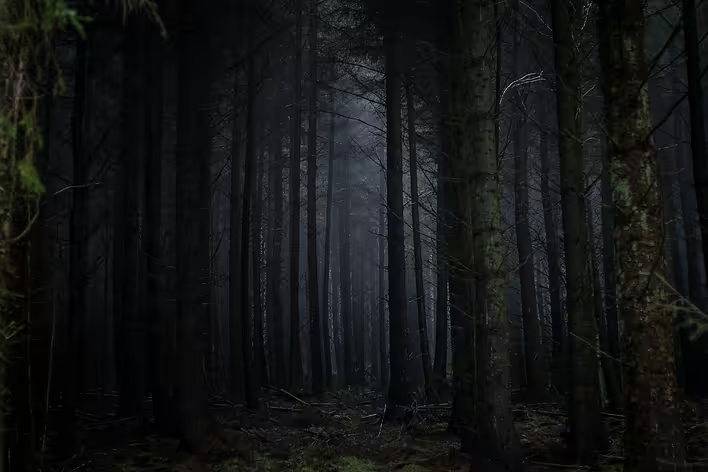
Imagine a night forest where armed hunters move between the trees. Each tries to step as quietly as possible, not knowing who might be hiding nearby and with what intentions. Calling out to someone not only reveals your location but also risks getting shot from the darkness.
This eerie metaphor explains the silence of the cosmos through the dark forest hypothesis. Perhaps the universe is not empty at all. Other intelligent civilizations may exist but deliberately remain silent, believing that silence is the best way to survive.
How the hypothesis relates to the Fermi paradox
The Milky Way contains hundreds of billions of stars, and planets, as we now know, are not rare. Humanity has already confirmed the existence of thousands of exoplanets, some of which are located in the so-called habitable zone. At the same time, we currently have no compelling evidence of life beyond Earth. This is directly noted by NAXA in their material on the search for extraterrestrial life.
From this arises the question known as the Fermi paradox: if other technologically advanced civilizations could arise in a vast and ancient galaxy, then where are they? Why do we not see their spacecraft, notice large engineering structures, or receive undeniable artificial signals?
In fact, this is not a paradox in the strict logical sense, but rather a contradiction between the assumption of the possible spread of intelligent life and the absence of its noticeable traces. The dark forest hypothesis offers one of the bleakest answers: the inhabitants of the cosmos remain silent because they fear each other.
How the "dark forest" works
In this model, each civilization primarily seeks to continue its own existence. The problem is that it cannot reliably determine the intentions of another civilization. Even a peaceful message does not prove that its sender is truly friendly. Similarly, it is impossible to guarantee that a benevolent society today will not become aggressive in a hundred, a thousand, or ten thousand years.
Distrust is exacerbated by cosmic distances. If civilizations are separated by hundreds of light-years, exchanging a few messages can take centuries. During this time, generations, culture, political systems, and technological capabilities of both sides can change. An agreement reached at the beginning of contact will guarantee nothing by the time a response is received.
This gives rise to the so-called chain of suspicion. The first civilization does not know whether the second is dangerous. The second, in turn, does not know whether the first considers it dangerous. Both may be peaceful, but each must account for the worst-case scenario.
Another important factor is the possibility of a technological explosion. A society that currently seems weak and poses no threat could develop extremely quickly on a cosmic timescale. While a message or expedition is en route, it could transform into a significantly stronger opponent.
If all these assumptions are accepted, open contact becomes dangerous. A civilization may decide that it is safer to destroy a potential adversary first rather than wait for it to do the same. Therefore, the most advantageous strategy turns out to be silence: not sending messages, not demonstrating technologies, and not attracting attention.
What does Liu Cixin have to do with it
The name of the hypothesis became popular thanks to the novel "The Dark Forest" by Chinese science fiction writer Liu Cixin, published in 2008. It is the second part of the "Remembrance of Earth's Past" trilogy, which begins with the novel "The Three-Body Problem."
In the book, the dark forest serves as a model of cosmic society. Its foundation consists of two assertions: survival is the primary need of any civilization, and civilizations constantly develop and expand while the amount of available matter in the universe remains limited. Along with the chain of suspicion and the possibility of rapid technological advancement, this creates an environment where even peaceful neighbors seem like potentially deadly threats.
The cosmos in the novel is compared to a dark forest where each civilization is an armed hunter. It hides among the trees, carefully listening to sounds, and can destroy anyone who reveals their location. Not necessarily out of hatred or cruelty, but due to the impossibility of quickly discerning others' intentions and the high cost of mistakes.
Liu Cixin is not the first to describe a universe where civilizations must hide or become prey to cosmic predators. Similar scenarios have appeared in science fiction before. Astronomer and writer David Brin considered the scenario of deadly automatic probes among the possible explanations for the "great silence" as early as 1983. However, it was Liu Cixin's novel that gave the concept a recognizable name and turned it into one of the most well-known answers to the Fermi paradox.
Hypothesis or scientific theory
Despite its popular name, the dark forest hypothesis is not a confirmed scientific theory. It is primarily a thought experiment and a hypothetical model built on assumptions that we currently cannot verify with real extraterrestrial civilizations.
It assumes that different intelligent species will think along similar lines, prioritize their own survival above all, and consider preemptive destruction an acceptable decision. However, extraterrestrial life may have a completely different psychology, form of society, and value system. Hostility is not necessarily a universal consequence of technological development.
The idea that an advanced civilization can completely hide is also questionable. A living planet may reveal its presence through its atmospheric composition, while technological activity may emit radio signals, industrial chemicals, artificial lighting, or other technosignatures. If potential observers possess significantly better tools, mere silence may prove insufficient.
Interstellar attack would also be extremely complex, costly, and slow. An aggressor would have no guarantee that the target would not develop, move, or prepare a response in time. Moreover, the use of powerful weapons could itself reveal the identity of the attacker.
Should humanity send signals
The dark forest hypothesis often arises in debates surrounding METI — the intentional sending of messages to potential extraterrestrial civilizations. Unlike SETI, where scientists primarily search for alien signals and other technosignatures, METI involves an active attempt to announce our presence.
Proponents of caution argue that humanity should not deliberately reveal its location until it understands the possible consequences. Their opponents point out that Earth could theoretically be detected even without a special greeting: through the properties of its atmosphere, radio emissions, or other signs of technological activity. Furthermore, fear of a hypothetical enemy does not prove that such an enemy exists.
Currently, we do not know whether the cosmos resembles a dark forest, an empty desert, or a vast city where inhabitants simply use communication methods that are incomprehensible to us. The dark forest hypothesis does not resolve the mystery definitively, but it does change our perspective on cosmic silence. The absence of voices does not always mean that there is no one around. Sometimes the quietest places are where everyone is listening very closely.