
This content has been automatically translated from Ukrainian.
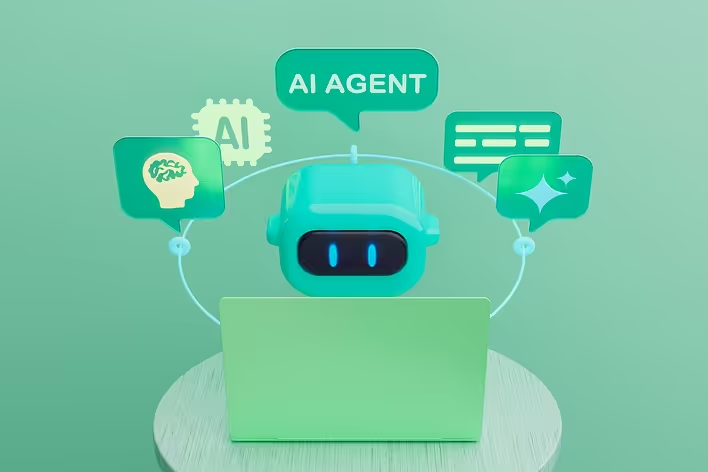
AI agent, or artificial intelligence agent, is a software system that receives a goal, independently determines the necessary steps, and performs actions on behalf of the user. It can analyze information, create a plan, interact with external services, check intermediate results, and adjust further actions depending on the situation.
A regular chatbot primarily answers questions. An AI agent is capable not only of explaining what needs to be done but also of performing part of the work: finding data, opening a file, updating a record in the system, sending a message, or executing code. OpenAI defines agents as systems that autonomously perform tasks on behalf of the user, manage the sequence of work, and use tools to obtain information and perform actions.
For example, when asked "prepare a sales report for the month," a regular language model may suggest a document structure. An AI agent, with the necessary access, can find data in tables or CRM, check metrics, create graphs, generate a report, and save it in a specified folder.
Why it is called an agent
The word agent in English means someone who acts on behalf of another person or organization. This meaning underlies the term: the system receives a task and a certain freedom in choosing how to execute it.
The user does not necessarily need to describe every step. Instead of a detailed command like "open the table, find the required column, count the values, and transfer the result to the document," one can formulate the end goal: "analyze the expenses for the quarter and show what we spent the most on."
The agent decides for itself which data it needs, which tools to use, and in what sequence to perform the work. This ability to manage its own process distinguishes the agent from a rigidly programmed script. Anthropic, for example, differentiates between ordinary workflows with predefined steps and agents where the language model dynamically selects subsequent actions and necessary tools.
How the AI agent works
At the core of a modern AI agent is often a large language model. It analyzes the task, instructions, and available context, and then determines the next step. However, the model itself is not yet a full-fledged agent.
For the system to work, it needs several interrelated components.
Model
The model acts as a kind of guiding mechanism. It understands the request, matches information, selects tools, formulates a plan, and determines whether the set goal has been achieved.
At the same time, not every step requires the most powerful model. Simple operations like classifying messages can be performed by a smaller and faster model, while complex decisions require broader analytical capabilities.
Instructions
Instructions define the role of the agent, its tasks, and the boundaries of what is allowed. They can specify which sources to use, in what format to present the result, when to ask for confirmation, and which actions not to perform.
For example, a support agent may receive a rule: to respond to typical questions independently, but to always pass the decision to a staff member before issuing a refund.
Tools
Tools allow the agent to interact with other programs and data. These can include internet searches, email, calendars, customer databases, file storage, calculators, code editors, or the company's internal system.
Without tools, the model primarily generates a text response. With tools, the agent can obtain relevant information or change something in an external system: send an email, update a record, create a document, or run a code check.
Memory and state
For multi-step tasks, the agent needs to retain information about already completed steps. Otherwise, it will not know which sources it has checked, what it has already changed, and at what stage it stopped.
The agent's memory may refer to the current context of the conversation, the history of task execution, saved user preferences, or access to a specific knowledge base. In OpenAI's documentation, state retention is mentioned as one of the capabilities needed to complete multi-step work.
Environment
The environment defines where the agent operates and what resources it has access to. One system may only see the uploaded document, while another may have access to corporate files, calendars, emails, and internal databases.
The capabilities and risks depend not only on the environment but also on it. An agent with permission to read the calendar is potentially less dangerous than a system that can independently send emails, change financial data, or delete files.
What is an agent cycle
An AI agent typically does not operate on the principle of "one request — one response," but instead performs a repetitive cycle:
receives a goal → analyzes the situation → chooses an action → uses a tool → checks the result → determines the next step.
The cycle repeats until the task is completed, an error occurs, or human intervention is needed. OpenAI refers to this cycle as the central mechanism of the agent's operation: the model can make several tool calls in succession until it meets the completion condition.
Imagine an agent tasked with finding a suitable room for a meeting. It can:
- check the number of participants;
- review their calendars;
- find available times;
- check free rooms;
- suggest the optimal option;
- after confirmation, create an event and send invitations.
If the required room is not available, the agent does not simply end the task with an error but can look for another time or suggest an online meeting.
How AI agent differs from a chatbot and regular automation
The boundary between these concepts is not always clear. A modern assistant can acquire agent functions, and a chatbot can gain access to tools. It is important to look not at the product name but at whether the system can manage multi-step work and perform real actions.
Google identifies reasoning, planning, monitoring results, and acting as key properties of agents. At the same time, an AI assistant typically interacts more closely with the user at each stage, while an agent has more freedom to perform tasks independently.
Examples of AI agents
An AI agent does not necessarily have to look like a robot or a separate program. It can be embedded in a website, work service, code editor, or corporate system.
Support agent reads the client's request, finds their order, checks company policies, suggests solutions, and updates the application status.
Research agent searches for information from multiple sources, compares data, separates the important, and prepares a structured report.
Code working agent reviews project files, finds the cause of an error, edits code, runs tests, and retries if the check fails.
Office agent can sort emails, prepare responses, find free time in the calendar, create documents, or transfer data between work systems.
Analytical agent retrieves data from tables and databases, checks it, performs calculations, and generates a report according to the user's request.
The benefits of an agent are particularly noticeable where tasks consist of several steps, contain unstructured data, or require choosing between different ways of acting. For simple and fully predictable operations, regular automation often remains cheaper and more reliable.
What is a multi-agent system
Not all complex tasks are performed by one universal agent. In a multi-agent system, the work is distributed among several specialized agents.
For example, one agent searches for sources, another analyzes facts, a third writes text, and a fourth checks the result. They can be managed by a central agent-manager, who distributes tasks and consolidates responses.
Another option is to pass work directly between agents. A support system may initially direct a request to a delivery agent, who may then pass it to an agent working with returns if necessary.
Multi-agent architecture is useful for complex processes, but it also increases the number of potential errors, costs, and complexity of control. Therefore, developers are advised to first check if the task can be performed by one agent with clear instructions and well-configured tools.
Does the AI agent work completely autonomously
The autonomy of the agent does not mean complete independence from humans. The level of permitted autonomy depends on the specific task and potential consequences.
One agent may be allowed to search for information and create drafts independently. Another must ask for confirmation before sending an email, paying a bill, deleting a file, or changing client data.
The safest approach is to grant the system only those rights that are truly necessary for its operation. For risky or irreversible actions, human confirmation should be required, and the user should have the ability to see the plan, stop execution, and correct the direction of work.
What problems may arise
AI agents inherit the limitations of language models. They may misunderstand the goal, use unreliable data, draw incorrect conclusions, or choose an unsuitable tool. In a multi-step process, one mistake can affect all subsequent actions.
An additional risk arises from access to external systems. If the agent has overly broad permissions, its mistake may lead not only to an incorrect response but also to unwanted data changes, sending messages, or disclosing confidential information.
Agent systems also require more time and computational resources than a single response from a language model. Multiple cycles of analysis, searching, and using tools increase costs and delays. Anthropic advises against complicating the system unnecessarily: for predictable tasks, a regular script or a single request to the model may be sufficient.
A reliable AI agent should have clear instructions, limited access rights, input and output data verification, an action log, and a clear way to transfer control to a human.
Is AI agent and agent AI the same thing?
These concepts are related but are used somewhat differently.
AI agent is a specific software system that performs tasks: for example, a support agent, research agent, or code-writing agent.
Agent AI or agent artificial intelligence is a broader concept. It describes an approach where artificial intelligence systems not only generate responses but also independently plan and execute a sequence of actions.
That is, an AI agent is a specific embodiment of the principles of agent AI.
Frequently asked questions
Is every neural network an AI agent?
No. A model that recognizes images, predicts values, or generates text may be part of an agent, but on its own, it does not necessarily manage the process and perform multi-step actions.
Can an AI agent work without a language model?
Yes, the concept of a software agent existed long before modern generative models. However, today the term AI agent is often used specifically for systems where a large language model helps understand the goal, plan, and choose tools.
Can an agent act without user permission?
Only within the rights granted to it. A well-designed system should require confirmation before risky, financial, or irreversible actions.
Does an AI agent replace a worker?
An agent can automate individual tasks or even an entire workflow, but it still requires a well-formulated goal, access to quality data, control, and accountability from a human. It is more appropriate to view it as an executive tool with some autonomy rather than as a completely independent digital worker.