

This content has been automatically translated from Ukrainian.
The word “pandemonium” is often used to describe complete chaos, disorder, and noise, where it is difficult to understand what is happening. It can be a crowd engulfed in panic, an uncontrolled argument, a flurry during an evacuation, or simply an extremely messy situation.
For example:
After the announcement of the results, a real pandemonium began in the hall. Due to the flight cancellations, the airport turned into a pandemonium.
The word sounds as if it came directly from ancient mythology, but it actually has a specific author. It was coined by the English poet John Milton for the poem “Paradise Lost”.
What does the word “pandemonium” mean
In Ukrainian dictionaries, pandemonium refers to a collection of demons, spirits, and other evil supernatural forces or a place of their gathering. At the same time, under the influence of the English language, the word is increasingly used in a figurative sense — as a term for extraordinary disorder, noise, and commotion.
A pandemonium can refer to a place or situation where:
- there is disorder and confusion;
- there is loud noise;
- there is uncontrolled commotion;
- there is general excitement or panic.
The correct stress is on pan-de-mó-nium. It is a masculine noun: pandemonium, pandemonium's, pandemonium.
In everyday conversation, the word is not used very often. It is more characteristic of literary works, journalism, reviews, and emotional descriptions. Instead, simpler terms are usually used: chaos, turmoil, disorder, commotion, hubbub. However, “pandemonium” sounds more expressive and creates an image of almost hellish chaos.
Who invented the word “pandemonium”
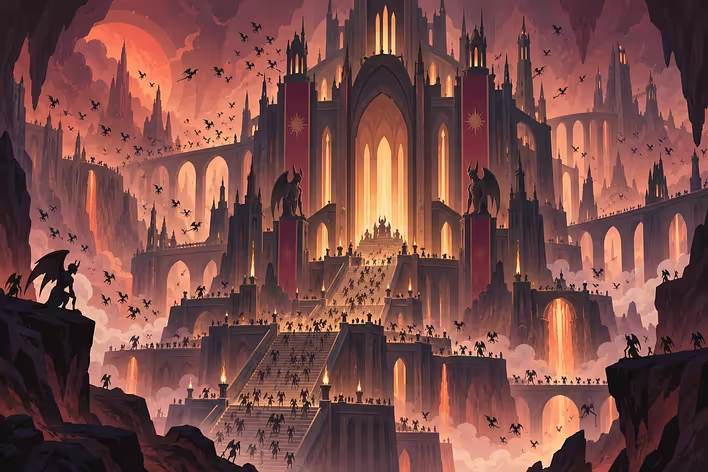
The term appeared in the epic poem by the English writer John Milton “Paradise Lost”, first published in 1667. In the work, Pandemonium is the capital of hell and a huge palace where Satan summons the fallen angels for a council.
Milton describes it as a luxurious and grand structure built by a demonic army with extraordinary speed. Thousands of spirits arrive for the council, filling the gates, porches, and spacious hall. In the original text, the poet refers to Pandemonium as “the high capital of Satan and his followers” — this fragment can be read in the electronic edition Milton Reading Room at Dartmouth College.
For the name, Milton used linguistic elements of Greek origin: pan — “all,” “everything,” and daimōn — “spirit,” “deity,” and in later Christian interpretations — “demon.” Therefore, Pandæmonium can be roughly translated as “place of all demons”.
Thus, Pandemonium was not a real place from ancient Greek beliefs. It is a literary name created in the 17th century using Greek linguistic elements.
How the name of the hellish capital became a term for chaos
Initially, Pandæmonium was a proper name, so it was written with a capital letter. It referred to a specific place in Milton's fictional world — the capital and palace where the council of demons takes place.
Gradually, the word transcended “Paradise Lost.” In the English language, it began to refer to a place where many noisy, unruly people gathered, and later — to the very state of extreme disorder. The proper name transformed into a common one, and the connection with demons became mostly figurative.
This shift in meaning is easy to explain. If everyone is shouting, arguing, running in different directions, and no one is listening to anyone, this scene can indeed resemble a demonic gathering. Therefore, pandemonium is not just disorder, but chaos on a large scale, often loud, spectacular, and somewhat threatening.
Where you can hear this word
A pandemonium can refer to the hustle and bustle at a train station, a heated political debate, chaotic events at a concert, or a situation where a crowd suddenly loses its composure. The word is also often used exaggeratedly or humorously:
When the children were allowed to open all the gifts at once, a pandemonium broke out in the room.
In fantasy, horror, video games, and music, Pandemonium often becomes the name of a hellish city, a demonic world, a spell, a level, or a specific work. In such cases, authors usually return to Milton's original image rather than just the modern meaning of “disorder.”
Pandemonium also refers to a collection of supernatural beings characteristic of a particular culture or belief system. For example, the phrase “Ukrainian pandemonium” may denote the entire world of demonological characters from Ukrainian tradition: devils, vampires, house spirits, water spirits, mermaids, and other beings. In this context, the word means not chaos, but a peculiar gathering or system of mythological images.
Pandemonium, chaos, and turmoil — is there a difference
These words are close in meaning but not entirely the same.
Chaos is the broadest and most neutral concept. It can describe both disorder in a room and the absence of a clear system in work.
Turmoil usually means loud commotion, noise, and domestic disorder. This word has a more expressive conversational tone.
Pandemonium amplifies the impression. It conveys a sense of scale, uncontrollability, and a hidden comparison to hell. That is why the phrase “the room was in disorder” sounds mundane, while “the room was in a pandemonium” paints a much more dramatic picture.
Thus, behind the striking word for chaos lies a quite specific literary history. Once, Pandemonium was the capital of hell in “Paradise Lost,” and today it can begin anywhere — from an overcrowded stadium to a room where children have opened a box of new toys.