

This content has been automatically translated from Ukrainian.
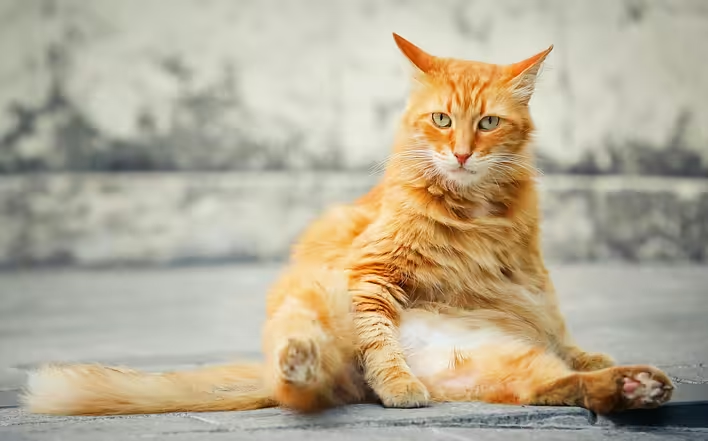
Ginger cats are a common phenomenon. However, a completely ginger cat occurs much less frequently. At the same time, among tortoiseshell and calico animals, almost all are, on the contrary, cats. This distribution is not related to breed or personality traits, but to the fact that the genetic change responsible for the ginger coloration is located on the X chromosome.
The color of cat fur generally resembles a multilayered painting. Some genes determine the primary pigment, others change its shade, create stripes or spots, lighten the color, or leave certain areas white. That’s why kittens from the same litter can look as if they come from different families.
How the color of fur in cats is determined
The main palette of cat colors is created by two types of melanin:
- eumelanin is responsible for black and brown shades;
- pheomelanin produces ginger, yellow, and cream colors.
However, the presence of a certain pigment is just the beginning. Numerous genes influence the final coloration, determining where and in what quantity melanin will be produced, how it will be distributed in the hair, and whether a pattern will appear on the fur.
For example, genetic "dilution" of color changes the distribution of pigment granules. As a result, black coloring becomes blue-gray, chocolate turns lilac, and ginger becomes cream. This is a recessive trait, so for it to manifest, the kitten must inherit the corresponding gene variant from both parents. A detailed scheme of the main genes of cat coloration is provided by The Veterinary Genetics Laboratory at the University of California, Davis.
Other genes govern the tabby pattern — tiger stripes, spots, marbled patterns, or the so-called ticking, where each hair has several colored stripes.
White fur requires a separate explanation. White is not another variety of melanin, but rather the absence of pigment. Certain genetic variants prevent pigment cells from reaching specific areas of the skin. This is how white paws, chest, belly, or large spots appear. Another dominant variant of white can mask all coloration, so a solid white cat can genetically be ginger, black, or even tortoiseshell — it’s just that these colors are not visible.
There is also temperature-dependent coloration, characteristic, in particular, of Siamese cats. The pigment is produced more actively in the cooler parts of the body, so the face, ears, paws, and tail become darker than the body.
What is special about ginger coloration
The genetic change associated with ginger fur is located on the X chromosome. This creates a noticeable difference between male and female cats.
Typically, a female cat has two X chromosomes — XX, while a male cat has one X and one Y — XY. In classical schemes, the ginger coloration variant is denoted by the letter O from the English word orange, while the non-ginger variant is o.
For a male cat, the single X chromosome determines everything:
- XᴼY — ginger male cat;
- XᵒY — non-ginger male cat.
A male cat only needs to inherit the ginger variant from its mother. It does not have a second X chromosome that could contain another variant of this gene.
A female cat can have three main combinations:
CombinationPossible colorationXᴼXᴼ | ginger
XᵒXᵒ | non-ginger
XᴼXᵒ | tortoiseshell or calico
For a female cat to be completely ginger, she must inherit the ginger variant from both parents. Under normal inheritance, her father must be ginger, and her mother must be ginger, tortoiseshell, or calico. To give birth to a ginger male, it is enough for the mother to pass on the required X chromosome. That’s why among ginger animals, there are usually more males.
However, the claim that all ginger cats are male is a myth. Ginger females are not a genetic anomaly: their birth simply requires a less common combination. The ratio can also differ in different populations. Where the ginger variant of the gene occurs frequently, there will be more ginger females.
The mystery of ginger fur was only recently solved
Scientists have long known about the connection between ginger coloration and the X chromosome, but the exact genetic change remained unknown for over a century. In 2025, two independent research groups linked ginger fur to the loss of a small fragment of DNA near or within the regulatory region of the gene ARHGAP36.
One team discovered a deletion of approximately 5.1 thousand base pairs in the intron of this gene. The results of the study were published in the scientific journal Current Biology, and a brief description of the work is available in the PubMed database.
Due to this change, ARHGAP36, which is usually not associated with coloration, begins to function unusually in melanocytes — the cells that produce pigment. The activity of several melanin synthesis genes decreases, and instead of dark eumelanin, the hair takes on a ginger or yellowish hue. A second independent study found the same underlying mechanism.
Why tortoiseshell cats have colored spots
A cat with the genotype XᴼXᵒ has two color variants: ginger on one X chromosome and non-ginger on the other. However, in the cells of a female organism, both X chromosomes do not work equally actively.
At an early stage of embryonic development, one of them is randomly turned off in each cell. In some cells, the active X chromosome carries the ginger variant, while in others it carries the non-ginger variant. When these cells multiply, they form entire areas of skin with the same "setting." This is how ginger and black spots appear on the fur.
This process is called X-inactivation, and the coloration of the cat is an example of cellular mosaicism. The School of Veterinary Medicine at the University of California, Davis also explains tortoiseshell and calico coloration as a result of random inactivation of different X chromosomes.
If there are no white areas or very few, the coloration is usually called tortoiseshell. If distinctive white spots are added to the ginger and black, it is called calico. Calico is the name of the coloration, not a separate breed.
Colors can also be diluted. In this case, instead of black and ginger, blue-gray and cream appear — this is how diluted tortoiseshell or calico coloration arises. Sometimes a tabby pattern is added to this: such a cat may be called torbie, from the combination of the English words tortoiseshell and tabby.
Are calico cats really only female?
Almost always, but not without exceptions.
A typical male cat with the genotype XY has only one X chromosome. Therefore, it is usually either ginger or non-ginger, but cannot inherit both variants simultaneously. Two different X chromosomes are needed for classic ginger and black patches.
However, rarely a male is born with the genotype XXY. The presence of a Y chromosome directs development along male lines, while two X chromosomes allow for both ginger and non-ginger variants. Due to X-inactivation, the fur of such a male can become tortoiseshell or calico.
Most XXY males are infertile. Studies of such animals have revealed developmental disorders of the testes and the absence of spermatogenesis. Therefore, the popular claim that a calico cat must be worth a lot of money as a rare fertile male is not true: rare coloration does not automatically make it capable of reproduction.
Another exception is chimerism. It occurs when two early embryos fuse into one organism. Such an animal has two cell lines with different sets of DNA. If one of them carries the ginger coloration variant and the other carries the non-ginger, the male can have tortoiseshell fur even without the XXY genotype.
A genetically confirmed case of a fertile tortoiseshell chimera male cat with two different cell lines XY has been described in the scientific literature. Therefore, the phrase "all tortoiseshell cats are infertile" is also too categorical. Such exceptions are extremely rare but possible.
Another possible mechanism is mosaicism, where the genetic change occurs after fertilization and is present only in a portion of the cells. Externally, a mosaic animal may resemble a chimera, although the mechanisms of their appearance are different: a chimera arises from the fusion of two embryos, while a mosaic develops from one.
Therefore, the sex of the animal should not be determined solely by color. Calico or tortoiseshell fur very likely indicates a female, but the final answer is provided by examination and, if necessary, genetic testing.
Why are ginger cats almost always striped?
Even a ginger cat that appears solid-colored from a distance usually has at least a faint tabby pattern: stripes on the paws and tail, lines on the face, or a characteristic "M" mark on the forehead.
The ginger variant masks the action of a genetic mechanism that can make the coloration solid in non-ginger cats. In genetics, this is called epistasis: the action of one gene alters or overrides the expression of another. Therefore, the striped pattern is noticeable even in genetically non-agouti ginger animals. This feature is confirmed by studies of the Orange locus and its interaction with fur pattern genes.
Stripes can be contrasting or barely visible, so some animals still appear completely ginger. However, from a genetic standpoint, ginger coloration almost always demonstrates some form of tabby pattern.
Does ginger coloration affect personality?
In popular culture, ginger cats are attributed with sociability, boldness, gluttony, and amusing clumsiness. However, there is no compelling evidence that the ginger coloration gene directly determines the personality or intelligence of the animal.
This impression may partly arise from the gender ratio. Since there are more male cats among ginger animals, people inadvertently project traits that are more often noticed in males onto the entire coloration. The behavior of a specific animal is much more strongly influenced by individual temperament, early socialization, health, living conditions, and prior experiences.
A ginger cat, therefore, is not a genetic anomaly. It simply needs to inherit the ginger variant on both X chromosomes, while a male only needs one. And tortoiseshell or calico fur is a kind of visible map of the processes that occurred when the future cat consisted of only a small number of cells.